
As organizations continue to develop smarter, connected, and software-defined products, managing engineering activities has become significantly more complex. Modern products are no longer built solely through software development—they combine hardware, embedded software, electronics, systems engineering, cloud technologies, and compliance requirements into a single ecosystem. This evolution demands a structured approach to managing the entire product lifecycle while ensuring collaboration between multidisciplinary teams.
Two methodologies frequently discussed in this context are Engineering Lifecycle Management (ELM) and Application Lifecycle Management (ALM). Although they share similar objectives, such as improving collaboration, increasing product quality, and accelerating delivery, they address different aspects of the development lifecycle.
Application Lifecycle Management focuses primarily on the lifecycle of software applications—from planning and development to testing, deployment, and maintenance. Engineering Lifecycle Management, on the other hand, provides a broader framework that connects requirements, systems engineering, software development, testing, verification, compliance, and change management across the complete engineering lifecycle of complex products.
For organizations building automotive software, aerospace systems, industrial automation solutions, medical devices, or other safety-critical products, understanding the distinction between ELM and ALM is essential. Choosing the right lifecycle management strategy helps improve engineering efficiency, reduce project risks, maintain regulatory compliance, and accelerate innovation.
If you’re looking to understand how Engineering Lifecycle Management supports modern product development, our comprehensive Engineering Lifecycle Management Guide explains its core principles, key components, implementation strategies, and business benefits for engineering organizations.
In this guide, we’ll compare Engineering Lifecycle Management and Application Lifecycle Management, explain their differences, identify where they complement each other, and help you determine which approach best fits your organization’s engineering and software development needs.
What Is Engineering Lifecycle Management (ELM)?
Engineering Lifecycle Management (ELM) is a comprehensive methodology for managing the entire lifecycle of complex products, If you’re new to Engineering Lifecycle Management, understanding its core principles is the best place to start. Read our guide on What Is Engineering Lifecycle Management? to learn how ELM improves collaboration, traceability, and governance across the complete engineering lifecycle. from initial requirements and system architecture to development, testing, deployment, maintenance, and continuous improvement. Unlike traditional software lifecycle approaches, ELM connects multiple engineering disciplines into a unified environment, enabling teams to collaborate efficiently while maintaining complete traceability across every engineering artifact.
An effective ELM strategy brings together requirements management, systems engineering, software development, hardware integration, quality assurance, configuration management, change control, and compliance processes. Instead of treating these activities as separate functions, Engineering Lifecycle Management creates a connected engineering ecosystem where information flows seamlessly between teams and tools.
This integrated approach provides organizations with a single source of truth for engineering data, making it easier to manage complex projects, evaluate the impact of changes, and ensure that every requirement is implemented, verified, and validated throughout the product lifecycle.
To better understand how these capabilities work together, explore Exploring the Core Components of Engineering Lifecycle Management, which explains the foundational elements of a successful ELM strategy in greater detail.
Core Objectives of Engineering Lifecycle Management
Organizations adopt Engineering Lifecycle Management to achieve several strategic goals:
- Establish end-to-end traceability across the engineering lifecycle.
- Improve collaboration between systems, hardware, software, and quality teams.
- Streamline engineering change management.
- Support compliance with industry regulations and standards.
- Reduce product development risks through better visibility.
- Accelerate innovation while maintaining engineering governance.
- Build a connected Digital Thread that links every stage of product development.
Industries That Depend on Engineering Lifecycle Management
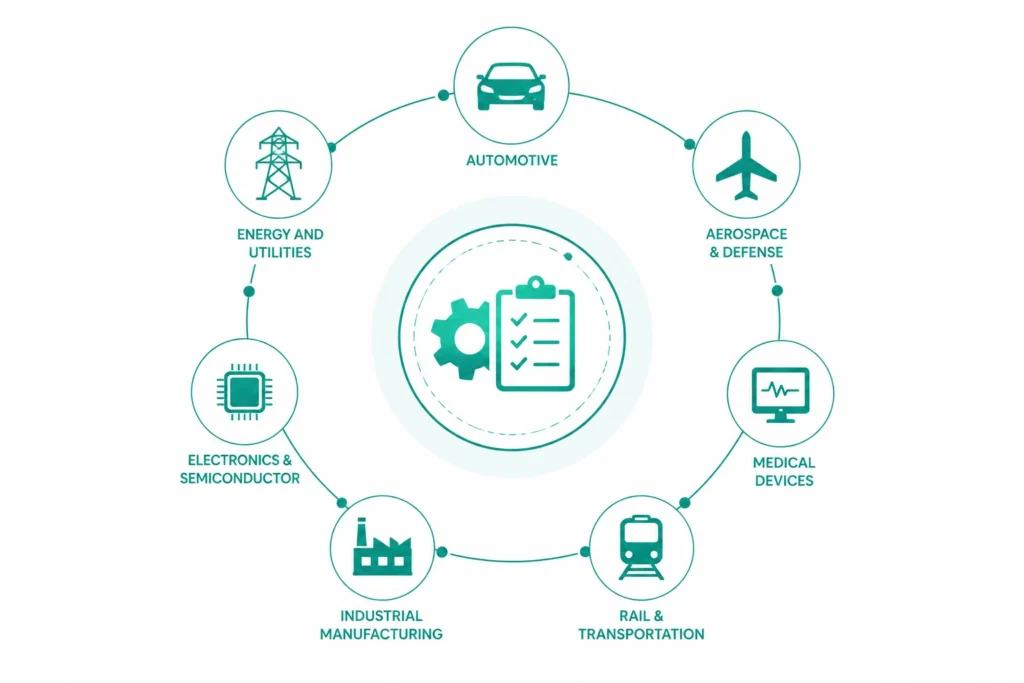
Engineering Lifecycle Management is widely used by organizations developing complex, software-intensive products where multiple engineering disciplines must work together throughout the product lifecycle.
These industries include:
- Automotive
- Aerospace & Defense
- Medical Devices
- Rail & Transportation
- Industrial Manufacturing
- Electronics & Semiconductor
- Energy and Utilities
In these sectors, maintaining complete lifecycle traceability is essential for meeting standards such as ISO 26262, ASPICE, DO-178C, IEC 62304, and EN 50128 while ensuring product quality and regulatory compliance.
What Is Application Lifecycle Management (ALM)?
Application Lifecycle Management (ALM) is a structured approach to managing the lifecycle of software applications from initial planning through development, testing, deployment, operation, and ongoing maintenance. Its primary objective is to help software development teams deliver reliable applications efficiently while supporting Agile, DevOps, and Continuous Integration/Continuous Delivery (CI/CD) practices.
Unlike Engineering Lifecycle Management, which encompasses multiple engineering disciplines, ALM focuses specifically on software engineering activities. It provides development teams with processes and tools to manage application requirements, source code, builds, testing, defect tracking, releases, and maintenance within a collaborative development environment.
Modern ALM platforms enable teams to plan sprints, manage backlogs, automate testing, monitor releases, and coordinate software delivery while improving visibility across the development lifecycle.
As software projects become more complex, effective requirements management becomes increasingly important. Organizations implementing structured software development processes often strengthen collaboration and traceability by adopting modern Digital Requirements Management practices, ensuring that business needs are clearly defined and connected to development activities throughout the application lifecycle.
Key Stages of Application Lifecycle Management
A typical ALM process includes:
- Planning and project management
- Requirements gathering
- Software design
- Development and coding
- Source code management
- Continuous Integration (CI)
- Software testing
- Defect management
- Release management
- Deployment
- Application maintenance and support
While ALM provides an effective framework for software delivery, it does not typically address broader engineering concerns such as systems engineering, hardware integration, functional safety, or multidisciplinary compliance. These capabilities are where Engineering Lifecycle Management extends beyond the traditional scope of Application Lifecycle Management.
Engineering Lifecycle Management (ELM) vs Application Lifecycle Management (ALM): A Detailed Comparison
Although Engineering Lifecycle Management (ELM) and Application Lifecycle Management (ALM) share several common objectives—such as improving collaboration, increasing product quality, and streamlining development—they are designed to address different business and engineering challenges.
The primary distinction lies in scope. ALM is centered on managing the lifecycle of software applications, whereas ELM manages the complete lifecycle of complex engineered products that often combine software, hardware, electronics, systems engineering, and regulatory requirements.
Organizations developing enterprise applications may find ALM sufficient for managing software delivery. However, companies building software-defined vehicles, aerospace systems, medical devices, industrial equipment, or embedded systems require the broader capabilities of Engineering Lifecycle Management to coordinate multidisciplinary teams and maintain end-to-end traceability.
The table below highlights the major differences between these two approaches.
| Feature | Engineering Lifecycle Management (ELM) | Application Lifecycle Management (ALM) |
|---|---|---|
| Primary Focus | Complete engineering lifecycle | Software application lifecycle |
| Scope | Requirements, systems engineering, hardware, software, testing, compliance | Software planning, development, testing, deployment, maintenance |
| Typical Users | Systems engineers, hardware engineers, software engineers, quality teams | Software developers, QA teams, DevOps engineers |
| Requirements Management | ✔ Comprehensive | ✔ Software-focused |
| Systems Engineering | ✔ Native capability | Limited |
| Hardware Integration | ✔ Supported | Not typically included |
| Engineering Traceability | Complete end-to-end | Mostly software artifacts |
| Compliance Management | Extensive support for regulated industries | Primarily software governance |
| Change Management | Enterprise-wide engineering changes | Software release management |
| Digital Thread | Fully supported | Limited implementation |
| Typical Industries | Automotive, Aerospace, Medical Devices, Rail, Manufacturing | Enterprise IT, SaaS, Mobile Apps, Web Applications |
While these differences provide a high-level understanding, selecting between ELM and ALM ultimately depends on the complexity of the products your organization develops, the number of engineering disciplines involved, and the regulatory requirements governing your industry.
Engineering Lifecycle Management is also frequently compared with Product Lifecycle Management (PLM). While ELM focuses on engineering processes and technical collaboration, PLM manages the broader product lifecycle, including manufacturing, supply chain, and service operations. Explore our detailed ELM vs PLM comparison to understand how these approaches complement each other.
Scope of Engineering Lifecycle Management
Engineering Lifecycle Management extends far beyond software development by connecting every engineering discipline involved in designing, developing, validating, and maintaining complex products.
Rather than treating engineering activities as isolated functions, ELM establishes a collaborative environment where requirements, architecture, software, hardware, testing, compliance, and change management remain connected throughout the product lifecycle.
A typical Engineering Lifecycle Management workflow includes:
- Requirements Engineering
- Systems Engineering
- Product Architecture
- Hardware Development
- Embedded Software Development
- Software Application Development
- Test Management
- Verification and Validation
- Engineering Change Management
- Configuration Management
- Compliance Management
- Release Planning
- Product Maintenance
One of the biggest strengths of ELM is its ability to maintain complete traceability As engineering systems become more complex, organizations increasingly adopt Model-Based Systems Engineering (MBSE) to improve system design and validation. While MBSE focuses on creating and managing system models, Engineering Lifecycle Management connects those models with requirements, software development, testing, and compliance activities. Learn more in our ELM vs MBSE comparison between every engineering artifact. This means organizations can quickly determine how a change in one requirement affects downstream designs, software components, test cases, defects, and compliance documentation.
For organizations implementing structured requirements management as part of an Engineering Lifecycle Management strategy, modern platforms such as Requirements Management with DOORS Next provide collaborative capabilities that help engineering teams manage evolving requirements while maintaining complete lifecycle traceability.
Why Engineering Organizations Choose ELM
Engineering organizations adopt ELM because it provides visibility across the entire product lifecycle rather than focusing on individual development activities.
Some of the major advantages include:
- Improved collaboration between multidisciplinary teams
- Better management of engineering changes
- Complete requirement traceability
- Faster impact analysis
- Improved engineering governance
- Enhanced regulatory compliance
- Reduced product development risks
- Better decision-making through connected engineering data
As products continue to become more intelligent and connected, Engineering Lifecycle Management provides the foundation for building a comprehensive Digital Thread that links every engineering activity from concept through service and maintenance.
Scope of Application Lifecycle Management
Application Lifecycle Management focuses specifically on the lifecycle of software applications and the processes required to deliver reliable software efficiently.
ALM enables software teams to manage projects from initial planning through deployment and ongoing support while promoting collaboration between developers, testers, DevOps engineers, and project managers.
A typical ALM lifecycle includes:
- Project Planning
- Business Requirements
- Software Design
- Development
- Source Code Management
- Continuous Integration
- Software Testing
- Defect Management
- Release Management
- Deployment
- Production Support
- Continuous Improvement
Modern ALM solutions integrate closely with Agile and DevOps methodologies, enabling organizations to automate software builds, testing, deployments, and release pipelines.
For engineering organizations that continue to use IBM Engineering Requirements Management DOORS, understanding Mastering Requirements with IBM DOORS Web Access (DWA) can improve collaboration by enabling secure browser-based access to requirements, reviews, and stakeholder participation without requiring every user to install the desktop application.
Where ALM Excels
Application Lifecycle Management is particularly effective for organizations developing:
- Enterprise business applications
- SaaS platforms
- Mobile applications
- Cloud-native solutions
- Customer portals
- Financial applications
- E-commerce platforms
- Internal enterprise software
These projects typically emphasize software delivery, release management, Agile planning, and DevOps automation rather than broader engineering governance.
However, when software becomes part of a larger engineered product, such as a vehicle, aircraft, medical device, or industrial control system, ALM alone may not provide the multidisciplinary capabilities needed to manage systems engineering, hardware integration, compliance, and end-to-end lifecycle traceability. In these scenarios, ALM often functions as a component within a broader Engineering Lifecycle Management framework rather than serving as the complete lifecycle solution.
When Should You Use Engineering Lifecycle Management (ELM)?
Engineering Lifecycle Management is the preferred approach for organizations developing complex, software-intensive products that require close collaboration between multiple engineering disciplines. Unlike traditional software development frameworks, ELM provides complete visibility across the entire engineering lifecycle, enabling teams to manage requirements, architecture, software, hardware, testing, and compliance within a connected ecosystem.
As products become increasingly intelligent and connected, engineering teams need more than isolated development tools—they need an integrated platform that supports collaboration, traceability, and governance from concept to deployment.
ELM is particularly valuable when organizations need to:
- Manage multidisciplinary engineering teams.
- Maintain end-to-end requirements traceability.
- Coordinate hardware and software development.
- Support systems engineering practices.
- Comply with industry regulations and safety standards.
- Perform engineering impact analysis efficiently.
- Build a Digital Thread across the product lifecycle.
These capabilities make Engineering Lifecycle Management an essential strategy for industries where engineering complexity and compliance are business-critical.
Typical Use Cases for ELM
Organizations commonly implement Engineering Lifecycle Management when developing:
- Software-Defined Vehicles (SDVs)
- Autonomous driving systems
- Aircraft control systems
- Medical devices
- Railway signaling systems
- Industrial automation platforms
- Embedded software solutions
- Robotics and intelligent manufacturing systems
- Defense and mission-critical applications
For these industries, disconnected engineering tools can create gaps in traceability, increase project risks, and make regulatory audits more difficult. Engineering Lifecycle Management addresses these challenges by connecting every engineering artifact within a unified lifecycle.
Many organizations begin their Engineering Lifecycle Management journey by first establishing a structured implementation roadmap. Following proven Tips for Successful IBM ELM Implementation can help organizations standardize engineering processes, improve user adoption, and maximize the value of their lifecycle management investment.
When Should You Use Application Lifecycle Management (ALM)?
Application Lifecycle Management is best suited for organizations whose primary objective is to develop, release, and maintain software applications efficiently.
ALM focuses on managing software development activities while supporting Agile methodologies, DevOps practices, Continuous Integration (CI), and Continuous Delivery (CD). It helps development teams streamline planning, coding, testing, deployment, and maintenance without addressing the broader engineering lifecycle.
Organizations typically choose ALM when building:
- Enterprise business applications
- Web applications
- SaaS platforms
- Mobile applications
- Customer portals
- Financial software
- Cloud-native solutions
- Internal business systems
For these software-centric projects, ALM provides sufficient capabilities to improve collaboration, automate development workflows, and accelerate software delivery.
However, when software becomes part of a larger engineered product involving electronics, mechanical systems, safety requirements, or regulatory compliance, organizations often discover that ALM alone cannot provide complete lifecycle visibility. In these situations, ALM becomes one component within a broader Engineering Lifecycle Management strategy.
How Engineering Lifecycle Management and Application Lifecycle Management Work Together
One of the biggest misconceptions is that organizations must choose either Engineering Lifecycle Management or Application Lifecycle Management. In reality, many engineering organizations successfully use both approaches together because they solve different problems.
Engineering Lifecycle Management provides the overarching engineering framework, while Application Lifecycle Management manages software development activities within that framework.
Consider the example of an automotive manufacturer developing an electric vehicle.
The Engineering Lifecycle Management platform manages:
- Product requirements
- Vehicle architecture
- Systems engineering
- Functional safety
- Engineering change management
- Compliance documentation
- Test planning
- Verification and validation
At the same time, the Application Lifecycle Management platform manages:
- Agile sprint planning
- User stories
- Source code repositories
- Build automation
- Continuous Integration
- Software testing
- Release management
By integrating these environments, organizations establish complete traceability from business requirements to deployed software, enabling engineering and software teams to collaborate more effectively while maintaining governance across the entire product lifecycle.
For organizations modernizing legacy engineering environments, transitioning to collaborative lifecycle platforms is often the next logical step. Our guide on Migrating from DOORS to DOORS Next explains how engineering teams can improve collaboration, scalability, and lifecycle traceability while preparing for modern Engineering Lifecycle Management practices.
Benefits of Engineering Lifecycle Management
Engineering Lifecycle Management delivers strategic benefits that extend well beyond engineering efficiency. By connecting every stage of product development, organizations gain greater visibility, improve collaboration, and reduce project risks.
Key benefits include:
Improved Cross-Functional Collaboration
Engineering teams across requirements, systems engineering, software development, testing, and quality assurance work from a shared engineering environment, reducing communication gaps and improving project alignment.
Complete Lifecycle Traceability
Every engineering artifact can be traced from initial requirements through implementation, verification, validation, and ongoing maintenance, simplifying impact analysis and regulatory reporting.
Better Change Management
Engineering changes can be evaluated quickly by identifying all affected requirements, software components, test cases, and downstream dependencies before implementation begins.
Improved Compliance
Organizations operating in regulated industries can maintain comprehensive audit trails that demonstrate compliance with standards such as ISO 26262, ASPICE, IEC 62304, and DO-178C.
Higher Product Quality
Connecting requirements with implementation and testing improves verification coverage, reduces defects, and helps engineering teams identify issues earlier in the development lifecycle
Benefits of Application Lifecycle Management
Application Lifecycle Management helps software development teams improve productivity and accelerate software delivery through standardized development processes.
Major benefits include:
- Faster software releases
- Improved Agile collaboration
- Better sprint planning
- Automated testing
- Continuous Integration and Continuous Delivery
- Improved defect management
- Better release planning
- Increased software quality
- Enhanced development visibility
These capabilities enable software organizations to deliver reliable applications more efficiently while supporting continuous improvement throughout the software lifecycle.
Common Tools Used for Engineering Lifecycle Management and Application Lifecycle Management
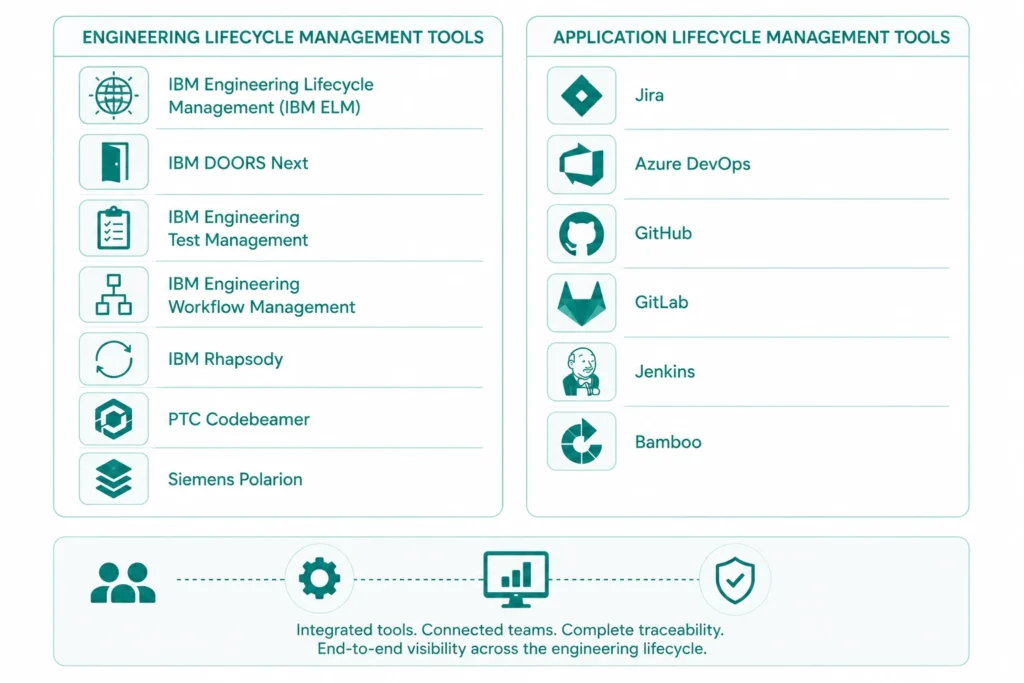
Choosing the right lifecycle management platform is just as important as selecting the appropriate methodology. Engineering organizations often use a combination of specialized tools to support requirements management, systems engineering, software development, testing, and collaboration.
When evaluating engineering platforms, many organizations compare solutions based on scalability, traceability, compliance support, and integration capabilities. Our detailed comparison of IBM DOORS Next vs Polarion explores two leading requirements management platforms and highlights the strengths of each for complex engineering environments.
Some of the most widely adopted Engineering Lifecycle Management tools include:
- IBM Engineering Lifecycle Management (IBM ELM)
- IBM DOORS Next
- IBM Engineering Test Management
- IBM Engineering Workflow Management
- IBM Rhapsody
- PTC Codebeamer
- Siemens Polarion
Popular Application Lifecycle Management tools include:
- Jira
- Azure DevOps
- GitHub
- GitLab
- Jenkins
- Bamboo
Many organizations integrate these platforms to create a connected engineering ecosystem that supports both enterprise software delivery and complex product engineering.
Challenges of Managing Engineering and Software Lifecycles Separately
As organizations scale their engineering operations, using disconnected tools and isolated processes often creates inefficiencies that impact productivity, product quality, and delivery timelines. Engineering teams may manage requirements in one platform, software developers in another, and testing teams in separate environments. Without an integrated lifecycle strategy, maintaining consistency across these functions becomes increasingly difficult.
Some of the most common challenges include:
Limited End-to-End Traceability
One of the biggest drawbacks of disconnected lifecycle management is the inability to trace engineering artifacts throughout the product lifecycle. Requirements may exist independently of development tasks, test cases, defects, or change requests, making it difficult to determine whether every requirement has been implemented and verified.
This lack of visibility becomes particularly problematic in regulated industries where demonstrating complete traceability is essential during audits.
Poor Cross-Functional Collaboration
Modern product development involves collaboration between systems engineers, software developers, quality assurance teams, product managers, and compliance specialists. When each team relies on separate tools without proper integration, communication gaps often emerge.
These gaps can lead to:
- Misaligned requirements
- Duplicate work
- Delayed approvals
- Conflicting documentation
- Increased project risks
An integrated lifecycle strategy ensures every stakeholder works with consistent, up-to-date engineering information.
Difficult Change Impact Analysis
Engineering requirements frequently evolve during development due to customer feedback, design improvements, regulatory updates, or technical constraints. Without connected engineering data, identifying the downstream impact of a requirement change becomes a time-consuming manual activity.
Teams may struggle to determine:
- Which software modules require modification?
- Which test cases need to be updated?
- Which engineering documents are affected?
- Which teams should be notified?
Integrated lifecycle management simplifies this process by establishing traceable relationships between engineering artifacts.
Manual Reporting and Compliance Efforts
Preparing project reports and compliance documentation can consume significant engineering resources when data is distributed across multiple systems.
Engineering managers often spend considerable time consolidating information from spreadsheets, project management tools, testing platforms, and requirements repositories before generating meaningful reports.
Even after implementing IBM Engineering Lifecycle Management, organizations often discover that creating actionable dashboards and cross-tool reports requires careful planning and expertise. Our article on Why IBM ELM Reporting Still Requires an Expert explains common reporting challenges and best practices for building comprehensive engineering insights.
Best Practices for Integrating Engineering Lifecycle Management and Application Lifecycle Management
Organizations that successfully combine ELM and ALM typically focus on process alignment as much as tool integration. A well-planned lifecycle strategy ensures that engineering and software teams collaborate effectively while maintaining governance, traceability, and development agility.
Some recommended best practices include:
Define a Unified Lifecycle Strategy
Establish common engineering objectives before selecting or integrating lifecycle management tools. Clearly define how requirements, development, testing, and change management will interact across the organization.
Build End-to-End Traceability
Create relationships between requirements, system designs, software components, work items, test cases, defects, and releases. This enables faster impact analysis and improves engineering visibility throughout the lifecycle.
Standardize Change Management
Implement consistent review and approval workflows so that engineering changes follow a structured process across both engineering and software teams.
Integrate Engineering Toolchains
Modern organizations rely on multiple engineering applications throughout product development. Connecting these tools reduces manual effort while improving collaboration and lifecycle visibility.
For organizations practicing Model-Based Systems Engineering (MBSE), integrating architecture models into the engineering lifecycle provides even greater visibility. Our guide on Comprehensive Guide to Rhapsody Model Manager: Revolutionizing Architectural Management explains how architecture models can be integrated with requirements, software development, and verification activities to create a connected digital engineering environment.
Automate Testing and Continuous Delivery
Automating software builds, testing, and deployment enables organizations to deliver updates faster while maintaining engineering quality. Automation also reduces manual errors and supports continuous improvement across development teams.
Continuously Measure Engineering Performance
Track key metrics such as requirement coverage, defect resolution time, change cycle time, test execution status, and release readiness. Regular performance monitoring helps organizations identify bottlenecks and improve engineering efficiency over time.
Why Choose MicroGenesis?
Engineering Lifecycle Management is more than implementing a software platform—it requires the right processes, governance, integrations, and domain expertise to deliver measurable business outcomes.
MicroGenesis has over 25 years of experience helping organizations modernize engineering environments through Engineering Lifecycle Management, Application Lifecycle Management, systems engineering, and digital engineering transformation initiatives.
Our expertise includes:
- Engineering Lifecycle Management implementation
- Application Lifecycle Management consulting
- IBM Engineering Lifecycle Management (IBM ELM)
- IBM DOORS Next
- IBM Engineering Workflow Management
- Engineering toolchain integration
- Model-Based Systems Engineering (MBSE)
- Embedded DevOps
- Engineering traceability
- Compliance enablement for ASPICE, ISO 26262, IEC 62304, and other industry standards
Organizations developing software-defined and safety-critical products also benefit from understanding why IBM ELM has become a preferred platform for engineering transformation. Our article on 7 Reasons IBM ELM for Product Engineering explores how IBM ELM helps engineering teams improve collaboration, strengthen traceability, and accelerate product development.
Whether you’re implementing a new lifecycle management platform, integrating engineering toolchains, or modernizing legacy development processes, MicroGenesis helps organizations build connected engineering ecosystems that improve collaboration, reduce risks, and accelerate innovation.
Frequently Asked Questions
Is Engineering Lifecycle Management the same as Application Lifecycle Management?
No. Engineering Lifecycle Management manages the complete engineering lifecycle of complex products, while Application Lifecycle Management focuses specifically on software application development, testing, deployment, and maintenance.
Can organizations use ELM and ALM together?
Yes. In fact, many engineering organizations use both approaches. ELM provides the overall engineering framework, while ALM manages software development activities within that framework.
Which industries benefit most from Engineering Lifecycle Management?
Industries such as automotive, aerospace, defense, medical devices, rail, industrial manufacturing, and electronics benefit significantly from Engineering Lifecycle Management because they require multidisciplinary collaboration, complete traceability, and regulatory compliance.
For example, organizations developing electric and autonomous vehicles use integrated engineering platforms to manage software, systems engineering, and compliance simultaneously. Learn more in our guide on Addressing Complexity in Electric Vehicle (EV) System Design and Development Using IBM ELM
What are the most widely used Engineering Lifecycle Management platforms?
Popular ELM platforms include IBM Engineering Lifecycle Management (IBM ELM), IBM DOORS Next, IBM Engineering Workflow Management, IBM Engineering Test Management, PTC Codebeamer, Siemens Polarion, and IBM Rhapsody.
How do organizations choose the right Engineering Lifecycle Management platform?
The right platform depends on several factors, including product complexity, regulatory requirements, engineering disciplines involved, integration capabilities, scalability, and long-term business objectives. Organizations should evaluate how well the platform supports traceability, collaboration, compliance, and future digital engineering initiatives.
Conclusion
Engineering Lifecycle Management and Application Lifecycle Management are complementary approaches that address different stages of modern product development. While ALM focuses on delivering high-quality software efficiently, ELM provides the broader engineering framework needed to manage complex products that combine software, hardware, systems engineering, testing, and compliance.
As products continue to evolve into intelligent, connected systems, organizations can no longer rely on isolated development tools and fragmented workflows. A connected lifecycle strategy enables engineering teams to improve collaboration, maintain complete traceability, accelerate innovation, and respond more effectively to changing customer and regulatory requirements.
Whether you’re beginning your digital engineering journey or modernizing existing development processes, understanding the relationship between ELM and ALM is the first step toward building a scalable and future-ready engineering ecosystem.