
The products being developed today are more sophisticated than ever before. Modern automobiles, aircraft, industrial equipment, healthcare devices, consumer electronics, and smart manufacturing systems combine mechanical components with embedded software, electronics, connectivity, cloud services, and artificial intelligence. Managing the development of these complex products requires more than traditional engineering practices—it demands an integrated approach that connects people, processes, and data throughout the lifecycle.
This is where Engineering Lifecycle Management (ELM) and Product Lifecycle Management (PLM) play a critical role.
Although these terms are often used interchangeably, they serve distinct purposes within an organization. Product Lifecycle Management focuses on managing the product from its initial concept through manufacturing, service, and retirement. Engineering Lifecycle Management, on the other hand, concentrates on the engineering activities required to design, validate, and continuously improve that product.
Rather than replacing one another, ELM and PLM work together to create a connected digital engineering ecosystem. Engineering teams rely on ELM to manage requirements, systems engineering, software development, verification, validation, and compliance, while manufacturing and business teams use PLM to manage product structures, CAD models, bills of materials (BOMs), supplier collaboration, and production processes.
Organizations investing in digital engineering often begin by understanding how Engineering Lifecycle Management supports connected product development. Our Engineering Lifecycle Management Guide provides a detailed overview of lifecycle management principles, digital engineering strategies, and best practices for implementing ELM successfully.
In this article, we’ll explore the key differences between ELM and PLM, explain where each fits within the product lifecycle, discuss how they complement each other, and examine why integrating both has become essential for organizations developing intelligent, software-defined products.
Why Understanding the Difference Between ELM and PLM Matters
As organizations accelerate digital transformation, engineering and manufacturing teams often adopt specialized tools to address different phases of product development. Without a clear understanding of the responsibilities of ELM and PLM, businesses may struggle with disconnected workflows, duplicated information, and limited visibility across the product lifecycle.
Engineering teams need platforms that manage requirements, systems models, software development, testing, and compliance, while manufacturing teams require solutions that control product data, configurations, mechanical designs, and production planning. Expecting a single platform to perform both roles can create inefficiencies and limit collaboration between departments.
Understanding how these lifecycle management approaches complement one another enables organizations to:
- Improve collaboration between engineering and manufacturing teams.
- Maintain consistent product information across departments.
- Strengthen engineering traceability and governance.
- Reduce design and production errors.
- Accelerate product development.
- Support regulatory compliance.
- Establish a connected Digital Thread across the organization.
For companies developing software-intensive and safety-critical products, integrating ELM and PLM is no longer optional—it is a strategic requirement for delivering innovation at scale.
What Is Engineering Lifecycle Management (ELM)?
Engineering Lifecycle Management (ELM) is a structured framework that connects engineering disciplines, development processes, and lifecycle data from initial requirements through validation, release, and ongoing product evolution.
If you’re looking for a broader understanding of Engineering Lifecycle Management, explore our guide on What Is Engineering Lifecycle Management? to learn its key components, benefits, and role in managing complex engineering projects.
Instead of managing engineering work in isolated applications, ELM creates a unified environment where requirements, architecture, software, testing, and engineering changes remain connected through complete lifecycle traceability.
Typical capabilities of an Engineering Lifecycle Management platform include:
- Requirements Management
- Systems Engineering
- Model-Based Systems Engineering (MBSE)
- Embedded Software Development
- Software Development
- Engineering Workflow Management
- Test Management
- Verification and Validation
- Configuration Management
- Engineering Change Management
- Compliance Management
- Continuous Integration and Continuous Testing
Model-Based Systems Engineering (MBSE) is an important part of modern engineering practices, helping teams design and validate complex systems using models. Discover how MBSE complements Engineering Lifecycle Management in our ELM vs MBSE comparison.
One of the defining strengths of ELM is its ability to establish traceable relationships between engineering artifacts. A requirement can be linked directly to system models, software components, test cases, defects, and change requests, making it easier to assess the impact of changes and demonstrate regulatory compliance.
To understand how these disciplines work together, read our guide on Exploring the Core Components of Engineering Lifecycle Management, which explains how connected engineering environments improve collaboration, visibility, and lifecycle governance.
Why Organizations Invest in ELM
Engineering Lifecycle Management enables organizations to manage increasing product complexity while improving engineering efficiency.
Key advantages include:
- End-to-end engineering traceability
- Better collaboration across multidisciplinary teams
- Faster engineering change management
- Improved impact analysis
- Higher product quality
- Streamlined compliance with industry standards
- Reduced development risks
- Greater visibility into engineering progress
These capabilities make ELM especially valuable for industries such as automotive, aerospace, medical devices, rail transportation, industrial automation, electronics, and defense.
What Is Product Lifecycle Management (PLM)?
Product Lifecycle Management (PLM) is a business process and technology framework that manages product-related information throughout the complete lifecycle of a product from concept and design through manufacturing, service, maintenance, and retirement.
While ELM focuses on engineering execution, PLM focuses on ensuring that every department involved in bringing a product to market works from a single source of accurate and controlled product information.
A modern PLM platform typically supports:
- Product Data Management (PDM)
- CAD integration
- Bill of Materials (BOM) management
- Product configuration management
- Mechanical design collaboration
- Supplier collaboration
- Manufacturing process planning
- Engineering document management
- Product variant management
- Service lifecycle management
PLM acts as the central repository for product data, enabling engineering, manufacturing, procurement, quality, and service teams to collaborate efficiently throughout the product lifecycle.
Unlike ELM, PLM generally does not manage engineering requirements, software development, systems engineering, or verification activities. Instead, it ensures that approved product definitions and manufacturing information remain accurate and accessible across the enterprise.
ELM vs PLM: Key Differences
Engineering Lifecycle Management (ELM) and Product Lifecycle Management (PLM) both play vital roles in modern product development, but they address different business objectives. While there is some overlap in the data they consume and share, their primary responsibilities remain distinct.
Engineering Lifecycle Management is concerned with how a product is engineered. It manages the technical processes involved in transforming requirements into validated products by connecting systems engineering, software development, testing, verification, and compliance.
Product Lifecycle Management, in contrast, focuses on managing the product itself throughout its business lifecycle. It centralizes product information, mechanical designs, manufacturing data, product configurations, supplier collaboration, and service documentation to ensure every stakeholder works from a single source of truth.
For organizations developing software-defined products, understanding these distinctions helps determine which capabilities belong in the engineering domain and which belong in manufacturing and product operations.
| Feature | Engineering Lifecycle Management (ELM) | Product Lifecycle Management (PLM) |
|---|---|---|
| Primary Focus | Engineering execution and governance | Product information management |
| Scope | Requirements to validation | Concept to retirement |
| Primary Users | Systems engineers, software engineers, QA teams | Product managers, manufacturing, procurement, suppliers |
| Requirements Management | ✔ Comprehensive | Limited |
| Systems Engineering | ✔ Native capability | Limited |
| Embedded Software | ✔ Core capability | Not primary focus |
| Mechanical Design | Supports engineering collaboration | ✔ Core capability |
| CAD Management | Limited | ✔ Extensive |
| Bill of Materials (BOM) | Limited | ✔ Core functionality |
| Manufacturing Planning | Limited | ✔ Extensive |
| Regulatory Compliance | ✔ Engineering compliance | Supports manufacturing documentation |
| Digital Thread | Engineering traceability | Product information continuity |
Engineering Lifecycle Management is also commonly compared with Application Lifecycle Management (ALM). While ALM focuses on managing the software development lifecycle, ELM provides a broader framework for multidisciplinary engineering. Learn more in our ELM vs ALM comparison.
Rather than replacing one another, ELM and PLM become significantly more valuable when integrated. Together, they enable organizations to connect engineering decisions with manufacturing execution, creating a seamless flow of information across the product lifecycle.
How ELM and PLM Work Together Across the Product Lifecycle
The easiest way to understand the relationship between Engineering Lifecycle Management and Product Lifecycle Management is to examine how they contribute during each phase of product development.
Instead of competing, both platforms support different teams while exchanging information that keeps engineering and manufacturing aligned.
1. Product Strategy and Requirements Definition
Every successful product starts with identifying customer needs, business objectives, regulatory obligations, and market opportunities.
During this phase, PLM manages:
- Product portfolio planning
- Product roadmap
- Product variants
- Initial product configurations
- Business planning
At the same time, ELM captures and manages:
- Customer requirements
- Business requirements
- Functional requirements
- System requirements
- Safety requirements
- Regulatory requirements
Structured requirements management is the foundation of successful engineering projects. Organizations implementing modern Engineering Lifecycle Management practices often adopt Digital Requirements Management to establish centralized requirement repositories, improve collaboration, and maintain complete traceability throughout development.
2. System Design and Architecture
After requirements are approved, engineering teams begin translating business objectives into technical solutions.
Engineering Lifecycle Management becomes the primary environment for:
- Systems Engineering
- Functional decomposition
- System architecture
- Software architecture
- Engineering workflows
- Design reviews
- Risk analysis
Meanwhile, PLM manages:
- Mechanical CAD models
- Product structures
- Component libraries
- Engineering drawings
- Product configurations
Organizations implementing Model-Based Systems Engineering (MBSE) further strengthen collaboration by connecting architecture models with lifecycle artifacts. Solutions such as Rhapsody Model Manager enable engineering teams to integrate system models, requirements, and software development activities within a connected engineering environment.
3. Engineering Development
As development begins, Engineering Lifecycle Management becomes the operational hub for multidisciplinary engineering teams.
Typical ELM activities include:
- Embedded software development
- Software engineering
- Source code management
- Engineering work item tracking
- Continuous Integration (CI)
- Continuous Testing
- Defect management
- Engineering traceability
PLM continues supporting engineering by maintaining:
- Product revisions
- Configuration control
- CAD synchronization
- Supplier collaboration
- Product documentation
This division allows engineering teams to focus on product functionality while manufacturing teams maintain accurate product definitions for downstream production activities.
For organizations managing complex requirements across multidisciplinary teams, Requirements Management with IBM DOORS Next provides collaborative capabilities that improve requirement quality, engineering governance, and lifecycle traceability.
4. Verification, Validation, and Compliance
Engineering verification ensures that the product has been built correctly, while validation confirms that it satisfies customer expectations and regulatory requirements.
Within ELM, engineering teams manage:
- Test planning
- Test execution
- Automated testing
- Verification reports
- Validation activities
- Requirement traceability
- Compliance evidence
PLM complements these activities by maintaining approved product configurations, manufacturing documentation, and controlled product records.
Organizations implementing Engineering Lifecycle Management platforms can accelerate adoption by following proven IBM ELM implementation best practices, helping establish governance, improve user adoption, and build scalable lifecycle processes from the outset.
5. Manufacturing, Production, and Service
Once engineering activities are complete, Product Lifecycle Management becomes increasingly important.
PLM supports:
- Manufacturing planning
- Supplier collaboration
- Production workflows
- Product configuration management
- Spare parts management
- Service documentation
- Product retirement
Engineering Lifecycle Management, however, continues supporting post-release engineering through:
- Software updates
- Product enhancements
- Engineering change requests
- Defect resolution
- Continuous engineering
- Future product releases
This ongoing collaboration is particularly important for connected products such as software-defined vehicles, industrial IoT platforms, and smart medical devices, where engineering continues long after the first product reaches customers.
When Should You Choose Engineering Lifecycle Management (ELM)?
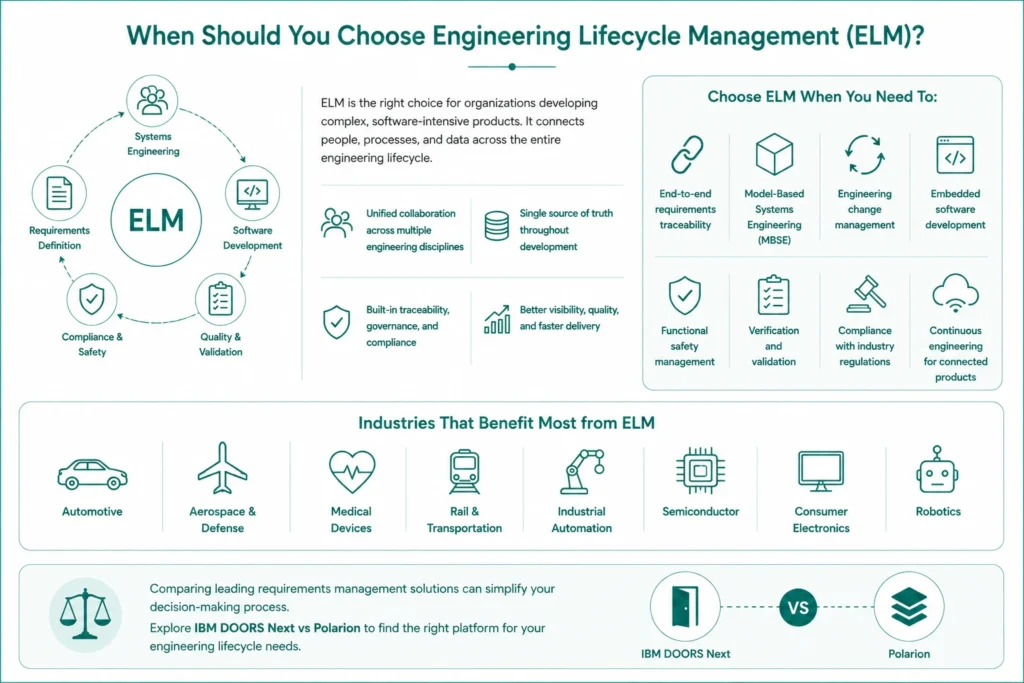
Engineering Lifecycle Management is the right choice for organizations developing products that combine software, electronics, mechanical components, and complex system interactions. As products become increasingly connected and software-driven, engineering teams need more than isolated development tools—they need a unified environment that supports collaboration, traceability, and governance across every engineering discipline.
ELM is particularly valuable when multiple teams work simultaneously on different aspects of a product. Systems engineers define requirements, software teams develop embedded applications, quality engineers perform validation, and compliance specialists ensure regulatory standards are met. Engineering Lifecycle Management brings these activities together, creating a single source of truth throughout development.
Organizations should consider ELM when they need to:
- End-to-end requirements traceability
- Model-Based Systems Engineering (MBSE)
- Engineering change management
- Embedded software development
- Functional safety management
- Verification and validation
- Compliance with industry regulations
- Continuous engineering for connected products
Industries that benefit most from Engineering Lifecycle Management include:
- Automotive
- Aerospace and Defense
- Medical Devices
- Rail and Transportation
- Industrial Automation
- Semiconductor
- Consumer Electronics
- Robotics
For organizations evaluating engineering lifecycle platforms, comparing leading requirements management solutions can simplify the decision-making process. Our guide on IBM DOORS Next vs Polarion explores the strengths, capabilities, and ideal use cases of two widely adopted engineering lifecycle solutions.
When Should You Choose Product Lifecycle Management (PLM)?
Product Lifecycle Management is most suitable for organizations that need to manage product information throughout manufacturing and commercial operations.
Unlike ELM, which focuses on engineering execution, PLM ensures that everyone involved in designing, producing, selling, and servicing a product works with accurate and controlled product information.
PLM becomes particularly valuable for organizations managing:
- Large product portfolios
- Mechanical engineering data
- Product variants
- Bills of Materials (BOMs)
- CAD models
- Manufacturing processes
- Supplier collaboration
- Product documentation
- Service lifecycle information
Manufacturers producing physical products at scale depend on PLM to improve collaboration between engineering, manufacturing, procurement, suppliers, and service organizations while maintaining product consistency throughout the lifecycle.
Why Modern Enterprises Need Both ELM and PLM
The question for most engineering-driven organizations is no longer whether they need ELM or PLM, it is how effectively these two environments can work together.
As products become increasingly software-defined, engineering and manufacturing teams can no longer operate in isolation. Mechanical designs influence embedded software, software updates affect product configurations, and engineering changes must flow seamlessly into manufacturing processes.
An integrated lifecycle strategy enables organizations to create a connected Digital Thread that links engineering activities with product information across the enterprise.
A simplified view of this relationship looks like this:
Product Lifecycle Management
- Product portfolio management
- Product configurations
- CAD management
- BOM management
- Manufacturing planning
- Supplier collaboration
- Service documentation
Engineering Lifecycle Management
- Requirements management
- Systems engineering
- Software development
- Embedded software
- Test management
- Compliance management
- Engineering traceability
- Continuous engineering
Business Outcomes
- Faster innovation
- Improved collaboration
- Higher product quality
- Reduced engineering risks
- Better compliance
- Accelerated product releases
Instead of duplicating information across disconnected tools, integrated lifecycle management enables engineering and manufacturing teams to collaborate using synchronized product and engineering data.
Benefits of Integrating ELM and PLM
Organizations that successfully integrate Engineering Lifecycle Management with Product Lifecycle Management gain advantages that extend well beyond engineering productivity. A connected lifecycle improves visibility, reduces manual effort, and supports better decision-making throughout product development.
End-to-End Lifecycle Visibility
Engineering, manufacturing, and service teams gain access to connected product information, making it easier to understand how requirements, designs, product configurations, and manufacturing activities relate to one another.
Improved Cross-Functional Collaboration
Software engineers, systems engineers, mechanical designers, manufacturing teams, suppliers, and quality specialists work with synchronized information, reducing communication gaps and minimizing rework.
Better Engineering Change Management
Changes introduced during engineering can be evaluated quickly because related requirements, designs, software components, test cases, and product structures remain connected.
Stronger Regulatory Compliance
Organizations operating in highly regulated industries can demonstrate complete traceability between requirements, implementation, testing, approvals, and released products, simplifying compliance with standards such as ISO 26262, ASPICE, IEC 62304, and DO-178C.
Faster Product Development
Integrated engineering and product management eliminate duplicate data entry, improve workflow automation, and accelerate collaboration across departments, reducing overall development cycles.
Foundation for Digital Thread Initiatives
Integrating ELM and PLM creates the foundation for a Digital Thread by connecting engineering data with manufacturing and operational information. This enables organizations to make informed decisions throughout the product lifecycle while supporting future Digital Twin initiatives and continuous product improvement.
Organizations developing software-defined vehicles and other intelligent systems often adopt connected lifecycle platforms to manage engineering complexity. Learn how Engineering Lifecycle Management supports these initiatives in Addressing Complexity in Electric Vehicle (EV) System Design and Development Using IBM ELM, which explores how integrated engineering practices improve traceability, compliance, and collaboration in next-generation automotive development.
Common Challenges Without ELM and PLM Integration
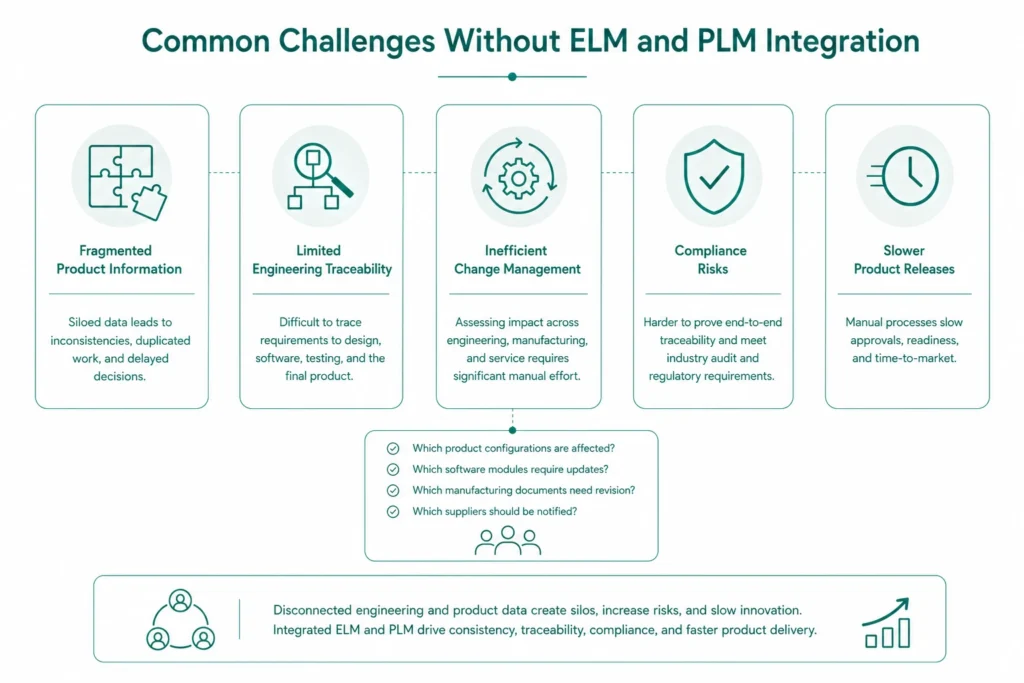
Many organizations implement Engineering Lifecycle Management and Product Lifecycle Management independently, expecting each platform to address its own business needs. While this approach may work initially, it often creates information silos that become increasingly difficult to manage as products grow more complex.
Engineering teams may maintain requirements, software artifacts, and test cases in one environment, while manufacturing teams manage product structures, CAD files, and Bills of Materials (BOMs) in another. Without effective integration, information must be transferred manually, increasing the risk of inconsistencies, delays, and costly errors.
Some of the most common challenges include:
Fragmented Product Information
When engineering and product data reside in separate systems without synchronization, teams often work with outdated or conflicting information. This can result in design inconsistencies, duplicated work, and delayed decision-making.
Limited Engineering Traceability
Engineering teams need to understand how a requirement influences system architecture, software components, testing activities, and ultimately the final product configuration. Without integrated lifecycle management, maintaining this level of traceability becomes difficult, particularly in highly regulated industries.
Inefficient Change Management
Engineering changes are inevitable during product development. However, without connected ELM and PLM environments, assessing the impact of a change across engineering, manufacturing, and service teams requires significant manual effort.
Questions such as:
- Which product configurations are affected?
- Which software modules require updates?
- Which manufacturing documents need revision?
- Which suppliers should be notified?
often require multiple teams to investigate independently, increasing response times and the likelihood of errors.
Compliance Risks
Industries such as automotive, aerospace, medical devices, and defense require organizations to demonstrate complete traceability during audits. Disconnected engineering and product data make it difficult to prove that every requirement has been implemented, verified, validated, and incorporated into the approved product configuration.
Slower Product Releases
When lifecycle information is fragmented, engineering approvals, manufacturing readiness, and product release activities often become manual processes. This slows time-to-market and reduces the organization’s ability to respond quickly to customer or regulatory changes.
Best Practices for Successfully Integrating ELM and PLM
A successful ELM and PLM implementation is not simply about connecting two software platforms, it requires aligning engineering processes, product governance, and organizational collaboration.
The following best practices can help organizations maximize the value of an integrated lifecycle strategy.
Establish Clear Ownership
Clearly define which information belongs in the Engineering Lifecycle Management environment and which belongs in Product Lifecycle Management. Engineering requirements, software development, and verification activities should remain within ELM, while product structures, manufacturing data, and service information should be governed through PLM.
Create a Connected Digital Thread
A Digital Thread links engineering artifacts with product data, enabling teams to trace every requirement from concept through design, testing, manufacturing, and service. This connected approach improves visibility, simplifies audits, and accelerates engineering decision-making.
Standardize Engineering Processes
Standardized workflows for requirements management, engineering changes, testing, and release management improve consistency across projects and reduce operational inefficiencies.
Integrate Best-of-Breed Engineering Tools
Most organizations rely on multiple engineering applications rather than a single platform. Integrating requirements management, systems engineering, testing, software development, and PLM solutions enables information to flow seamlessly across the engineering ecosystem.
Organizations modernizing their engineering environments often find that IBM Engineering Lifecycle Management (IBM ELM) provides the capabilities needed to connect multidisciplinary engineering teams, strengthen lifecycle traceability, and support complex product development initiatives.
Plan for Continuous Improvement
Lifecycle management should evolve alongside the business. Regularly reviewing engineering workflows, automation opportunities, integration strategies, and performance metrics helps organizations continuously improve collaboration and accelerate innovation.
How MicroGenesis Helps Organizations Integrate ELM and PLM
Successfully integrating Engineering Lifecycle Management and Product Lifecycle Management requires more than technology—it requires expertise in engineering processes, systems integration, and digital transformation.
MicroGenesis has more than 25 years of experience helping organizations modernize engineering ecosystems across automotive, aerospace, industrial manufacturing, medical devices, electronics, and other engineering-intensive industries.
Our capabilities include:
- Engineering Lifecycle Management consulting
- Product Lifecycle Management integration
- IBM Engineering Lifecycle Management (IBM ELM)
- IBM DOORS Next implementation
- PTC Codebeamer consulting
- Model-Based Systems Engineering (MBSE)
- Engineering Toolchain Integration
- Digital Thread implementation
- Engineering Traceability
- Embedded DevOps
- Automotive Process Consulting
Whether you’re implementing a new Engineering Lifecycle Management platform, integrating PLM with engineering workflows, or building a connected Digital Thread, MicroGenesis helps organizations establish scalable lifecycle management strategies that improve collaboration, product quality, compliance, and engineering productivity.
Frequently Asked Questions
What is the primary difference between ELM and PLM?
Engineering Lifecycle Management focuses on engineering activities such as requirements management, systems engineering, software development, testing, verification, and compliance. Product Lifecycle Management manages product information, mechanical design, manufacturing processes, product configurations, and service lifecycle data.
Can ELM replace PLM?
No. ELM and PLM address different business functions. ELM supports engineering execution, while PLM manages product information throughout manufacturing and operational lifecycles. Organizations developing complex products typically benefit from using both together.
Which industries benefit most from integrating ELM and PLM?
Industries such as automotive, aerospace, defense, rail, medical devices, industrial automation, and electronics gain the greatest value because they develop products that combine mechanical engineering, embedded software, electronics, and stringent regulatory requirements.
Why is integration between ELM and PLM important?
Integration creates a connected Digital Thread that synchronizes engineering and product information. This improves collaboration, simplifies engineering change management, enhances traceability, and accelerates product development while reducing operational risks.
How does ELM support software-defined products?
Engineering Lifecycle Management enables organizations to manage requirements, embedded software, testing, cybersecurity, systems engineering, and continuous product updates. This makes it particularly valuable for Software-Defined Vehicles (SDVs), connected medical devices, industrial IoT solutions, and other intelligent products.
Conclusion
Engineering Lifecycle Management (ELM) and Product Lifecycle Management (PLM) are not competing methodologies—they are complementary disciplines that address different aspects of modern product development.
ELM empowers engineering teams to manage requirements, systems engineering, software development, verification, validation, and compliance with complete lifecycle traceability. PLM ensures that product information, mechanical designs, manufacturing processes, and service data remain consistent throughout the product’s lifecycle.
As organizations continue to develop increasingly intelligent and software-driven products, integrating ELM and PLM has become a strategic necessity. Together, they establish a connected Digital Thread that improves collaboration between engineering and manufacturing, accelerates innovation, strengthens compliance, and enables organizations to deliver higher-quality products faster.
By adopting an integrated lifecycle management strategy, businesses can reduce complexity, improve operational efficiency, and build a strong foundation for future digital engineering initiatives.