

Modern products are becoming increasingly complex. Automotive vehicles, aircraft, medical devices, industrial equipment, rail systems, and defense platforms combine software, electronics, mechanical components, sensors, networks, and physical systems.
Managing this complexity through disconnected documents and spreadsheets can make it difficult for engineering teams to understand relationships, analyze changes, and maintain traceability.
Model-Based Systems Engineering (MBSE) provides a structured approach to this challenge. It uses digital system models to represent requirements, architecture, behavior, interfaces, constraints, and relationships throughout the engineering lifecycle.
This guide explains what Model-Based Systems Engineering is, how MBSE works, its lifecycle, key principles, relationship with SysML, benefits, challenges, tools, and practical applications across modern engineering.
What Is Model-Based Systems Engineering (MBSE)?
Model-Based Systems Engineering (MBSE) is a systems engineering methodology that uses structured digital models as a primary means of representing, analyzing, communicating, and managing system information throughout the product lifecycle.
Instead of depending primarily on separate documents, engineers create connected representations of the system that can include:
- Stakeholder needs
- System requirements
- Functional behavior
- System architecture
- Interfaces
- Components
- Dependencies
- Constraints
- Verification relationships
- Traceability
The model becomes a structured engineering reference that evolves as the product develops.
MBSE does not necessarily eliminate documents. Specifications, reports, approvals, and other controlled artifacts may still be required. The difference is that the underlying engineering information is represented and managed through connected models.
For organizations exploring the broader shift toward digital engineering, the Digital Engineering for Automotive guide provides additional context on model-centric engineering and its role in modern automotive product development.
Why Are Organizations Moving Toward MBSE?
Traditional systems engineering becomes increasingly difficult to manage as products become more sophisticated.
A large engineering program can involve thousands of requirements, multiple disciplines, numerous interfaces, different product variants, and frequent design changes.
When this information is distributed across disconnected documents and tools, teams may encounter:
- Conflicting versions of engineering information
- Repeated manual updates
- Difficult change impact analysis
- Weak relationships between requirements and design
- Limited visibility across engineering disciplines
- Late discovery of design problems
- Time-consuming reviews
- Difficult traceability
MBSE addresses these issues by creating a connected representation of the system.
For example, when a system requirement changes, engineers can examine the associated architecture elements, interfaces, components, and verification activities.
The value of MBSE is therefore not simply the ability to create diagrams. Its real purpose is to help engineering teams understand relationships, analyze system behavior, support decisions, and maintain consistency throughout development.
Document-Centric Engineering vs. Model-Based Systems Engineering
The main difference between document-centric engineering and MBSE is how engineering information is represented and maintained.
| Document-Centric Engineering | Model-Based Systems Engineering |
|---|---|
| Documents are the primary engineering reference | Digital models provide a central engineering reference |
| Information is frequently duplicated | Model elements can be reused |
| Changes often require manual synchronization | Relationships can support impact analysis |
| Traceability may require separate matrices | Relationships can be represented within the model |
| System behavior can be difficult to visualize | System behavior can be represented through models |
| Engineering information may be distributed across documents | Multiple disciplines can work from connected system information |
| Reviews depend heavily on documents | Reviews can use structured model views |
MBSE does not mean that documents become irrelevant. Instead, models provide a structured foundation from which engineering information and documentation can be managed more consistently.
💡
What Are the Core Principles of MBSE?
A successful MBSE implementation generally depends on several principles.
1. Establish a Common Engineering Reference
The system model provides a structured representation of the product and its relationships.
This can reduce unnecessary duplication and give engineering teams a common reference for system information.
2. Maintain End-to-End Traceability
Requirements, architecture, design elements, interfaces, implementation information, and verification activities can be connected.
This helps engineers understand where requirements are addressed and what may be affected when changes occur.
3. Analyze Problems Early
Models can be evaluated before implementation is complete.
Engineering teams can use structured modeling, simulation, and analysis to identify inconsistencies or design concerns earlier in the lifecycle.
4. Support Multidisciplinary Collaboration
MBSE provides systems, software, electrical, mechanical, safety, cybersecurity, and other engineering disciplines with a common way to represent the product.
5. Continuously Evolve the Model
An MBSE model should change as engineering knowledge changes.
MBSE is therefore not simply a modeling exercise performed during the architecture stage. It is a lifecycle-oriented engineering practice.
What Is the MBSE Lifecycle?
The MBSE lifecycle connects system definition and engineering activities from early concept development through operation.
A typical lifecycle can include:
Stakeholder Needs
↓
Requirements Analysis
↓
System Modeling
↓
Functional Architecture
↓
Logical Architecture
↓
Physical Architecture
↓
Simulation and Analysis
↓
Hardware and Software Development
↓
System Integration
↓
Verification and Validation
↓
Deployment
↓
Maintenance and Evolution
The exact process depends on the industry, organization, product, development methodology, and regulatory environment.
The key principle is that the model evolves with the product rather than being created once and then left unchanged.
Key Components of MBSE
Requirements Modeling
Requirements modeling represents stakeholder expectations and engineering requirements in a structured environment.
Requirements can be related to system elements, architecture, interfaces, constraints, and verification activities.
This can improve:
- Requirements consistency
- Traceability
- Change impact analysis
- Requirement coverage
Functional Architecture
Functional architecture describes what the system needs to accomplish without necessarily defining the physical implementation.
For an automotive system, functions could include:
- Monitoring vehicle conditions
- Managing battery state
- Detecting obstacles
- Controlling braking
- Processing sensor information
- Providing driver assistance
Logical Architecture
Logical architecture describes how system functions interact and depend on each other.
It provides an intermediate representation between system-level functions and physical implementation.
Physical Architecture
Physical architecture maps functions and responsibilities to actual system elements.
These may include:
- Electronic Control Units
- Sensors
- Actuators
- Processors
- Communication networks
- Software components
- Physical subsystems
Behavioral Modeling
Behavioral models describe how a system responds to events, inputs, conditions, and interactions.
Common representations include:
- State machines
- Activity flows
- Sequence interactions
These models allow engineers to examine dynamic behavior before implementation is complete.
Interface Modeling
Complex products often contain many interfaces.
In automotive systems, these may involve technologies such as:
- CAN
- LIN
- Automotive Ethernet
- FlexRay
- SOME/IP
Interface modeling helps engineers understand relationships and dependencies between system elements.
MBSE and SysML: What Is the Relationship?
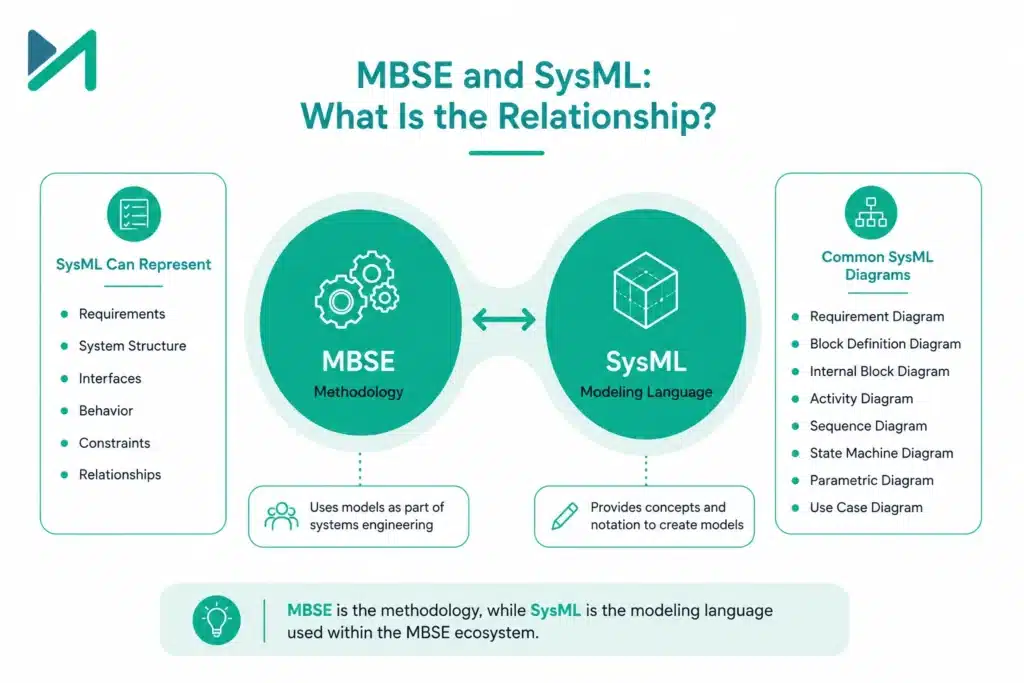
SysML, or Systems Modeling Language, is a modeling language used to represent systems engineering information. MBSE is the broader methodology and engineering approach.
This distinction is important.
MBSE describes how an organization uses models as part of systems engineering, while SysML provides standardized concepts and notation that can be used to create system models.
SysML can represent:
- Requirements
- System structure
- Interfaces
- Behavior
- Constraints
- Relationships
Common SysML representations include:
- Requirement diagrams
- Block Definition Diagrams
- Internal Block Diagrams
- Activity diagrams
- Sequence diagrams
- State machine diagrams
- Parametric diagrams
- Use case diagrams
Therefore, MBSE and SysML should not be treated as interchangeable terms.
MBSE is the methodology, while SysML is one of the important modeling languages used within the MBSE ecosystem.
MBSE for Software-Defined Vehicles
The growth of Software-Defined Vehicles (SDVs) has increased the importance of model-centric engineering in the automotive industry.
An SDV combines vehicle hardware, embedded software, connectivity, sensors, electronic architectures, cloud services, and continuously evolving software capabilities.
This creates relationships between:
- Vehicle functions
- System requirements
- Software requirements
- ECUs
- Sensors
- Networks
- Software components
- Safety requirements
- Cybersecurity requirements
- Verification activities
MBSE can provide a structured system representation that helps engineering teams understand these relationships.
To understand the concept itself, see What Is a Software-Defined Vehicle?
The SDV development lifecycle provides additional context on how software-intensive vehicle development progresses across engineering stages.
Organizations working through this transformation can also explore SDV engineering challenges to understand some of the practical issues associated with increasingly software-driven vehicles.
💡
MBSE and Digital Engineering
MBSE is an important part of broader digital engineering initiatives.
Digital engineering connects engineering data, models, tools, processes, and lifecycle activities into a more integrated environment.
A simplified flow can look like:
Requirements
↓
System Models
↓
Architecture
↓
Engineering Design
↓
Implementation
↓
Testing
↓
Verification
↓
Release
↓
Operation
The Digital Engineering for Automotive guide provides a broader perspective on how digital engineering can support modern automotive product development.
MBSE and the Digital Thread
A digital thread connects related engineering information throughout the product lifecycle.
MBSE contributes structured system models to this connected environment.
For example:
Requirements
↓
System Model
↓
Architecture
↓
Software and Hardware
↓
Testing
↓
Verification
↓
Release
↓
Maintenance
When models are connected with lifecycle systems, engineering teams can obtain better visibility into how information moves across different stages of product development.
This becomes especially important when multiple engineering disciplines and tools are involved.
MBSE and Engineering Lifecycle Management
MBSE and Engineering Lifecycle Management address complementary engineering requirements.
MBSE focuses heavily on:
- System models
- Architecture
- Behavior
- Relationships
- Interfaces
- System analysis
Engineering Lifecycle Management can provide capabilities around:
- Requirements
- Development
- Testing
- Change management
- Defects
- Configuration
- Release activities
- Traceability
Connecting MBSE with ELM can help organizations maintain relationships between system models and downstream engineering activities.
This becomes useful when requirements, architecture, software development, testing, and verification are managed through different environments.
MBSE and ASPICE
Automotive organizations may also use Automotive SPICE, commonly known as ASPICE, to evaluate and improve engineering processes.
MBSE can support structured automotive development by providing organized engineering models, requirements relationships, architecture information, and traceability.
For readers who are new to the subject, What Is ASPICE? explains the fundamentals and terminology.
Organizations evaluating engineering process capability can also explore ASPICE level assessment.
MBSE and ASPICE should not be considered interchangeable. MBSE is a systems engineering methodology, while ASPICE provides a process assessment framework. They can, however, work together within a disciplined automotive engineering environment.
For organizations comparing process improvement frameworks, ASPICE vs. CMMI provides additional context.
Teams planning an ASPICE improvement initiative can also refer to the ASPICE implementation roadmap.
How MBSE Supports Automotive Engineering
Modern automotive products involve interactions between mechanical systems, electrical architecture, embedded software, connectivity, safety, cybersecurity, and cloud services.
MBSE can provide a common system representation across these disciplines.
Vehicle Architecture
Engineers can represent relationships between vehicle functions, ECUs, networks, sensors, and other system elements.
Functional Safety
Safety-related requirements and system relationships can be represented alongside architecture and verification information.
Software-Defined Vehicle Development
Models can help teams understand relationships between software functions, vehicle capabilities, hardware, and system interfaces.
Product Variants
Structured models can help organizations represent common architectures and product-specific variations.
Requirements Traceability
Requirements can be connected with architecture elements, design decisions, and verification activities.
Early Design Analysis
System relationships and behavior can be evaluated before implementation is complete.
MBSE in Other Industries
MBSE is not limited to automotive engineering.
Aerospace and Defense
Aircraft, spacecraft, defense platforms, and mission systems contain numerous interfaces and dependencies. MBSE can provide a structured way to represent system architecture and relationships.
Medical Devices
Medical devices often combine hardware, embedded software, electronics, sensors, and regulatory requirements. Model-based approaches can help teams understand system relationships and verification activities.
Rail
Rail systems involve rolling stock, signaling, control systems, communication networks, infrastructure, and safety considerations. MBSE can support coordination across these interconnected elements.
Industrial Manufacturing
Modern industrial systems combine mechanical equipment, electronics, software, sensors, networks, and control systems. MBSE can help teams manage these relationships within a common engineering framework.
The actual value of MBSE depends on how effectively models are incorporated into the organization’s engineering processes.
What Are the Benefits of MBSE?
A properly planned MBSE implementation can provide several engineering benefits.
Better System Understanding
Models provide structured representations of system relationships that can make complex engineering information easier to analyze.
Improved Traceability
Connected model elements can make relationships between requirements, architecture, design, and verification easier to understand.
Earlier Problem Detection
Teams can analyze system behavior and dependencies before implementation is complete, helping identify potential issues earlier.
Better Multidisciplinary Collaboration
A shared model can provide systems, software, hardware, safety, and other engineering teams with a common reference.
Faster Change Impact Analysis
When relationships are explicitly represented, engineers can investigate how a change could affect other parts of the system.
Reduced Information Duplication
Reusable model elements can reduce unnecessary repetition across engineering artifacts.
Improved Lifecycle Visibility
When models are connected with lifecycle tools, teams can obtain a broader view of engineering information and relationships.
These benefits are not automatic. They depend on model quality, governance, tool integration, engineering discipline, and adoption.
What Are the Challenges of MBSE Adoption?
MBSE changes established engineering practices, so implementation should be treated as an engineering transformation rather than simply a software deployment.
Organizational Resistance
Teams that have traditionally relied on documents may need time and training to adopt model-centric workflows.
Modeling Skills
Engineers need appropriate knowledge of modeling concepts, standards, tools, and the engineering processes surrounding them.
Tool Integration
Models may need to exchange information with requirements management, ALM, PLM, simulation, testing, and development environments.
Model Governance
Large programs need clear rules for model structure, ownership, naming, versioning, reuse, access, and quality.
Legacy Data
Existing programs may contain significant engineering information in documents or older systems that needs to be incorporated into a model-centric environment.
Maintaining Model Quality
A model only remains useful when its information is accurate, structured, maintained, and aligned with the actual system.
For this reason, organizations should avoid treating MBSE as a simple tool installation exercise.
💡
MBSE Implementation Best Practices
Start With a Pilot
Select a project, subsystem, or engineering problem where MBSE can demonstrate measurable value.
Define Modeling Governance
Establish conventions for model structure, naming, ownership, versioning, reviews, and reuse.
Connect Requirements Early
System models should not operate independently from requirements management.
Establish Traceability
Define relationships between requirements, architecture, implementation, and verification.
Integrate the Toolchain
Where appropriate, connect modeling environments with requirements, ALM, PLM, simulation, testing, and development platforms.
Train Engineering Teams
Training should cover both modeling techniques and the engineering processes associated with model-based development.
Measure Adoption
Organizations can track indicators such as model coverage, traceability completeness, review efficiency, reuse, defect discovery timing, and engineering cycle time.
Expand Gradually
Once a pilot demonstrates measurable value, the approach can be extended to additional programs and engineering disciplines.
MBSE Tools and Technology Ecosystem
MBSE rarely operates as an isolated technology.
A modern engineering environment may include multiple tool categories:
| Engineering Area | Example Technologies |
|---|---|
| Systems Modeling | IBM Rhapsody, Cameo Systems Modeler, Enterprise Architect |
| Requirements Management | IBM DOORS Next, Jama Connect |
| Engineering Lifecycle Management | IBM ELM, PTC Codebeamer |
| PLM | Siemens Teamcenter, PTC Windchill |
| Simulation | MATLAB/Simulink |
| Development and Collaboration | Jira, GitLab |
Tool selection should be based on engineering requirements rather than popularity alone.
Important evaluation criteria include:
- Modeling capabilities
- Standards support
- Requirements integration
- Traceability
- Version control
- Collaboration
- Simulation integration
- API capabilities
- Tool interoperability
- Scalability
- Lifecycle coverage
For Software-Defined Vehicle programs, the toolchain becomes particularly important because engineering information needs to move between multiple environments. The SDV toolchain architecture article provides additional context.
MBSE and Embedded DevOps
Modern automotive products require close coordination between systems engineering and software engineering.
This creates an opportunity to connect MBSE with Embedded DevOps.
Embedded DevOps applies DevOps practices to software developed for hardware-dependent environments, connecting software development, integration, testing, automation, and release activities with embedded engineering constraints.
Embedded DevOps can connect:
- System requirements
- Software development
- Source control
- Build automation
- Testing
- Hardware integration
- Configuration management
- Release processes
Learn more about What Is Embedded DevOps?
MBSE does not replace Embedded DevOps. The two approaches can complement one another when system-level models and software delivery processes are connected.
💡
How to Choose an MBSE Tool
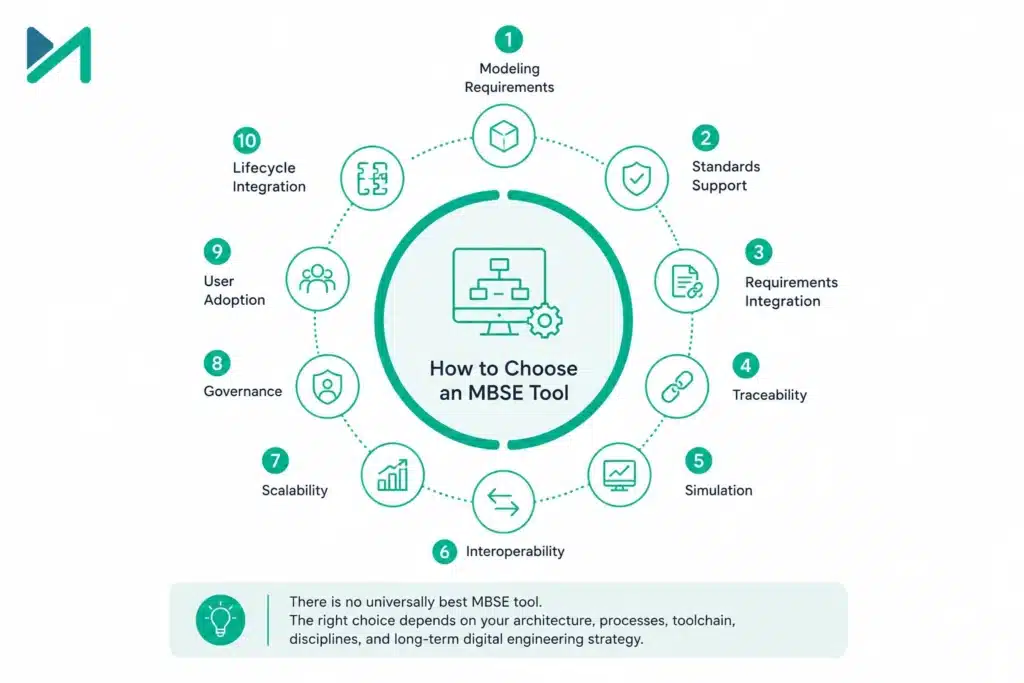
Selecting an MBSE tool should begin with the engineering problem rather than the product name.
Organizations should evaluate:
1. Modeling Requirements
What system structures, behaviors, relationships, and constraints need to be represented?
2. Standards Support
Which modeling standards and engineering practices need to be supported?
3. Requirements Integration
Can requirements be connected with system models?
4. Traceability
Can relationships be maintained across engineering activities?
5. Simulation
Does the environment support the analysis and simulation workflows required by the engineering program?
6. Interoperability
Can the tool exchange information with the organization’s existing engineering platforms?
7. Scalability
Can the environment support large programs and distributed engineering teams?
8. Governance
Can organizations manage model versions, access, ownership, and quality?
9. User Adoption
Can engineers realistically incorporate the tool into their daily workflows?
10. Lifecycle Integration
Can the modeling environment participate in the wider digital engineering ecosystem?
There is no universally best MBSE tool. The appropriate choice depends on the organization’s product architecture, processes, existing toolchain, engineering disciplines, and long-term digital engineering strategy.
How MicroGenesis Helps Organizations Adopt MBSE
Adopting MBSE successfully requires more than purchasing a modeling platform. Organizations need to align methodology, engineering processes, tools, integrations, governance, and team capabilities.
MicroGenesis supports engineering organizations working toward model-centric and digitally connected engineering environments.
Our capabilities include:
- MBSE consulting and implementation
- Systems modeling implementation
- Requirements management
- Requirements traceability
- Toolchain integration
- Digital Thread enablement
- ASPICE-oriented process improvement
- Embedded DevOps integration
- IBM Engineering Lifecycle Management
- PTC Codebeamer solutions
- Automotive engineering services
MicroGenesis works with engineering environments across automotive, aerospace and defense, rail, manufacturing, and medical device domains.
The focus is on helping organizations establish practical engineering processes that connect requirements, system models, development, testing, verification, and lifecycle information.
For organizations evaluating an MBSE initiative, a practical starting point is to assess the existing engineering lifecycle, toolchain, requirements process, modeling maturity, traceability requirements, and desired business outcomes.
Frequently Asked Questions About MBSE
What is MBSE?
Model-Based Systems Engineering (MBSE) is a systems engineering methodology that uses structured digital models as a primary means of representing, analyzing, communicating, and managing system information across the product lifecycle.
What is the difference between MBSE and traditional systems engineering?
Traditional systems engineering often relies heavily on documents and specifications. MBSE uses connected digital models to represent system structure, behavior, requirements, relationships, and engineering information.
Is SysML the same as MBSE?
No. MBSE is a systems engineering methodology, while SysML is a modeling language that can be used to represent systems within an MBSE approach.
Which industries use MBSE?
MBSE is used in industries developing complex multidisciplinary systems, including automotive, aerospace, defense, rail, medical devices, and industrial manufacturing.
What are the main benefits of MBSE?
Key benefits can include improved system understanding, stronger traceability, better multidisciplinary collaboration, earlier design analysis, improved change impact analysis, and reduced duplication of engineering information.
Does MBSE replace engineering documents?
Not necessarily. Organizations may still need specifications, reports, approvals, and other controlled documents. MBSE changes how the underlying engineering information is structured and managed.
How does MBSE support ASPICE?
MBSE can provide structured requirements, architecture information, traceability, and engineering evidence that support disciplined automotive development processes. It does not replace ASPICE or automatically establish process compliance.
Is MBSE useful for Software-Defined Vehicles?
Yes. SDVs involve complex relationships between vehicle functions, software, electronics, networks, safety, cybersecurity, and other engineering domains. MBSE can provide a structured representation of these relationships.
How should an organization start an MBSE initiative?
A practical starting point is to identify a suitable pilot, define measurable objectives, establish modeling governance, connect requirements, select appropriate tools, train engineers, and expand progressively after demonstrating value.
Conclusion
As products become increasingly software-intensive and multidisciplinary, managing engineering information through disconnected documents becomes more challenging.
Model-Based Systems Engineering provides a structured approach for addressing this complexity by placing digital system models at the center of engineering activities.
MBSE can connect requirements, architecture, behavior, interfaces, implementation, testing, verification, and lifecycle information. When integrated with Engineering Lifecycle Management, Digital Engineering, ASPICE-oriented processes, Embedded DevOps, and Software-Defined Vehicle development, it can become an important foundation for modern engineering.
Successful MBSE adoption is not simply a matter of selecting a modeling tool. Organizations need an appropriate methodology, governance framework, engineering skills, tool integrations, and adoption strategy.
The most effective implementations start with a clear engineering problem, establish measurable objectives, demonstrate value through focused projects, and then expand the model-centric approach across the wider engineering organization.
MicroGenesis helps organizations evaluate and implement engineering approaches that connect systems modeling, requirements, lifecycle management, traceability, tool integration, and modern software engineering practices.