
The automotive industry is becoming increasingly software-driven. Modern vehicles combine embedded software, connectivity, advanced driver assistance systems, electric powertrains, cloud services, cybersecurity capabilities, and over-the-air updates. As software becomes central to vehicle functionality, automotive engineering teams need a faster and more controlled way to develop, test, validate, and release software.
Traditional automotive development often depends on sequential processes, manual testing, long integration cycles, and separate engineering teams. These approaches can become difficult to scale when vehicle software needs to evolve continuously.
This is where an Automotive DevOps Framework becomes valuable.
Automotive DevOps brings development, testing, systems engineering, automation, operations, and release management into a connected engineering workflow. Unlike conventional enterprise DevOps, it must also account for embedded software, hardware dependencies, functional safety, cybersecurity, engineering traceability, and automotive standards.
This guide explains what an Automotive DevOps Framework is, how its architecture works, its core components, implementation challenges, key KPIs, and how organizations can implement Automotive DevOps successfully.
What Is an Automotive DevOps Framework?
An Automotive DevOps Framework is a structured engineering approach that connects automotive software development, testing, automation, deployment, lifecycle management, and compliance into a continuous workflow designed for software-intensive vehicles.
It extends traditional DevOps by incorporating automotive-specific engineering activities such as systems engineering, embedded software development, hardware validation, requirements management, HIL testing, safety processes, and engineering traceability.
A complete framework can connect:
- Requirements management
- Systems engineering
- Software development
- Configuration management
- Continuous integration
- Continuous testing
- Simulation and HIL testing
- Continuous delivery
- Release management
- Engineering traceability
- Monitoring and feedback
Instead of treating development, testing, and release as isolated activities, Automotive DevOps creates a continuous engineering loop.
Why Automotive DevOps Matters for Modern Vehicle Development
Vehicle software is becoming more complex as manufacturers introduce connected features, ADAS capabilities, intelligent systems, electric powertrain functions, and OTA updates.
For organizations developing Software Defined Vehicles, software delivery cannot remain limited to the traditional vehicle production cycle.
Automotive DevOps can help engineering organizations:
- Accelerate software integration
- Improve development feedback
- Reduce integration problems
- Increase test automation
- Support continuous software validation
- Improve engineering collaboration
- Strengthen traceability
- Support controlled OTA releases
- Improve release predictability
- Reduce repetitive engineering activities
If you are evaluating the broader transformation toward software-driven vehicles, our Digital Engineering for Automotive guide provides additional context on how digital engineering practices are reshaping automotive product development.
You can also learn what a Software Defined Vehicle is and how software becomes part of the vehicle’s continuously evolving product lifecycle.
Traditional Automotive Development vs Automotive DevOps
| Traditional Automotive Development | Automotive DevOps |
|---|---|
| Sequential development | Continuous engineering |
| Manual builds | Automated builds |
| Infrequent integration | Continuous integration |
| Testing concentrated later | Continuous testing |
| Engineering silos | Cross-functional collaboration |
| Manual release activities | Automated release workflows |
| Limited lifecycle visibility | End-to-end traceability |
| Late defect discovery | Earlier feedback |
| Long release cycles | Shorter feedback and release cycles |
The objective is not simply to make development faster. Automotive DevOps aims to make the entire engineering process more repeatable, measurable, connected, and manageable.
Core Principles of an Automotive DevOps Framework
1. Continuous Integration
Continuous Integration automatically builds and validates software whenever relevant changes are introduced into the shared development environment.
A typical automotive CI workflow can include:
- Source code integration
- Cross-compilation
- Static code analysis
- Unit testing
- Build verification
- Artifact generation
Frequent integration allows teams to identify compatibility and integration issues before they become more difficult to resolve.
2. Continuous Testing
Continuous testing is the practice of executing relevant automated tests throughout the software lifecycle instead of postponing validation until the end of development.
For automotive programs, testing may span several levels:
- Unit testing
- Integration testing
- Functional testing
- Regression testing
- Software-in-the-Loop testing
- Hardware-in-the-Loop testing
- Performance testing
- Security testing
The appropriate combination depends on the product architecture, development process, safety requirements, and validation strategy.
3. Continuous Delivery
Continuous Delivery keeps validated software in a state where it can be prepared for controlled release.
Automotive release workflows may include:
- Firmware packaging
- Version management
- Artifact storage
- Release approvals
- Validation gates
- Compliance documentation
- OTA package preparation
This approach helps organizations establish greater consistency around software releases.
4. Engineering Traceability
Traceability is one of the most important elements of Automotive DevOps.
A connected engineering chain can look like:
Customer Requirement → System Requirement → Software Requirement → Development Task → Source Code → Build → Test Case → Test Result → Release
This relationship helps teams understand the impact of changes and investigate defects.
It can also support compliance activities by connecting engineering evidence across the lifecycle.
Automotive DevOps Architecture
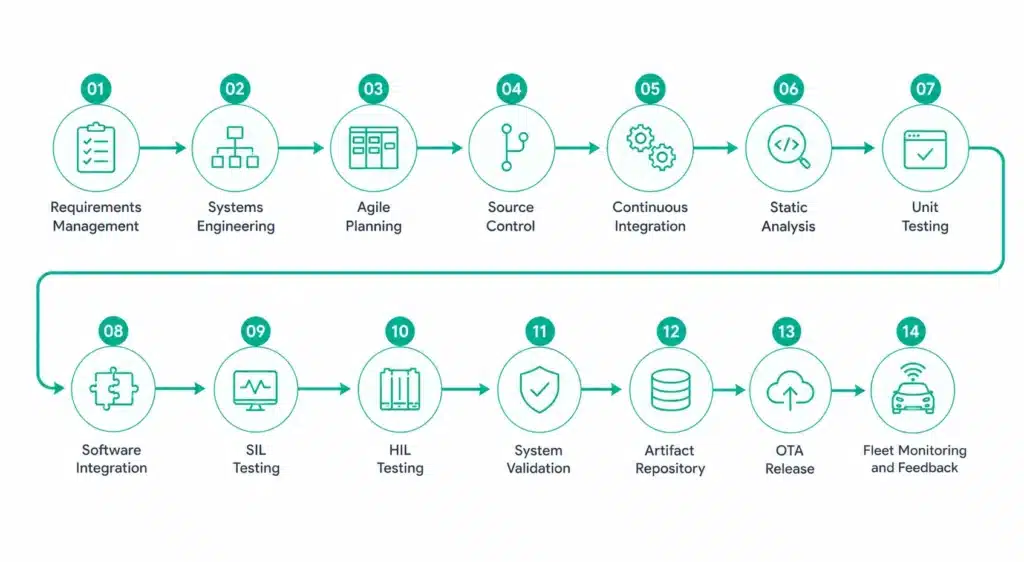
A modern Automotive DevOps architecture typically connects several engineering domains.
Requirements Management
IBM DOORS Next / PTC Codebeamer
↓
Systems Engineering
IBM Rhapsody / Cameo
↓
Agile Planning
Jira / IBM EWM
↓
Source Control
Git / GitLab
↓
Continuous Integration
Jenkins / GitLab CI
↓
Static Analysis
↓
Unit Testing
↓
Software Integration
↓
SIL Testing
↓
HIL Testing
↓
System Validation
↓
Artifact Repository
↓
OTA Release
↓
Fleet Monitoring and Feedback
The exact toolchain will vary by organization. The important consideration is how the tools work together across the engineering lifecycle.
For organizations developing Software Defined Vehicles, the SDV toolchain architecture provides a useful reference for understanding how engineering tools and software delivery workflows can be connected.
💡
Key Components of an Automotive DevOps Framework
Requirements Management
Requirements management provides the foundation for defining what the vehicle system and its software must accomplish.
A connected requirements environment can support:
- Requirement creation
- Version control
- Reviews and approvals
- Change management
- Traceability
- Impact analysis
Requirements should not remain isolated from development and testing. Connecting requirements to downstream engineering activities helps teams understand how changes affect the product.
Source Code Management
Distributed version control systems such as Git provide the foundation for collaborative software development.
Important capabilities include:
- Branch management
- Merge requests
- Code reviews
- Version history
- Change tracking
Build Automation
Build automation ensures that software is compiled and packaged consistently.
Typical activities include:
- Cross-compilation
- Dependency management
- Binary generation
- Build verification
- Automated artifact creation
Automating these activities reduces reliance on manually configured development environments.
Static Code Analysis
Static analysis examines source code without executing it.
Automotive development teams may use static analysis to identify:
- Coding standard violations
- Potential memory problems
- Security weaknesses
- Code complexity
- Other defects
Static analysis can become part of the CI pipeline so that issues are identified before software moves further through the workflow.
Test Automation
Automated testing allows engineering teams to validate software continuously.
Depending on the program, testing can include:
- Unit testing
- Integration testing
- Regression testing
- SIL testing
- HIL testing
- Performance testing
- Security testing
Release Management
Release management provides controlled processes for moving validated software toward deployment.
It can include:
- Firmware packaging
- Version control
- Release approvals
- Artifact management
- Compliance evidence
- Deployment preparation
Automotive DevOps and ASPICE
ASPICE is an automotive process assessment framework used to evaluate the capability and consistency of development processes across relevant engineering activities.
Automotive DevOps can support process improvement by automating repeatable activities, maintaining engineering records, connecting lifecycle artifacts, and improving consistency.
For teams beginning their ASPICE journey, start with our guide explaining what ASPICE is.
An ASPICE level assessment can help organizations understand their current process capability and identify improvement areas.
Organizations planning implementation can also use an ASPICE implementation roadmap to structure process improvements around measurable engineering objectives.
Automotive DevOps Standards and Engineering Processes
| Standard / Practice | Automotive DevOps Contribution |
| ASPICE | Process automation, traceability, evidence and repeatability |
| ISO 26262 | Verification, validation and controlled change processes |
| ISO/SAE 21434 | Integration of cybersecurity activities into development |
| AUTOSAR | Consistent software integration and standardized automotive software development |
Automotive DevOps does not automatically make an organization compliant with any standard. Instead, automation and traceability can provide infrastructure that supports defined engineering and compliance processes.
For organizations comparing process frameworks, our ASPICE vs CMMI comparison explains how the two approaches differ.
Automotive DevOps for Software Defined Vehicles
Software Defined Vehicles require a different approach to vehicle software development.
Software functionality can continue to evolve after a vehicle has entered service, creating a need for:
- Continuous software integration
- Automated validation
- OTA update preparation
- Secure software delivery
- Faster defect resolution
- Continuous regression testing
- Lifecycle traceability
Automotive DevOps provides the engineering foundation needed to support these activities.
The SDV development lifecycle explains how software engineering activities fit into the broader lifecycle of a Software Defined Vehicle.
Organizations should also understand the engineering challenges associated with SDVs before defining their DevOps transformation strategy.
Automotive DevOps and Embedded DevOps
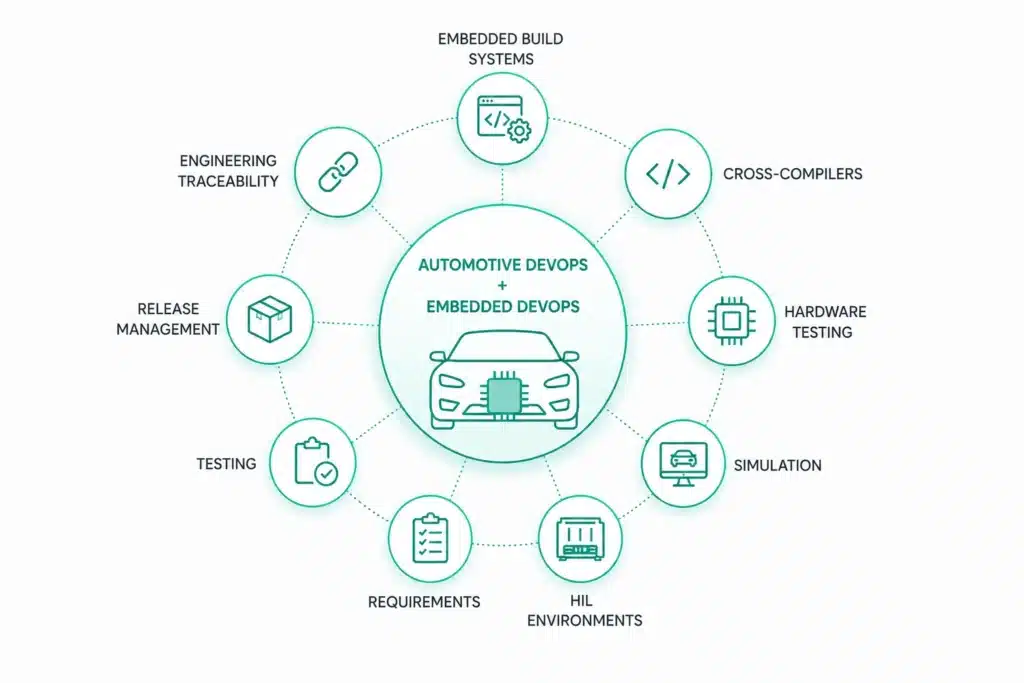
Automotive software is fundamentally an embedded engineering discipline. Software may need to interact with ECUs, sensors, actuators, real-time systems, networks, and physical vehicle components.
This makes Automotive DevOps closely connected to Embedded DevOps.
A successful approach should connect software automation with:
- Embedded build systems
- Cross-compilers
- Hardware testing
- Simulation
- HIL environments
- Requirements
- Testing
- Release management
- Engineering traceability
This integration helps prevent the creation of another isolated CI/CD pipeline that remains disconnected from the rest of the engineering organization.
💡
Challenges in Implementing an Automotive DevOps Framework
Automotive organizations often have complex development environments built over many years.
Common implementation challenges include:
Legacy Processes
Existing development workflows may depend on manual approvals, document-based handoffs, and sequential engineering activities.
Hardware Dependencies
Physical hardware may be limited or shared between teams, making continuous automated testing more difficult.
Toolchain Fragmentation
Requirements, modeling, development, testing, configuration management, and release activities may be managed through different platforms.
Long Build and Test Cycles
Large automotive software programs can have extensive build and validation requirements.
Manual Testing
Hardware-dependent validation can remain heavily manual when suitable automation infrastructure is unavailable.
Compliance Requirements
Engineering automation must operate within defined safety, security, quality, and process requirements.
Organizational Resistance
DevOps transformation changes responsibilities, workflows, collaboration models, and engineering practices. Technology alone cannot solve this challenge.
A phased implementation approach is therefore usually more practical than attempting to automate the entire lifecycle at once.
How to Implement an Automotive DevOps Framework
A practical implementation can follow these stages.
Step 1: Assess the Existing Engineering Environment
Document the current development, requirements, build, test, release, and compliance processes.
Identify:
- Manual activities
- Process bottlenecks
- Tool silos
- Integration problems
- Testing limitations
- Traceability gaps
Step 2: Define the Target Engineering Workflow
Determine how requirements, systems engineering, software development, testing, CI/CD, release management, and monitoring should interact.
Step 3: Prioritize Automation
Start with high-value activities such as:
- Automated builds
- Static analysis
- Unit testing
- Regression testing
- Artifact management
- Traceability
Step 4: Connect the Toolchain
Integrate the engineering tools that are already part of the organization’s development environment.
The objective should be to create a connected workflow rather than replace every existing tool.
Step 5: Establish Traceability
Define how requirements should connect to development activities, code, builds, tests, defects, and releases.
Step 6: Introduce Continuous Validation
Expand automated validation across simulation, SIL, HIL, system testing, performance testing, and security testing as appropriate.
Step 7: Measure and Improve
Track engineering KPIs, identify bottlenecks, and continuously improve the pipeline.
Best Practices for Automotive DevOps
Organizations can improve the effectiveness of their Automotive DevOps implementation by following these practices:
- Standardize engineering workflows
- Integrate requirements with development and testing
- Automate repeatable activities
- Use frequent code integration
- Introduce automated quality checks
- Expand test automation progressively
- Maintain end-to-end traceability
- Integrate security into the development lifecycle
- Monitor pipeline performance
- Establish clear release governance
- Use measurable engineering KPIs
- Review and improve processes regularly
The objective should be continuous engineering improvement rather than automation for its own sake.
KPIs for Measuring Automotive DevOps Success
Automotive organizations should establish measurable indicators before scaling their DevOps transformation.
Useful KPIs include:
| KPI | What It Indicates |
| Deployment frequency | How often software can be released |
| Build success rate | Reliability of automated builds |
| Lead time for changes | Time from development to validated delivery |
| Test automation coverage | Degree of automated validation |
| Defect escape rate | Defects reaching later lifecycle stages |
| Mean Time to Recovery | Speed of restoring affected services or software |
| Change failure rate | Reliability of software changes |
| Traceability coverage | Extent of lifecycle artifact connectivity |
| Release cycle duration | Overall speed of software delivery |
These metrics should be interpreted within the organization’s engineering context rather than treated as isolated targets.
How MicroGenesis Helps With Automotive DevOps
Building an Automotive DevOps Framework requires more than selecting a CI/CD platform.
Organizations need to connect development automation with requirements management, systems engineering, testing, lifecycle management, compliance, and engineering traceability.
MicroGenesis helps automotive OEMs and Tier 1 suppliers design and implement connected engineering environments through:
- Automotive DevOps consulting
- Embedded CI/CD implementation
- Engineering toolchain integration
- IBM Engineering Lifecycle Management
- IBM DOORS Next implementation
- PTC Codebeamer implementation
- Engineering traceability
- Embedded DevOps enablement
- ASPICE process alignment
- ISO 26262 process alignment
- Digital Thread implementation
- Managed engineering services
With more than 25 years of engineering transformation experience, MicroGenesis helps organizations modernize software development processes and establish scalable engineering workflows.
The engagement can begin with an assessment of the current engineering environment and progress toward a target Automotive DevOps architecture, implementation roadmap, toolchain integration, and continuous improvement model.
Frequently Asked Questions
What is an Automotive DevOps Framework?
An Automotive DevOps Framework connects software development, testing, automation, deployment, lifecycle management, and engineering governance into a continuous workflow designed for automotive software and embedded engineering environments.
How is Automotive DevOps different from traditional DevOps?
Automotive DevOps must account for embedded software, physical hardware, functional safety, cybersecurity, HIL testing, specialized toolchains, engineering traceability, and automotive development processes.
Can Automotive DevOps support ASPICE?
Yes. Automation, traceability, configuration management, continuous testing, and evidence collection can support organizations implementing and improving processes associated with ASPICE. However, DevOps alone does not guarantee ASPICE compliance.
Why is traceability important in Automotive DevOps?
Traceability connects requirements with development, source code, builds, tests, results, and releases. This helps teams perform impact analysis, investigate defects, demonstrate engineering evidence, and support compliance activities.
What tools are used in Automotive DevOps?
Depending on the engineering environment, organizations may use IBM DOORS Next, IBM ELM, PTC Codebeamer, Git, GitLab, Jenkins, Jira, SonarQube, artifact repositories, simulation platforms, and HIL testing environments.
Is Automotive DevOps important for Software Defined Vehicles?
Yes. SDVs require software to evolve throughout the vehicle lifecycle. Automotive DevOps provides automation and connected engineering workflows that can support continuous integration, validation, release management, and controlled software updates.
Conclusion
Automotive software development is moving from periodic delivery toward continuous engineering. As Software Defined Vehicles increase the amount and complexity of software inside modern vehicles, engineering organizations need processes that can support frequent integration, automated testing, traceability, controlled releases, and continuous improvement.
An effective Automotive DevOps Framework brings these capabilities together.
The strongest implementations connect Engineering Lifecycle Management, Embedded DevOps, CI/CD, engineering traceability, ASPICE processes, systems engineering, testing, and digital engineering into one connected workflow.
For automotive OEMs and Tier 1 suppliers, the next step is not simply to introduce another DevOps tool. It is to evaluate the existing engineering environment, identify the highest-value automation opportunities, establish the target toolchain, and implement the framework in measurable stages.
Ready to Build Your Automotive DevOps Framework?
MicroGenesis can help you assess your current engineering processes, define an Automotive DevOps strategy, integrate your engineering toolchain, implement embedded CI/CD, strengthen traceability, and align development workflows with automotive engineering requirements.
Talk to MicroGenesis about Automotive DevOps consulting and implementation and build a scalable engineering environment for software-defined vehicle development.