
Organizations across aerospace, automotive, medical devices, electronics, and other engineering-intensive industries are modernizing their requirements engineering practices to keep pace with increasingly complex products and faster development cycles. While IBM Engineering Requirements Management DOORS (Classic DOORS) has been a trusted platform for decades, today’s engineering environment demands greater collaboration, cloud readiness, seamless integrations, and end-to-end traceability.
IBM Engineering Requirements Management DOORS Next (DNG), a core component of IBM Engineering Lifecycle Management, represents the next generation of requirements management. Built on a modern web-based architecture, DOORS Next enables organizations to manage complex requirements more efficiently while supporting Agile development, DevOps, Model-Based Systems Engineering (MBSE), and continuous engineering practices. To understand how IBM ELM connects requirements, development, testing, and change management into a unified platform, read our guide on Exploring the Core Components of Engineering Lifecycle Management.
Migrating from Classic DOORS to DOORS Next is more than a technology upgrade, it’s an opportunity to modernize engineering processes, improve collaboration, and establish a connected digital engineering ecosystem. Organizations planning an IBM ELM implementation often work with experienced IBM ELM consulting services and an IBM ELM partner India to reduce migration risks and accelerate adoption.
In this comprehensive guide, we’ll explore everything you need to know about migrating from DOORS to DOORS Next, including migration strategies, planning, execution, best practices, common challenges, and how an experienced IBM Platinum Partner and IBM ELM solution provider like MicroGenesis can help ensure a successful transition.
Why Move to DOORS Next?
As engineering projects become increasingly software-driven and globally distributed, traditional desktop-based requirements management tools struggle to support modern collaboration and lifecycle management. DOORS Next addresses these limitations by providing a scalable, web-based platform that integrates seamlessly with the broader IBM Engineering Lifecycle Management ecosystem.
If you’re evaluating whether DOORS Next is the right requirements platform for your organization, our detailed guide on Requirements Management with DOORS Next explains its capabilities, architecture, and best practices in depth.
Some of the most compelling reasons to migrate include:
Modern User Interface
Unlike Classic DOORS, DOORS Next provides an intuitive browser-based interface that enables engineering teams to collaborate from anywhere without relying on desktop clients. Real-time editing, reviews, comments, and dashboards improve productivity across distributed teams.
Built for Integration
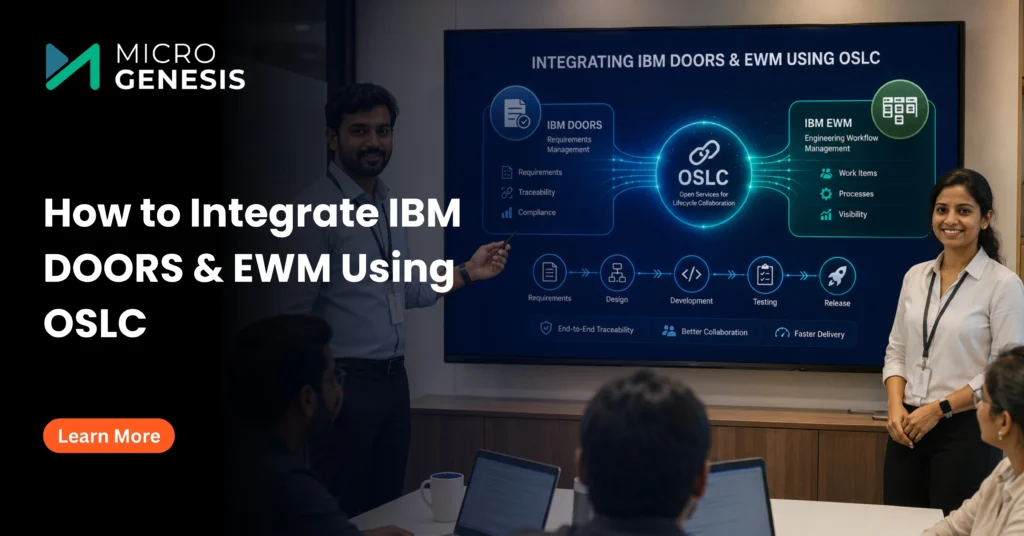
One of the biggest advantages of DOORS Next is its ability to integrate with other engineering tools using Open Services for Lifecycle Collaboration (OSLC). This enables organizations to connect requirements with testing, software development, and workflow management, creating a seamless engineering environment. Learn more about this integration in our article on Integrating IBM Engineering Requirements Management DOORS and Engineering Workflow Management (EWM) Using OSLC.
Improved Collaboration
DOORS Next introduces advanced capabilities such as:
- Versioned Components
- Global Configurations
- Collaborative Reviews
- Shared Views
- Real-time Editing
These features improve teamwork across geographically distributed engineering organizations while maintaining consistency throughout the product lifecycle.
Better Regulatory Compliance
Industries such as automotive, aerospace, medical devices, and defense require compliance with standards like ISO 26262, FDA 21 CFR Part 11, and IEC 62304.
DOORS Next simplifies compliance through:
- End-to-end traceability
- Baselining
- Electronic reviews
- Change history
- Audit-ready reporting
Organizations implementing engineering lifecycle management services can leverage these capabilities to strengthen governance while reducing audit effort.
Enterprise Scalability
Modern engineering organizations manage thousands of requirements across multiple products, variants, and distributed teams. DOORS Next is designed to support enterprise-scale engineering while maintaining performance, security, and governance.
Flexible Deployment
Unlike Classic DOORS, which primarily supports on-premises deployments, DOORS Next supports:
- Cloud
- Hybrid
- On-premises
This flexibility enables organizations to align deployment strategies with their business and compliance requirements.
Many enterprises migrating to DOORS Next also adopt broader IBM ELM managed services to simplify administration, upgrades, integrations, and ongoing platform optimization.
Key Differences Between DOORS and DOORS Next
Although both solutions focus on requirements management, they differ significantly in architecture, collaboration capabilities, scalability, and integration support.
If you’re still evaluating which platform best fits your engineering needs, our detailed comparison of IBM DOORS Next vs Polarion provides valuable insights into their strengths, limitations, and ideal use cases.
| Feature | Classic DOORS | DOORS Next |
| UI | Rich Client | Web-based |
| Architecture | Module-based | Component-based |
| Collaboration | Limited | Real-time |
| Customization | DXL | JavaScript & REST APIs |
| Deployment | On-premises | Cloud / Hybrid / On-premises |
| Variant Management | Manual | Global Configurations |
Migration Strategy and Planning
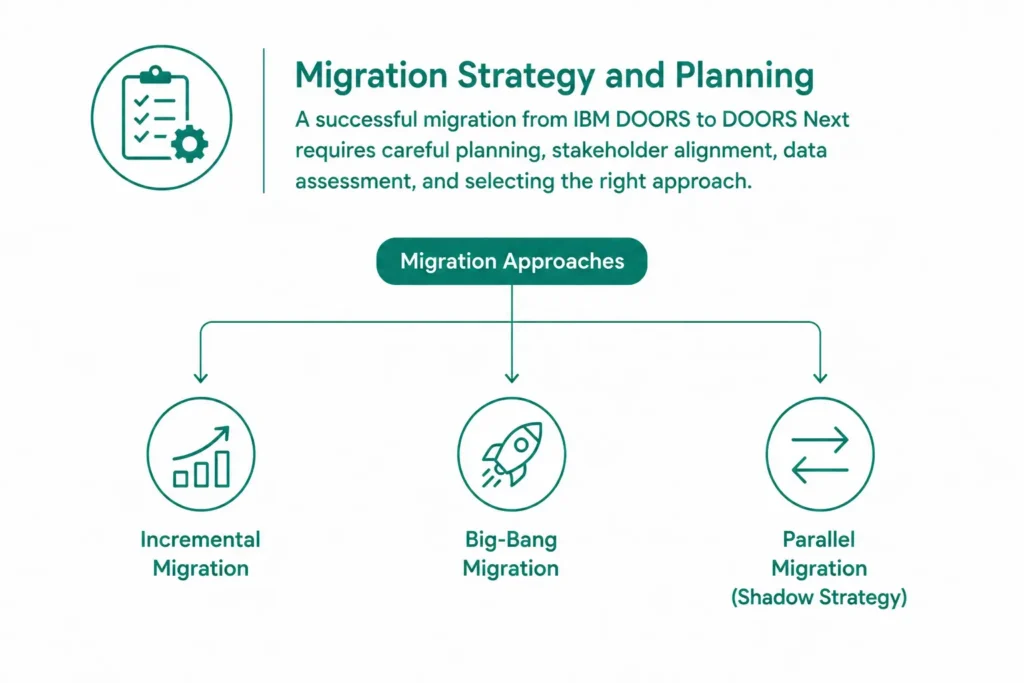
A successful migration from IBM Engineering Requirements Management DOORS to DOORS Next requires more than simply moving data from one platform to another. It involves careful planning, stakeholder alignment, data assessment, and selecting the right migration approach based on your organization’s engineering processes and business objectives.
Whether you’re migrating a single project or an enterprise-wide requirements repository, having a structured migration roadmap significantly reduces risks and ensures a smoother transition. Many organizations engage an experienced IBM ELM solution provider or IBM ELM consulting services team to design a migration strategy that aligns with their long-term engineering life cycle management goals.
There are three common migration approaches:
Incremental Migration
In an incremental migration, modules or projects are migrated in phases instead of all at once. This approach minimizes operational risks and allows engineering teams to gradually adapt to the new environment without disrupting ongoing development.
It is particularly suitable for organizations that:
- Manage multiple active projects
- Have geographically distributed engineering teams
- Require continuous project execution during migration
- Prefer validating each migration phase before proceeding
This phased approach also provides opportunities to optimize processes and address issues before the next migration wave.
Big-Bang Migration
A big-bang migration transfers the entire DOORS environment to DOORS Next in a single implementation phase.
This strategy is ideal when:
- The existing DOORS environment is relatively small
- Projects have reached completion
- Downtime can be scheduled
- The migration timeline is limited
Although this approach reduces the duration of the migration project, it requires extensive planning, validation, and testing before production rollout.
Parallel Migration (Shadow Strategy)
Many enterprises prefer a parallel migration strategy, where both Classic DOORS and DOORS Next operate simultaneously for a defined period.
During this phase:
- Existing teams continue working in Classic DOORS.
- The new DOORS Next environment is validated.
- Users receive training before full adoption.
- Data quality and integrations are verified.
Once stakeholders are confident in the new environment, organizations can transition completely to DOORS Next with minimal disruption.
This strategy is particularly effective for regulated industries where business continuity and compliance are critical.
Before You Begin Your Migration
Regardless of the migration strategy you choose, organizations should ensure they have:
- A detailed inventory of existing DOORS projects and modules
- Data complexity and dependency analysis
- Attribute and hierarchy mapping
- Integration assessment
- A comprehensive validation plan
- User training and change management strategy
Working with an experienced IBM ELM partner helps organizations identify potential migration risks early and establish best practices that reduce implementation time while improving overall project success.
Preparing Your DOORS Data
Migration success begins long before the first artifact is transferred. One of the most important phases of migrating from DOORS to DOORS Next is preparing your existing data.
Proper preparation ensures cleaner data, fewer migration issues, and a more maintainable requirements management environment after implementation.
Rather than moving outdated information into a modern platform, organizations should treat migration as an opportunity to improve data quality and optimize engineering processes.
Assess Your Current DOORS Landscape
Start by performing a comprehensive assessment of your existing DOORS environment. Understanding the current state of your requirements repository helps determine the migration scope, identify potential risks, and prioritize projects.
Evaluate areas such as:
- Number of projects and modules
- Active versus obsolete requirements
- Attribute structure and consistency
- Custom object types
- DXL scripts
- Internal and external links
- User permissions
- Existing integrations
This assessment becomes the foundation for a successful migration strategy.
If your organization relies heavily on IBM DOORS for enterprise requirements management, our guide on Mastering Requirements with IBM DOORS Web Access (DWA) provides additional insights into managing legacy DOORS environments before migration.
Clean Up Your Data
Migration provides an excellent opportunity to eliminate years of accumulated technical debt.
Before migrating:
- Remove obsolete modules
- Archive completed projects
- Standardize naming conventions
- Eliminate duplicate attributes
- Consolidate inconsistent data
- Review permissions
- Simplify module structures
Cleaning your data before migration reduces complexity while improving the performance and usability of DOORS Next.
Organizations implementing IBM Engineering Lifecycle Management often discover that this cleanup phase significantly improves reporting accuracy, traceability, and long-term governance.
For organizations in the automotive sector, modernizing requirements data also supports better systems engineering practices. Learn more in our article on Addressing Complexity in Electric Vehicle (EV) System Design and Development Using IBM ELM.
Plan for DXL Replacement
One of the most significant technical changes when moving from Classic DOORS to DOORS Next is the transition away from DXL (DOORS eXtension Language).
Many organizations rely on DXL for:
- Custom reports
- Validation rules
- Workflow automation
- Data manipulation
- Traceability reports
Since DOORS Next does not support DXL, these customizations must be redesigned using modern technologies such as:
- JavaScript extensions
- REST APIs
- OSLC integrations
- Jazz Reporting Service (JRS)
- External Business Intelligence tools
This modernization not only replaces legacy functionality but also creates opportunities to build more scalable, maintainable, and collaborative engineering workflows.
Organizations looking to improve reporting after migration should also understand the capabilities and limitations of IBM reporting tools. Read Why IBM ELM Reporting Still Requires an Expert to learn how expert reporting strategies can maximize the value of your engineering data.
The Migration Process Explained
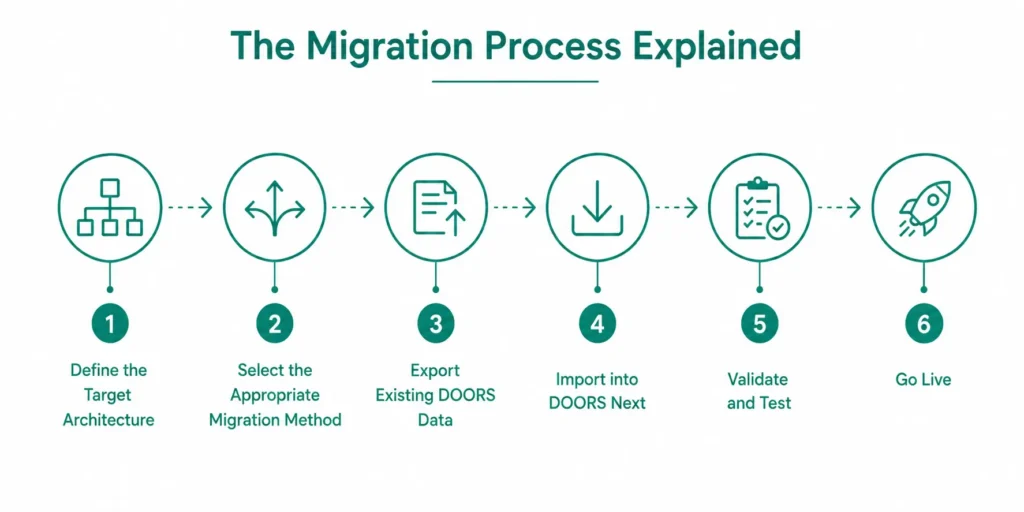
Once planning and data preparation are complete, organizations can begin the actual migration process. A structured migration approach minimizes risks while ensuring that requirements, traceability, attributes, and engineering relationships are preserved throughout the transition.
Step 1: Define the Target Architecture
Begin by designing your new DOORS Next environment.
This includes defining:
- Components
- Artifact types
- Configurations
- Folder structures
- Link relationships
- Naming conventions
Taking time to design the target architecture helps create a scalable and maintainable requirements management environment that aligns with your organization’s engineering lifecycle management services strategy.
Step 2: Select the Appropriate Migration Method
Organizations typically choose one of the following migration methods:
- IBM Migration Utility
- ReqIF Export and Import
- Custom migration tools
- Third-party migration accelerators
The best approach depends on the size and complexity of the existing DOORS repository, customization requirements, and business objectives.
Step 3: Export Existing DOORS Data
Before exporting data:
- Lock production modules if necessary.
- Capture metadata.
- Document module relationships.
- Record traceability information.
- Validate baselines.
This preparation helps preserve engineering integrity throughout the migration.
Step 4: Import into DOORS Next
Import the exported data into DOORS Next while validating:
- Artifact types
- Attribute mapping
- Link integrity
- Module hierarchy
- Folder structure
- User permissions
Resolve any inconsistencies before moving to production.
Step 5: Validate and Test
Comprehensive validation should confirm that:
- Requirements were migrated successfully.
- Traceability has been preserved.
- Reports generate correctly.
- Permissions are accurate.
- Workflows function as expected.
- Integrations operate correctly.
Testing should involve both technical administrators and business users to ensure the new environment meets operational requirements.
Step 6: Go Live
After successful validation:
- Train engineering teams.
- Finalize governance processes.
- Monitor system performance.
- Collect user feedback.
- Optimize workflows where necessary.
Organizations that partner with an experienced IBM Platinum Partner for IBM ELM implementation often achieve faster adoption and fewer post-migration issues because they benefit from proven migration methodologies, governance frameworks, and ongoing support.
Post-Migration Best Practices
Successfully migrating from DOORS to DOORS Next is a major milestone, but migration is only the beginning of your modernization journey. To maximize the return on your IBM ELM implementation, organizations should establish governance, optimize engineering workflows, and encourage user adoption to fully leverage the capabilities of IBM Engineering Lifecycle Management.
The following best practices help ensure that your new requirements management environment remains scalable, secure, and aligned with evolving business needs.
Training and User Adoption
Transitioning from the Classic DOORS interface to the web-based DOORS Next environment introduces new concepts such as components, configurations, artifact types, and collaborative reviews. Without proper training, users may struggle to adopt these capabilities effectively.
To improve adoption:
- Conduct role-based training sessions for business analysts, systems engineers, and administrators.
- Provide hands-on workshops covering common tasks such as creating artifacts, managing baselines, linking requirements, and generating reports.
- Develop internal champions who can mentor teams and encourage best practices.
- Offer ongoing learning resources as new platform features become available.
Organizations working with experienced IBM ELM consulting services providers often benefit from structured training programs that accelerate user adoption and reduce productivity loss during the transition.
Establish Strong Data Governance
A modern requirements management platform requires clear governance policies to maintain consistency, traceability, and compliance over time.
Key governance practices include:
- Standardizing naming conventions for artifacts and components.
- Defining attribute usage guidelines.
- Establishing review and approval workflows.
- Creating reusable requirement templates.
- Maintaining consistent baselines across projects.
Good governance improves engineering quality while supporting long-term scalability across multiple teams and product lines.
For organizations looking to build stronger requirements management processes, our guide on Complete Guide on Digital Requirements Management explores best practices for managing digital requirements across complex engineering projects.
Monitor System Performance
Once DOORS Next is in production, continuous monitoring helps maintain system reliability and performance as projects grow.
Engineering teams should regularly monitor:
- Application performance
- Server resource utilization
- Database health
- User response times
- Large project performance
- Configuration complexity
Periodic health assessments help identify optimization opportunities before they impact engineering productivity.
Organizations relying on IBM ELM managed services often use proactive monitoring to maintain platform performance, apply updates, and minimize operational disruptions.
Integrate Your Engineering Toolchain
One of the greatest advantages of DOORS Next is its ability to integrate seamlessly with the broader IBM Engineering Lifecycle Management ecosystem.
After migration, organizations should connect requirements with:
- Engineering Test Management (ETM)
- Engineering Workflow Management (EWM)
- IBM Rhapsody
- Jira
- Git
- DevOps pipelines
- Product Lifecycle Management (PLM) platforms
These integrations establish complete end-to-end traceability while improving collaboration across engineering disciplines.
If you’re planning to connect requirements management with change management, our article on Integrating IBM Engineering Requirements Management DOORS and Engineering Workflow Management (EWM) Using OSLC explains how OSLC enables seamless engineering integrations.
Implement Configuration Management
Modern engineering organizations frequently manage multiple product variants, software versions, and parallel development streams.
DOORS Next provides Global Configurations that enable organizations to:
- Manage multiple product variants
- Support parallel development
- Create engineering baselines
- Maintain traceability across versions
- Simplify product line engineering
Proper configuration management improves collaboration while ensuring engineering consistency across large programs.
Organizations adopting broader engineering lifecycle management services often combine configuration management with integrated change management and test management to create a complete Digital Thread across the engineering lifecycle.
Common Challenges and How to Overcome Them
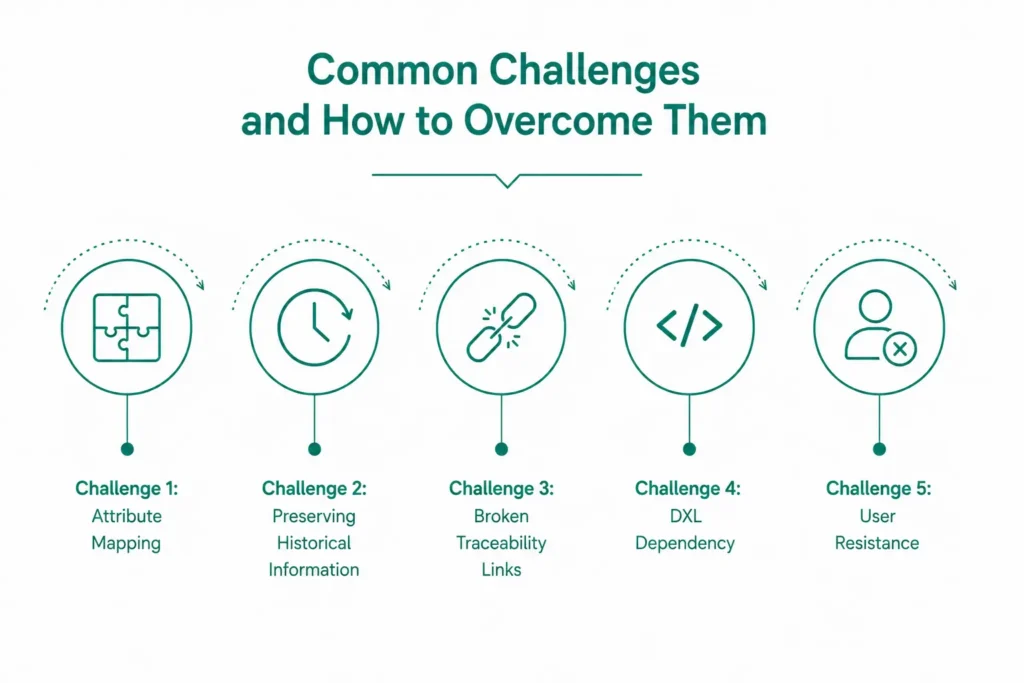
Every migration project presents unique challenges. Understanding these obstacles in advance helps organizations reduce risk and ensure a smoother transition.
Challenge 1: Attribute Mapping
One of the most common migration issues involves inconsistent attribute definitions between Classic DOORS and DOORS Next.
Problems may include:
- Different attribute types
- Missing mandatory fields
- Duplicate custom attributes
- Inconsistent naming conventions
How to overcome it
Develop a detailed attribute mapping document before migration and validate mappings using pilot projects before migrating production data.
Challenge 2: Preserving Historical Information
Although requirements and traceability can be migrated successfully, organizations often need continued access to historical audit information, archived baselines, and legacy reports.
How to overcome it
Maintain archived DOORS environments where necessary or export historical information before migration for future reference and compliance purposes.
Challenge 3: Broken Traceability Links
Requirements frequently contain links to:
- Other requirements
- Test cases
- Change requests
- Design artifacts
- External engineering tools
Improper migration sequencing can break these relationships.
How to overcome it
Migrate interdependent modules together whenever possible and perform comprehensive link validation after migration.
Maintaining traceability is one of the primary reasons organizations invest in IBM Engineering Lifecycle Management, making link validation a critical migration activity.
Challenge 4: DXL Dependency
Many organizations have invested years developing custom DXL scripts for reporting, validation, automation, and workflow customization.
Since DOORS Next no longer supports DXL, organizations must redesign these capabilities using modern technologies.
How to overcome it
Replace DXL functionality with:
- REST APIs
- JavaScript extensions
- OSLC integrations
- Jazz Reporting Service (JRS)
- External reporting platforms
If your organization depends heavily on custom reports, our article Why IBM ELM Reporting Still Requires an Expert explains how modern reporting strategies can improve visibility and decision-making after migration.
Challenge 5: User Resistance
Technology is only one part of a successful migration. People and processes play an equally important role.
Engineering teams accustomed to Classic DOORS may initially resist new workflows and user interfaces.
How to overcome it
- Involve users early in the migration project.
- Demonstrate the benefits of DOORS Next.
- Provide structured training.
- Encourage pilot projects.
- Collect feedback throughout the rollout.
Organizations partnering with an experienced IBM ELM partner India often benefit from comprehensive change management programs that improve user adoption and long-term success.
Future-Proofing Your Requirements Engineering Practice
Migrating to DOORS Next is more than replacing a legacy tool—it is an opportunity to transform your entire engineering ecosystem.
Organizations should use this transition to establish a modern engineering foundation that supports continuous innovation and long-term scalability.
Key initiatives include:
Adopt Agile and Continuous Engineering
DOORS Next supports iterative development, making it easier to align requirements management with Agile and DevOps methodologies.
Leverage AI and Automation
Modern engineering teams increasingly use AI-powered capabilities to improve:
- Requirement quality analysis
- Duplicate detection
- Traceability validation
- Impact analysis
- Engineering reviews
Build a Connected Engineering Platform
Create a Digital Thread by integrating requirements with:
- Systems engineering
- Software development
- Test management
- Change management
- Release management
This improves collaboration while enabling end-to-end engineering visibility.
Enable Cloud Readiness
Cloud and hybrid deployments provide:
- Improved scalability
- Better collaboration
- Simplified infrastructure management
- Enhanced disaster recovery
- Faster platform updates
Organizations working with an experienced IBM Platinum Partner, IBM ELM solution provider, or IBM ELM partner can accelerate modernization while ensuring their engineering platform remains ready for future technologies and evolving business requirements.
IBM Engineering Lifecycle Management Training
Migrating from DOORS to DOORS Next is only the first step in modernizing your engineering environment. To maximize the long-term value of your investment, organizations need ongoing platform management, user enablement, and continuous optimization. This is where IBM Engineering Lifecycle Management training play a critical role.
Many organizations lack the internal resources to administer, maintain, upgrade, and optimize their IBM ELM environment while simultaneously supporting engineering teams. Partnering with an experienced IBM ELM solution provider allows businesses to focus on product innovation while ensuring their engineering platform remains secure, scalable, and high-performing.
Benefits of Engineering Lifecycle Management Managed Services
Professional engineering lifecycle management managed services help organizations maintain a reliable and efficient IBM ELM environment through proactive administration and continuous support. These services typically include:
- IBM ELM platform administration and monitoring
- Performance tuning and health assessments
- Version upgrades and patch management
- Backup and disaster recovery planning
- License and user management
- Toolchain integration support
- Configuration management and governance
- Ongoing technical support and issue resolution
Managed services reduce operational overhead, improve platform availability, and ensure that engineering teams can work without interruptions.
Importance of IBM Engineering Lifecycle Management Training
Technology adoption is most successful when users understand how to use the platform effectively. Comprehensive IBM Engineering Lifecycle Management training equips engineers, project managers, business analysts, and administrators with the knowledge needed to maximize the capabilities of IBM ELM.
Training programs typically cover:
- DOORS Next requirements management
- Engineering Workflow Management (EWM)
- Engineering Test Management (ETM)
- Global Configuration Management
- Requirements traceability and reporting
- OSLC integrations
- Best practices for collaborative engineering
- Administration and platform management
Well-trained teams adopt new processes faster, improve collaboration, reduce user errors, and achieve greater returns from their IBM ELM investment.
As a trusted IBM Platinum Partner, IBM ELM partner India, and provider of IBM ELM consulting services, MicroGenesis offers end-to-end engineering lifecycle management services, including IBM ELM implementation, managed services, platform optimization, and customized IBM Engineering Lifecycle Management training to help organizations build a connected, future-ready engineering ecosystem.
Why Choose an IBM ELM Partner for DOORS Next Migration?
Migrating from IBM DOORS to DOORS Next is a strategic transformation that impacts your requirements management processes, engineering workflows, integrations, and compliance initiatives. While organizations can perform migrations internally, partnering with an experienced IBM ELM partner significantly reduces project risks and accelerates the transition.
An experienced IBM ELM partner India brings proven methodologies, certified IBM specialists, and deep expertise in IBM Engineering Lifecycle Management, helping organizations migrate successfully while aligning their engineering environment with industry best practices.
What Does an IBM ELM Partner Do?
A qualified IBM ELM solution provider supports organizations throughout the entire migration and modernization journey by offering:
- Migration assessment and planning
- IBM ELM implementation and deployment
- Requirements migration from Classic DOORS to DOORS Next
- Toolchain integration using OSLC
- Engineering workflow optimization
- Data migration validation and testing
- Performance tuning and platform optimization
- Ongoing engineering lifecycle management managed services
- IBM Engineering Lifecycle Management training and user enablement
These services help organizations modernize their engineering processes while minimizing disruption to ongoing development programs.
Benefits of Working with an IBM Platinum Partner
Choosing an IBM Platinum Partner provides access to certified expertise and direct collaboration with IBM technologies. Organizations benefit from:
- Proven implementation frameworks
- Certified IBM consultants and solution architects
- Faster deployment and migration timelines
- Reduced implementation risks
- Best practices for governance and compliance
- Long-term technical support and platform optimization
- Access to the latest IBM ELM capabilities and product updates
Whether you’re migrating a single project or transforming enterprise-wide engineering processes, an experienced partner ensures that your investment in IBM Engineering Lifecycle Management delivers measurable business value.
MicroGenesis is a trusted IBM ELM reporting helping organizations successfully implement, integrate, optimize, and support IBM Engineering Lifecycle Management solutions across automotive, aerospace, medical devices, industrial equipment, electronics, and other engineering-intensive industries.
Conclusion: Why MicroGenesis Is Your Ideal Migration Partner
Migrating from DOORS to DOORS Next is more than a technical upgrade—it is a strategic investment in modern IBM Engineering Lifecycle Management. A successful migration requires careful planning, robust governance, seamless integrations, and expert guidance to minimize risk and maximize long-term value.
As a trusted IBM Platinum Partner, IBM ELM partner India, and leading provider of IBM ELM consulting services, MicroGenesis helps organizations modernize their requirements engineering practices through proven migration methodologies and end-to-end engineering lifecycle management services.
Our expertise includes:
- DOORS to DOORS Next migration planning and execution
- IBM ELM implementation and platform modernization
- Engineering toolchain integration using OSLC
- Requirements management consulting
- Post-migration optimization and IBM ELM managed services
- Training, governance, and long-term platform support
Whether you’re planning a pilot migration or an enterprise-wide transformation, MicroGenesis provides the technical expertise, industry experience, and implementation best practices needed to ensure a successful transition to DOORS Next and a future-ready engineering ecosystem.