

Engineering organizations today are developing products that are far more sophisticated than ever before. From Software-Defined Vehicles (SDVs) and autonomous mobility platforms to connected medical devices, aerospace systems, industrial automation, and smart manufacturing solutions, modern products combine mechanical engineering, electronics, embedded software, cloud connectivity, artificial intelligence, and cybersecurity. Managing these multidisciplinary products requires engineering teams to collaborate efficiently while maintaining quality, compliance, and complete lifecycle visibility.
To support this growing complexity, organizations are increasingly adopting Engineering Lifecycle Management (ELM) and Model-Based Systems Engineering (MBSE). Although these terms are often discussed together, they are not the same. Each serves a unique purpose within the engineering ecosystem, and understanding the distinction helps organizations build more efficient and connected engineering processes.
Engineering Lifecycle Management is a comprehensive framework for managing engineering activities throughout the product development lifecycle. It connects requirements, systems engineering, software development, testing, verification, validation, change management, and compliance into a unified engineering environment.
Model-Based Systems Engineering is a systems engineering methodology that uses digital models instead of traditional document-based approaches to define, analyze, design, and validate complex systems. These models provide engineers with a shared understanding of system architecture, behavior, interfaces, and interactions before implementation begins.
Rather than competing approaches, ELM and MBSE complement each other. MBSE strengthens systems engineering by improving how systems are designed and analyzed, while ELM manages the complete engineering lifecycle by connecting models with requirements, software development, testing, engineering workflows, and compliance activities.
Organizations beginning their digital engineering transformation often start by understanding the broader lifecycle framework before implementing advanced modeling practices. Our Engineering Lifecycle Management Guide explains how Engineering Lifecycle Management helps organizations establish connected engineering processes, improve collaboration, and build a scalable Digital Thread across the product lifecycle.
In this article, we’ll explain the differences between Engineering Lifecycle Management and Model-Based Systems Engineering, explore where each fits within the engineering lifecycle, examine how they complement one another, and discuss why organizations developing complex products increasingly implement both.
Why Engineering Organizations Are Moving Toward Model-Based Development
For many years, engineering teams relied on documents, spreadsheets, presentations, and manually maintained specifications to communicate product requirements and system designs. While these methods were sufficient for relatively simple products, they become increasingly difficult to manage as products evolve into highly connected systems that combine hardware, embedded software, electronics, cloud services, and intelligent automation.
Traditional document-based engineering often creates several challenges:
- Multiple versions of requirements and design documents
- Inconsistent information across engineering teams
- Time-consuming document reviews
- Manual updates during design changes
- Limited collaboration between disciplines
- Weak traceability between engineering artifacts
- Difficulty assessing the impact of engineering changes
Model-Based Systems Engineering addresses many of these challenges by replacing static documentation with structured digital models that represent system behavior, architecture, interfaces, and interactions. These models improve collaboration, provide better visibility into complex systems, and help engineering teams identify design issues earlier in the development process.
However, MBSE focuses specifically on system modeling. It does not manage the complete engineering lifecycle. Organizations still need a framework to manage requirements, engineering workflows, software development, testing, verification, validation, compliance, and engineering changes. This is where Engineering Lifecycle Management delivers additional value by connecting every engineering activity within a unified lifecycle.
What Is Engineering Lifecycle Management (ELM)?
Engineering Lifecycle Management (ELM) is a structured approach for managing engineering activities, engineering teams, engineering data, and development processes throughout the complete product lifecycle.
If you’re new to Engineering Lifecycle Management, our What Is Engineering Lifecycle Management? guide explains its core concepts, key components, and how it helps organizations manage complex engineering projects with better collaboration and traceability.
Instead of treating requirements management, software development, testing, verification, and compliance as separate activities, ELM establishes a connected engineering environment where every engineering artifact remains linked from concept through deployment, maintenance, and continuous improvement.
A modern Engineering Lifecycle Management platform typically supports:
- Requirements Management
- Systems Engineering
- Model-Based Systems Engineering integration
- Embedded Software Development
- Software Development
- Test Management
- Verification and Validation
- Engineering Workflow Management
- Configuration Management
- Change Management
- Compliance Management
- Release Management
One of the defining capabilities of Engineering Lifecycle Management is end-to-end traceability. Requirements can be connected directly to architecture models, engineering work items, software components, test cases, defects, and releases. This enables engineering teams to understand how changes affect downstream activities, improve decision-making, and simplify regulatory compliance.
To learn more about the key disciplines that make up an Engineering Lifecycle Management environment, read Exploring the Core Components of Engineering Lifecycle Management, which explains how organizations create connected engineering ecosystems across multidisciplinary development teams.
Why Organizations Invest in Engineering Lifecycle Management
Engineering Lifecycle Management helps organizations:
- Improve collaboration across multidisciplinary engineering teams
- Maintain complete engineering traceability
- Accelerate engineering change management
- Improve product quality
- Reduce engineering risks
- Strengthen compliance with industry regulations
- Increase visibility across engineering projects
- Support continuous engineering for connected products
Engineering Lifecycle Management is particularly valuable for organizations developing safety-critical and software-intensive products that must comply with standards such as ASPICE, ISO 26262, IEC 62304, DO-178C, and ISO/SAE 21434.
What Is Model-Based Systems Engineering (MBSE)?
Model-Based Systems Engineering (MBSE) is a systems engineering methodology that uses digital models as the primary method for defining, analyzing, designing, and validating complex systems.
Instead of relying on disconnected documents, spreadsheets, and presentation files, MBSE creates standardized models that represent system architecture, functional behavior, interfaces, operational scenarios, and relationships between system components. These models provide a common engineering language that improves communication across multidisciplinary teams and reduces ambiguity during product development.
Typical MBSE activities include:
- System architecture modeling
- Functional decomposition
- Behavioral modeling
- Interface definition
- Requirements allocation
- Design simulation
- System validation
- Impact analysis
Some of the most widely used MBSE tools include:
- IBM Rhapsody
- Cameo Systems Modeler
- Enterprise Architect
- MATLAB/Simulink
- SysML-based modeling platforms
Organizations implementing MBSE often integrate modeling tools with their Engineering Lifecycle Management platform to maintain traceability between requirements, architecture models, software implementation, testing, and verification activities.
For engineering teams adopting IBM Rhapsody, Comprehensive Guide to Rhapsody Model Manager explains how architecture models can be managed collaboratively while maintaining complete lifecycle traceability across engineering projects.
Why Modern Engineering Needs More Than Documents
For decades, engineering teams relied on documents, spreadsheets, presentations, and static diagrams to define system requirements and communicate design decisions. While this approach worked for less complex products, it becomes difficult to manage when multiple engineering disciplines work simultaneously on large, software-intensive systems.
Modern products contain thousands of interconnected components, and even a small change in one subsystem can affect software, electronics, mechanical assemblies, testing activities, and regulatory documentation. Managing these dependencies through documents alone often leads to inconsistencies, duplicated effort, and delayed decision-making.
Common challenges associated with document-based engineering include:
- Inconsistent information across engineering teams
- Duplicate documentation and version conflicts
- Limited collaboration between disciplines
- Manual change management
- Weak lifecycle traceability
- Time-consuming engineering reviews
- Difficulty understanding the impact of engineering changes
Model-Based Systems Engineering addresses these issues by using digital models as the primary engineering artifact. These models provide a structured representation of the system and help engineers validate designs before implementation begins.
However, models alone cannot manage the complete engineering lifecycle. Organizations also need a framework that connects requirements, models, software development, testing, verification, compliance, and engineering workflows. Engineering Lifecycle Management provides this broader lifecycle capability, ensuring that engineering activities remain connected from concept through product release and ongoing maintenance.
ELM vs MBSE: Key Differences
Although Engineering Lifecycle Management and Model-Based Systems Engineering are closely related, they solve different engineering challenges. MBSE focuses on designing and analyzing complex systems through digital models, whereas ELM governs the complete engineering lifecycle surrounding those models.
The simplest way to understand the difference is to think of MBSE as a specialized engineering methodology and ELM as the framework that manages the entire engineering process.
| Feature | Engineering Lifecycle Management (ELM) | Model-Based Systems Engineering (MBSE) |
|---|---|---|
| Primary Focus | Managing the complete engineering lifecycle | Designing and modeling complex systems |
| Scope | Requirements through maintenance | Systems engineering methodology |
| Requirements Management | Comprehensive lifecycle management | Supports requirements allocation |
| Systems Architecture | Supports architecture development | Core capability |
| Software Development | Managed within lifecycle | Supports implementation through models |
| Test Management | Complete test lifecycle | Supports model validation |
| Compliance Management | Full lifecycle governance | Supports compliance through models |
| Engineering Traceability | End-to-end traceability | Partial traceability |
| Change Management | Comprehensive engineering change management | Model updates and design refinement |
| Primary Output | Connected engineering lifecycle | System models and architecture |
The most important distinction is that MBSE helps engineers understand and design the system, while ELM ensures that every engineering activity related to that system remains connected, governed, and traceable throughout the lifecycle.
Engineering Lifecycle Management is also frequently compared with Application Lifecycle Management (ALM). While MBSE focuses on system modeling and ELM governs the engineering lifecycle, ALM is designed to manage software development activities. Explore our ELM vs ALM comparison to understand how these approaches differ.
How ELM and MBSE Fit into the Engineering Lifecycle
Rather than replacing one another, MBSE operates as an important capability within a broader Engineering Lifecycle Management strategy. Together, they create a connected engineering environment where models, requirements, software, testing, and compliance remain synchronized throughout product development.
A simplified engineering workflow typically follows this sequence:
Customer Requirements
↓
Requirements Management (ELM)
↓
System Modeling (MBSE)
↓
System Architecture and Design
↓
Software and Hardware Development (ELM)
↓
Testing and Verification (ELM)
↓
Compliance and Engineering Traceability (ELM)
↓
Deployment, Maintenance, and Continuous Engineering
Within this workflow:
- Engineering Lifecycle Management manages engineering processes, collaboration, governance, testing, and compliance.
- Model-Based Systems Engineering creates the system models that guide engineering decisions and validate system behavior before implementation.
- Together, they establish a Digital Thread that connects every engineering artifact across the product lifecycle.
Organizations implementing modern requirements engineering often strengthen this workflow by adopting Digital Requirements Management, enabling engineering teams to maintain accurate, version-controlled requirements that remain linked to models, software, and verification activities throughout development.
Where MBSE Adds the Most Value
Model-Based Systems Engineering delivers the greatest value during the early phases of product development, where design decisions have the highest impact on cost, quality, and project timelines.
By replacing static documentation with structured digital models, MBSE enables engineering teams to evaluate system behavior before physical implementation, reducing costly design iterations later in the project.
Key areas where MBSE provides significant value include:
System Architecture Design
Engineers can visualize complex systems, understand relationships between subsystems, and evaluate different architectural approaches before development begins.
Functional and Behavioral Modeling
Digital models represent how systems respond under different operating conditions, helping teams identify potential design issues early.
Interface Definition
MBSE clearly defines communication between hardware, software, sensors, controllers, and external systems, reducing integration challenges during implementation.
Early Design Validation
Simulation allows engineering teams to verify design assumptions before committing to development, lowering engineering risk and improving product quality.
Cross-Disciplinary Collaboration
Mechanical, electrical, software, and systems engineers work from the same set of models, creating a common engineering language that improves communication and decision-making.
Organizations using IBM Rhapsody for Model-Based Systems Engineering can further enhance collaboration by integrating models into their engineering lifecycle. Learn more in our guide on Rhapsody Model Manager, which explains how collaborative model management improves engineering traceability and lifecycle governance.
Where Engineering Lifecycle Management Adds the Most Value
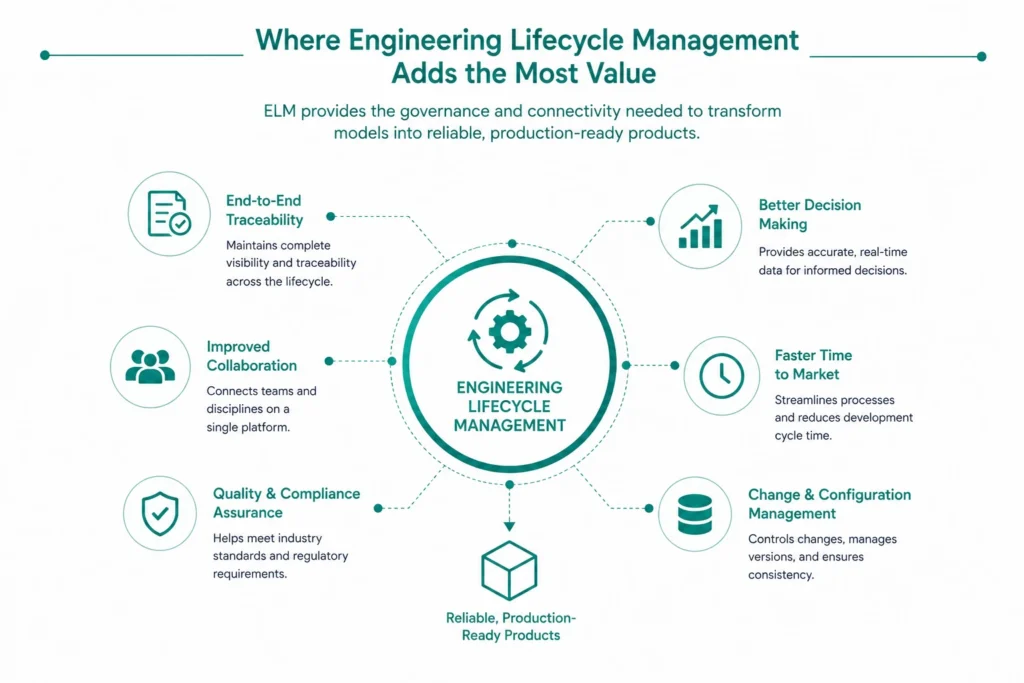
While Model-Based Systems Engineering focuses on creating and validating system models, Engineering Lifecycle Management provides the governance and connectivity needed to transform those models into reliable, production-ready products. It manages the complete engineering lifecycle by ensuring that every activity, from requirements definition to product release, remains connected and traceable.
Engineering Lifecycle Management adds value across several critical areas of product development.
End-to-End Requirements Traceability
One of the biggest strengths of ELM is its ability to establish traceability across the engineering lifecycle. Requirements are linked to system models, engineering work items, software components, test cases, defects, and releases. This enables teams to quickly assess the impact of changes and verify that every requirement has been implemented and validated.
Organizations looking to modernize requirements management can benefit from Requirements Management with IBM DOORS Next, which demonstrates how collaborative requirements management improves engineering visibility and lifecycle traceability.
Engineering Governance
ELM standardizes engineering processes by introducing consistent workflows, approvals, version control, and audit trails. This ensures that engineering activities follow defined processes and that every change is documented throughout the lifecycle.
Compliance Management
Engineering organizations working in regulated industries must demonstrate compliance with standards such as:
- ASPICE
- ISO 26262
- IEC 62304
- DO-178C
- ISO/SAE 21434
ELM helps organizations maintain the evidence required for audits by connecting requirements, design artifacts, verification activities, and test results within a single engineering environment.
Change and Configuration Management
Engineering changes can affect multiple teams and engineering artifacts. ELM simplifies change management by providing complete visibility into dependencies, allowing teams to evaluate the downstream impact of changes before implementation.
Collaboration Across Engineering Teams
Modern product development requires collaboration between systems engineers, software developers, quality engineers, test teams, and compliance specialists. ELM provides a centralized platform where stakeholders can access consistent engineering information, reducing communication gaps and improving project coordination.
ELM vs MBSE Across the Product Lifecycle
Engineering Lifecycle Management and Model-Based Systems Engineering contribute to different phases of the engineering lifecycle. Rather than performing the same tasks, they support complementary activities that together enable efficient product development.
Requirements Definition
Engineering Lifecycle Management
- Captures and manages business, stakeholder, and system requirements
- Maintains version control and approvals
- Establishes traceability across engineering artifacts
Model-Based Systems Engineering
- Allocates requirements to system models
- Defines relationships between system functions and components
- Supports requirements analysis
System Design
Engineering Lifecycle Management
- Tracks engineering tasks and workflows
- Manages reviews and approvals
- Maintains lifecycle governance
Model-Based Systems Engineering
- Develops system architecture
- Creates behavioral and functional models
- Defines interfaces between subsystems
Development
Engineering Lifecycle Management
- Manages software development
- Coordinates engineering work items
- Supports configuration management
- Tracks engineering progress
Model-Based Systems Engineering
- Provides design guidance for implementation
- Ensures software and hardware development align with validated system models
Verification and Validation
Engineering Lifecycle Management
- Manages test planning and execution
- Tracks defects
- Maintains compliance evidence
- Verifies requirement coverage
Model-Based Systems Engineering
- Validates system behavior through simulation
- Confirms architecture before implementation
- Identifies design issues early in the development cycle
Change Management
Engineering Lifecycle Management
- Tracks engineering changes
- Performs impact analysis
- Maintains complete lifecycle traceability
Model-Based Systems Engineering
- Updates system models to reflect approved engineering changes
- Keeps architecture aligned with evolving product requirements
This complementary relationship enables organizations to maintain consistency from initial requirements through deployment while reducing engineering risks and improving collaboration.
Benefits of Using ELM and MBSE Together
Organizations that integrate Engineering Lifecycle Management with Model-Based Systems Engineering gain a more connected engineering environment that improves both technical execution and project governance. Instead of treating system models as isolated design artifacts, they become an integral part of the engineering lifecycle.
Some of the key benefits include:
Better Engineering Collaboration
Requirements, architecture models, software development, testing, and verification remain connected, enabling multidisciplinary teams to work from consistent engineering information.
Improved Lifecycle Traceability
Engineering artifacts remain linked throughout development, making it easier to understand the relationship between requirements, models, implementation, and validation activities.
Faster Design Validation
MBSE enables engineers to validate system behavior through simulation, while ELM ensures those validation activities remain connected to requirements, testing, and compliance records.
Reduced Engineering Risk
Early design validation combined with structured lifecycle management helps identify issues sooner, reducing costly rework and improving project predictability.
Stronger Regulatory Compliance
Integrated engineering data simplifies audits by providing complete traceability between requirements, models, software implementation, testing, and verification evidence.
Foundation for a Digital Thread
When ELM and MBSE are integrated, engineering models become part of a connected Digital Thread rather than standalone design files. This enables organizations to improve visibility, collaboration, and decision-making across the entire engineering lifecycle.
While ELM integrates closely with MBSE during engineering, it also works alongside Product Lifecycle Management (PLM) to connect engineering activities with manufacturing, product data, and service operations. Learn more about how these two approaches complement each other in our ELM vs PLM guide.
Organizations implementing Engineering Lifecycle Management platforms often strengthen these capabilities by following proven IBM ELM implementation best practices, helping establish scalable engineering processes and improve lifecycle governance from the outset.c
Industries That Benefit from Engineering Lifecycle Management and Model-Based Systems Engineering
As products become more intelligent and software-driven, Engineering Lifecycle Management and Model-Based Systems Engineering have become essential across industries where product complexity, safety, and regulatory compliance are critical. Organizations developing multidisciplinary systems benefit from combining model-based design with structured lifecycle management to improve collaboration and maintain engineering traceability.
Some of the industries that gain the greatest value include:
Automotive
Modern vehicles combine mechanical systems with embedded software, advanced driver assistance systems (ADAS), connectivity, and autonomous technologies. Engineering teams use MBSE to model vehicle architectures and validate system behavior, while ELM manages requirements, software development, testing, compliance, and engineering changes throughout the vehicle lifecycle.
Organizations developing next-generation mobility solutions can explore Addressing Complexity in Electric Vehicle (EV) System Design and Development Using IBM ELM to understand how connected engineering practices help manage software-defined vehicles and complex automotive systems.
Aerospace and Defense
Aircraft, satellites, and defense platforms require rigorous systems engineering, complete lifecycle traceability, and compliance with strict industry regulations. MBSE helps engineers model complex system interactions, while ELM provides governance across requirements, verification, validation, and certification activities.
Medical Devices
Medical device manufacturers must demonstrate complete traceability from customer requirements through product validation. Combining MBSE and ELM enables engineering teams to improve design quality, simplify regulatory audits, and accelerate product development while meeting standards such as IEC 62304.
Rail and Transportation
Rail signaling, transportation infrastructure, and intelligent mobility systems involve numerous interconnected subsystems. Model-based design improves system planning and validation, while lifecycle management ensures engineering consistency throughout long product lifecycles.
Industrial Automation and Robotics
Industrial automation solutions integrate sensors, controllers, embedded software, communication protocols, and intelligent manufacturing systems. Engineering organizations use MBSE to model system interactions and ELM to manage engineering execution, testing, and product evolution.
Semiconductor and High-Tech Electronics
Semiconductor and electronics companies manage increasingly sophisticated hardware and software platforms. Engineering Lifecycle Management helps coordinate multidisciplinary development teams, while MBSE supports system architecture and interface modeling during early design phases.
Common Tools Used for ELM and MBSE
Selecting the right engineering platform is an important step in building a connected engineering environment. While ELM and MBSE address different aspects of product development, they are often implemented using integrated toolchains that enable seamless collaboration across engineering disciplines.
Popular Engineering Lifecycle Management Platforms
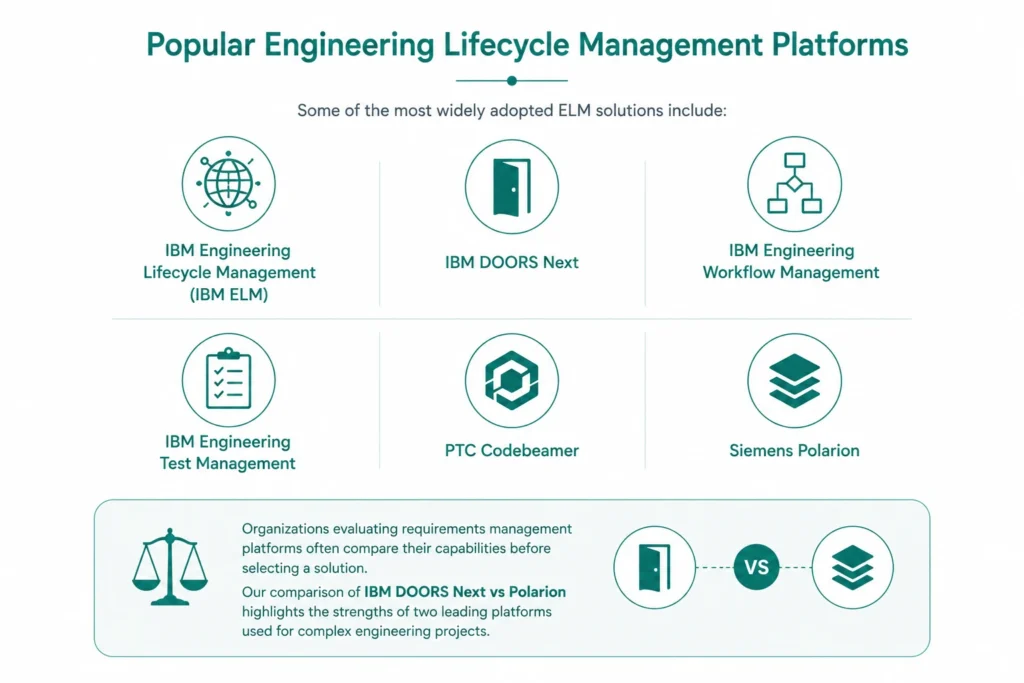
Some of the most widely adopted ELM solutions include:
- IBM Engineering Lifecycle Management (IBM ELM)
- IBM DOORS Next
- IBM Engineering Workflow Management
- IBM Engineering Test Management
- PTC Codebeamer
- Siemens Polarion
Organizations evaluating requirements management platforms often compare their capabilities before selecting a solution. Our comparison of IBM DOORS Next vs Polarion highlights the strengths of two leading platforms used for complex engineering projects.
Popular Model-Based Systems Engineering Tools
Commonly used MBSE solutions include:
- IBM Rhapsody
- Cameo Systems Modeler
- Enterprise Architect
- MATLAB/Simulink
- SysML-based modeling platforms
Rather than using these tools independently, many organizations integrate them into a unified engineering ecosystem where requirements, architecture models, software development, testing, and engineering workflows remain connected.
Common Challenges Without ELM and MBSE Integration
Organizations that implement MBSE without a supporting Engineering Lifecycle Management framework often struggle to extend the value of system models across the complete product lifecycle. Similarly, organizations that rely only on ELM without adopting model-based engineering may find it difficult to manage increasingly complex system architectures.
Some common challenges include:
Models Disconnected from Requirements
When architecture models are not linked to engineering requirements, maintaining consistency between system design and implementation becomes difficult. Changes made to requirements may not be reflected in system models, increasing the risk of design inconsistencies.
Limited Lifecycle Traceability
Without integration, engineering teams cannot easily trace relationships between requirements, models, software components, test cases, and releases. This limits visibility and makes impact analysis more time-consuming.
Manual Documentation
Engineering teams often spend significant time manually updating documents to reflect changes made in system models or engineering workflows. This effort increases the possibility of errors and slows development.
Weak Change Management
Engineering changes frequently require updates across requirements, models, software, and testing activities. Without an integrated lifecycle, coordinating these changes becomes more complex and increases the likelihood of inconsistencies.
Compliance Gaps
Organizations working in regulated industries must demonstrate complete traceability throughout the engineering lifecycle. Disconnected engineering artifacts make it more difficult to produce audit evidence and verify compliance with industry standards.
By integrating MBSE with ELM, organizations establish a connected engineering environment where requirements, models, software development, testing, and compliance activities remain synchronized throughout the product lifecycle.
How MicroGenesis Helps
MicroGenesis helps engineering organizations successfully integrate Engineering Lifecycle Management and Model-Based Systems Engineering to build connected engineering ecosystems that improve collaboration, strengthen traceability, and accelerate innovation.
Our expertise includes:
- Engineering Lifecycle Management consulting and implementation
- IBM Engineering Lifecycle Management (IBM ELM)
- IBM DOORS Next
- IBM Rhapsody implementation
- Model-Based Systems Engineering consulting
- Engineering Toolchain Integration
- Digital Thread implementation
- Engineering Traceability
- Embedded DevOps
- Automotive Process Consulting
With more than 25 years of engineering transformation experience, MicroGenesis works with organizations across automotive, aerospace, medical devices, industrial automation, electronics, and other engineering-intensive industries to modernize engineering processes and improve product development outcomes.
Whether your organization is beginning its MBSE journey or expanding an existing Engineering Lifecycle Management environment, our consultants help design scalable engineering practices that support collaboration, compliance, and continuous innovation.
Frequently Asked Questions
What is the difference between Engineering Lifecycle Management and Model-Based Systems Engineering?
Engineering Lifecycle Management is a framework for managing engineering activities across the complete product lifecycle. Model-Based Systems Engineering is a methodology that uses digital models to define, analyze, design, and validate complex systems. MBSE supports systems engineering, while ELM manages the broader engineering lifecycle.
Can MBSE replace Engineering Lifecycle Management?
No. MBSE focuses on system modeling and design activities. It does not manage requirements, software development, testing, engineering workflows, or compliance throughout the lifecycle. MBSE delivers the greatest value when implemented within an Engineering Lifecycle Management environment.
Why are ELM and MBSE implemented together?
MBSE improves system design by creating structured digital models, while ELM connects those models with requirements, engineering workflows, software development, testing, and compliance. Together, they establish end-to-end engineering traceability and improve collaboration across multidisciplinary teams.
Which industries benefit the most from ELM and MBSE?
Automotive, aerospace, defense, medical devices, rail, industrial automation, robotics, semiconductor, and electronics industries commonly implement both approaches because they develop complex products that require structured systems engineering and comprehensive lifecycle management.
Conclusion
Engineering Lifecycle Management and Model-Based Systems Engineering are complementary disciplines that address different aspects of modern engineering. MBSE enables engineering teams to design, analyze, and validate complex systems using digital models, while ELM manages the complete engineering lifecycle by connecting requirements, models, software development, testing, verification, change management, and compliance.
As organizations continue to develop software-defined and highly connected products, integrating ELM and MBSE has become essential for improving collaboration, reducing engineering risks, and maintaining complete lifecycle traceability. Together, they provide the foundation for a connected Digital Thread that enables engineering teams to deliver innovative, high-quality products with greater confidence and efficiency.