
Embedded software development is becoming increasingly complex. Modern products such as Software Defined Vehicles, medical devices, industrial automation systems, aerospace platforms, and connected IoT products depend on large and continuously evolving software stacks.
As software becomes a larger part of the product, engineering teams need to build, integrate, test, validate, and release software more frequently. Traditional embedded development processes, which often depend on manual integration, long release cycles, hardware availability, and late-stage testing, can make this difficult.
This is why organizations are adopting Embedded CI/CD and Embedded DevOps practices.
Unlike conventional CI/CD for cloud and web applications, embedded CI/CD must account for cross-compilation, firmware, hardware dependencies, real-time operating systems, simulation, Hardware-in-the-Loop testing, safety requirements, and engineering traceability.
This guide explains CI/CD for embedded systems, how an embedded CI/CD pipeline works, its key stages, challenges, best practices, tools, and how organizations can implement scalable Embedded DevOps practices.
What Is CI/CD for Embedded Systems?
CI/CD for embedded systems is an engineering approach that automates software integration, building, testing, validation, packaging, and release activities for firmware and embedded software while accounting for hardware, toolchain, and compliance requirements.
The objective is to create a repeatable development pipeline that gives engineers rapid feedback whenever software changes are introduced.
Continuous Integration
Continuous Integration focuses on frequently integrating code changes into a shared source repository.
A typical CI process can automatically trigger:
- Source code validation
- Automated builds
- Static code analysis
- Unit testing
- Integration testing
- Build verification
The earlier a defect is detected, the easier it is generally to investigate and correct.
Continuous Delivery
Continuous Delivery extends CI by automating the activities required to prepare validated software for release.
For embedded products, this can include:
- Firmware packaging
- Artifact management
- Release validation
- Approval workflows
- Release documentation
- Deployment preparation
- OTA package generation
Because embedded software may control physical devices or safety-critical functions, deployment can require additional validation and approval before software reaches production.
For organizations moving toward a broader Embedded DevOps approach, CI/CD becomes an important part of connecting development, testing, operations, and engineering governance.
Why Do Embedded Systems Need CI/CD?
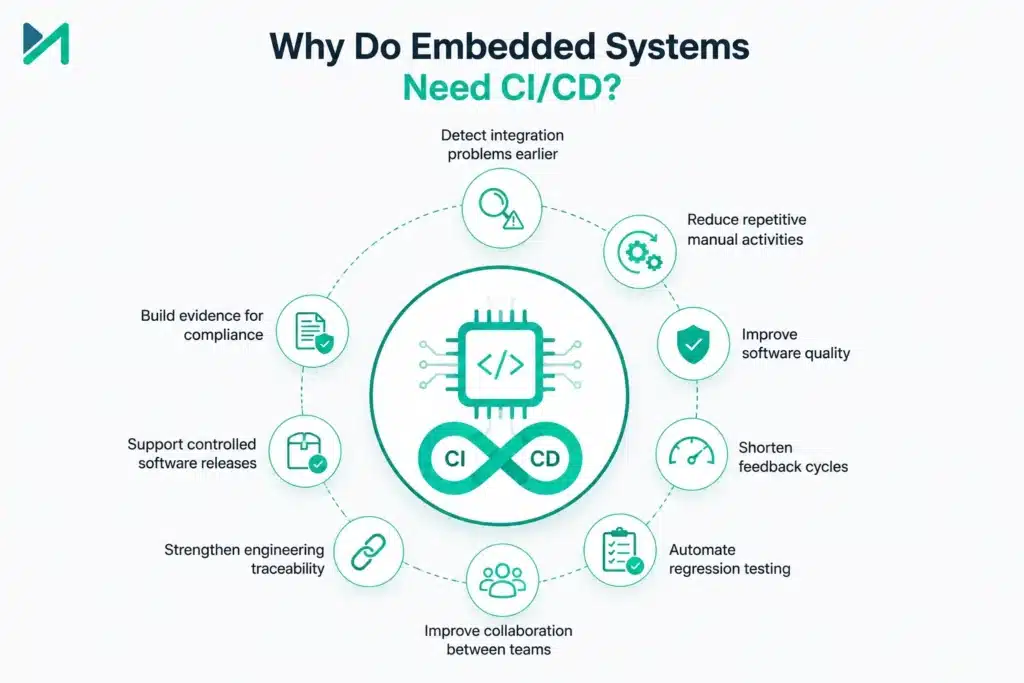
Embedded software has evolved from relatively isolated firmware into complex software ecosystems.
A modern automotive ECU, for example, may include AUTOSAR software, middleware, device drivers, application software, bootloaders, security mechanisms, and safety-related functionality.
Managing these components manually can create integration delays and increase the risk of defects.
A well-designed embedded CI/CD pipeline can help engineering teams:
- Detect integration problems earlier
- Reduce repetitive manual activities
- Improve software quality
- Shorten feedback cycles
- Automate regression testing
- Improve collaboration between engineering teams
- Strengthen engineering traceability
- Support controlled software releases
- Build evidence for applicable compliance processes
The business value is not simply faster builds. The objective is to create a more predictable and measurable software engineering process.
💡
Embedded CI/CD vs Traditional CI/CD
The principles of CI/CD remain similar across software environments, but embedded development introduces additional constraints.
| Traditional CI/CD | Embedded CI/CD |
|---|---|
| Cloud and web applications | Firmware and embedded software |
| Standard development environments | Cross-compilation environments |
| Virtualized execution | Physical hardware targets |
| API and application testing | Hardware and system testing |
| Containers and cloud infrastructure | Hardware-dependent toolchains |
| Automated application deployment | Firmware flashing and controlled OTA updates |
| Limited hardware dependency | Significant hardware dependency |
| Conventional test environments | Simulation and HIL environments |
This difference means an embedded CI/CD implementation requires more than simply installing a CI server.
The pipeline must account for the complete engineering environment, including source control, compilers, build systems, test frameworks, hardware, simulation platforms, artifact repositories, requirements, and compliance evidence.
How Does an Embedded CI/CD Pipeline Work?
A typical embedded CI/CD pipeline can follow this flow:
Developer Commit → Source Control → Static Analysis → Cross Compilation → Unit Testing → Build Generation → Integration Testing → Simulation → HIL Testing → System Validation → Firmware Packaging → Artifact Repository → Controlled Deployment
Each stage provides feedback before software progresses further through the development lifecycle.
The exact architecture varies according to the product, hardware platform, development methodology, safety requirements, and engineering toolchain.
Organizations designing a broader embedded toolchain can also benefit from understanding the architecture of an SDV toolchain, particularly when developing software-intensive automotive products.
Key Stages of an Embedded CI/CD Pipeline
1. Source Code Management
The pipeline begins with version-controlled source code.
Common platforms include:
- Git
- GitHub
- GitLab
- Bitbucket
Source control enables teams to manage branches, revisions, code reviews, and development history.
For embedded environments, source control should be connected to the wider engineering workflow so that code changes can be associated with requirements, tasks, defects, builds, and tests.
2. Automated Build
A code change can trigger an automated build process.
Depending on the embedded environment, the build may involve:
- Cross-compilation
- Dependency resolution
- Binary generation
- Linker validation
- Compiler warning analysis
- Firmware packaging
Automating builds reduces the inconsistencies that can occur when developers rely on manually configured environments.
3. Static Code Analysis
Static analysis evaluates source code without executing the software.
Embedded teams may use static analysis to identify:
- Coding standard violations
- Buffer-related issues
- Null pointer risks
- Memory-related defects
- Excessive complexity
- Potential software defects
Tools such as SonarQube, Coverity, Polyspace, and PC-lint can be incorporated into the development pipeline depending on the project’s requirements.
For regulated automotive programs, static analysis should be considered as part of a broader quality and process strategy rather than as an isolated activity.
4. Unit Testing
Unit testing validates individual software components independently.
Automated unit testing can help teams identify defects earlier and reduce regression risks.
Common frameworks include:
- Google Test
- CppUTest
- Unity Test Framework
Tests can be executed automatically as part of the CI pipeline whenever relevant code changes are committed.
5. Integration Testing
After individual components have been tested, integrated software must be validated.
Integration testing can verify:
- Component communication
- Interface compatibility
- Middleware interactions
- Driver integration
- Software dependencies
This stage becomes particularly important when multiple teams develop different parts of the embedded software stack.
6. Simulation Testing
Simulation allows engineering teams to validate software before all physical hardware is available.
Depending on the project, teams may simulate:
- Processors
- Sensors
- Networks
- Vehicle behavior
- Hardware interactions
Simulation can reduce dependency on scarce hardware and allow testing to begin earlier.
7. Hardware-in-the-Loop Testing
Hardware-in-the-Loop, commonly known as HIL, connects real hardware to a simulated environment.
HIL testing can be used to evaluate:
- ECU behavior
- Sensor interactions
- Fault conditions
- Safety functions
- Real-time performance
HIL is particularly relevant to automotive, aerospace, industrial automation, and other embedded engineering environments.
For Software Defined Vehicle programs, HIL can become an important part of validating software against realistic system behavior throughout the development lifecycle.
8. Continuous Validation
A mature embedded pipeline can automate multiple forms of validation, including:
- Functional testing
- Regression testing
- Performance testing
- Stress testing
- Safety testing
- Security testing
Automating these activities provides faster feedback and can improve release confidence.
9. Release Management
Once software has passed the required validation stages, release activities can begin.
These may include:
- Version tagging
- Firmware packaging
- Release notes
- Artifact signing
- Compliance documentation
- Approval workflows
- Deployment preparation
For products supporting OTA updates, release management must also account for secure and controlled deployment.
Embedded CI/CD for Software Defined Vehicles
Software Defined Vehicles are changing how automotive products are developed and maintained.
Instead of treating software as a fixed component delivered only when a vehicle is manufactured, SDV architectures enable software capabilities to evolve throughout the vehicle lifecycle.
This creates a need for more automated engineering and software delivery processes.
Embedded CI/CD can support SDV development through:
- Continuous software integration
- Automated testing
- Faster defect feedback
- Firmware validation
- OTA release preparation
- Software traceability
- Controlled deployment
- Continuous regression testing
To understand the broader product context, see our guide to Digital Engineering for Automotive.
You can also explore what a Software Defined Vehicle is and the SDV development lifecycle to understand why software delivery has become central to modern automotive engineering.
CI/CD and Engineering Traceability
Speed alone is not enough for embedded engineering.
Engineering organizations also need to know how a software change relates to the requirement, design element, build, test, verification result, and release.
A connected workflow can look like:
Requirement → Development Task → Source Code → Build → Test Case → Test Result → Release
This traceability can provide greater visibility into the impact of changes and help teams maintain engineering evidence.
It is particularly important when projects need to demonstrate alignment with processes or standards such as ASPICE and ISO 26262.
CI/CD and ASPICE
ASPICE introduces structured process expectations for automotive software and systems development.
Embedded CI/CD can support these processes by automating repeatable engineering activities and maintaining evidence from development and validation workflows.
Potential benefits include:
- Consistent software integration
- Automated build processes
- Configuration management support
- Automated testing
- Improved traceability
- Repeatable engineering workflows
- Better visibility into development evidence
Organizations beginning their automotive process improvement journey can first understand what ASPICE is and then evaluate their current capability through an ASPICE level assessment.
For teams planning implementation, an ASPICE implementation roadmap can help connect process improvement with practical engineering activities.
Common Embedded CI/CD Challenges
Implementing CI/CD in an embedded environment can be more complicated than implementing it for cloud-native applications.
Common challenges include:
Hardware Availability
Physical test hardware may be limited, expensive, or shared across multiple teams.
Legacy Toolchains
Older compilers, build systems, proprietary tools, and hardware interfaces can make automation difficult.
Long Build Times
Large embedded projects may require significant compilation and integration time, reducing developer feedback speed.
Manual Testing
Testing that depends heavily on physical hardware can remain difficult to automate.
Weak Traceability
Disconnected requirements, source repositories, test environments, and release systems can make engineering relationships difficult to maintain.
Toolchain Fragmentation
Engineering teams may use different platforms for requirements, modeling, development, testing, source control, and release management.
These challenges should be addressed through both technical automation and process modernization.
For organizations developing SDVs, our guide to SDV engineering challenges provides additional context on the complexity of software-intensive automotive development.
Best Practices for Embedded CI/CD
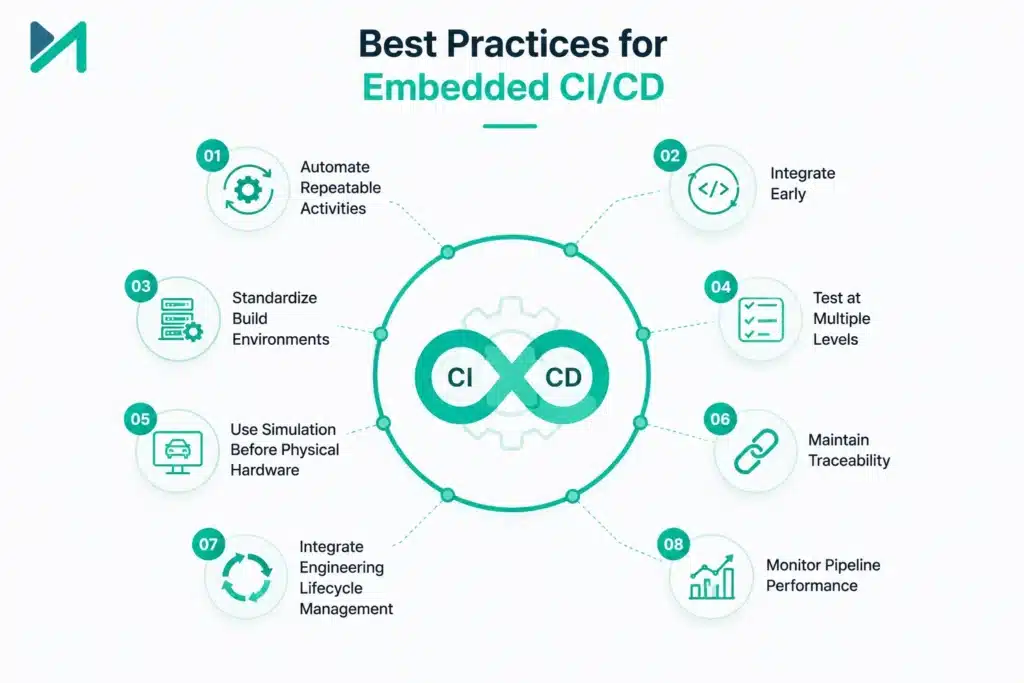
A successful embedded CI/CD implementation should be designed around the actual engineering process.
Automate Repeatable Activities
Any repetitive activity that can be reliably automated should be evaluated for pipeline integration.
Integrate Early
Code should be integrated frequently instead of allowing large changes to accumulate before integration.
Standardize Build Environments
Consistent development and build environments help reduce configuration-related failures.
Test at Multiple Levels
Do not rely on a single testing stage. Combine unit, integration, simulation, HIL, regression, and system-level validation as appropriate.
Use Simulation Before Physical Hardware
Where practical, simulation can reduce hardware dependency and provide earlier feedback.
Maintain Traceability
Connect requirements, code, builds, tests, results, and releases wherever the toolchain supports it.
Integrate Engineering Lifecycle Management
CI/CD becomes more valuable when connected with Engineering Lifecycle Management, requirements management, testing, and release processes.
Monitor Pipeline Performance
Track build duration, failure rates, test results, queue times, and other useful engineering metrics to identify bottlenecks.
💡
Tools Used in Embedded CI/CD
An embedded CI/CD ecosystem usually contains several categories of tools.
| Category | Examples |
| Source Control | Git, GitHub, GitLab, Bitbucket |
| CI/CD | Jenkins, GitLab CI/CD, Azure DevOps |
| Build | CMake, Make, Bazel |
| Static Analysis | SonarQube, Coverity, Polyspace |
| Unit Testing | Google Test, CppUTest, Unity |
| Artifact Management | JFrog Artifactory, Nexus |
| Requirements Management | IBM DOORS Next |
| ALM / ELM | IBM ELM, PTC Codebeamer |
| Containerization | Docker |
| Monitoring | Grafana, Prometheus |
The best combination depends on the product, existing engineering environment, compliance requirements, and integration needs.
Choosing tools individually without considering the complete toolchain can create new silos. A better approach is to design the target engineering workflow first and then select tools that support it.
How to Build an Embedded CI/CD Strategy
Organizations planning an embedded CI/CD transformation should consider the following steps:
Step 1: Assess the Current Engineering Process
Document how code is developed, integrated, built, tested, released, and maintained today.
Identify manual activities, delays, disconnected tools, and recurring quality problems.
Step 2: Define Automation Priorities
Start with high-value activities such as automated builds, static analysis, unit testing, and regression testing.
Step 3: Design the Target Pipeline
Define how source control, build systems, testing environments, hardware, simulation, artifact repositories, and release processes will connect.
Step 4: Establish Traceability
Determine how requirements, code, builds, tests, defects, and releases will be associated.
Step 5: Integrate Compliance Activities
Identify which engineering evidence and approval activities need to be generated or maintained through the pipeline.
Step 6: Expand Automation Gradually
Begin with a controlled pilot, measure the results, and expand automation across additional products and teams.
This approach reduces implementation risk and allows organizations to demonstrate value before scaling the solution.
How MicroGenesis Helps With Embedded CI/CD
Implementing embedded CI/CD successfully requires more than configuring a Jenkins server or creating a build pipeline.
Engineering organizations need to connect development automation with requirements, testing, traceability, compliance, hardware validation, and lifecycle management.
MicroGenesis helps organizations modernize embedded software engineering through Embedded DevOps consulting, CI/CD implementation, engineering tool integration, and lifecycle transformation services.
Our capabilities include:
- Embedded DevOps consulting
- CI/CD pipeline design
- CI/CD implementation
- Build automation
- Test automation
- Engineering toolchain integration
- Engineering Lifecycle Management
- IBM ELM implementation
- IBM DOORS Next integration
- PTC Codebeamer implementation
- Requirements traceability
- HIL integration
- ASPICE process alignment
- ISO 26262 process alignment
- Managed engineering services
Our approach is designed to connect engineering processes rather than automate isolated activities.
For organizations looking specifically for Embedded DevOps services, MicroGenesis can help assess the existing environment, define the target architecture, select appropriate automation opportunities, and implement an integrated engineering workflow.
Frequently Asked Questions
What is CI/CD for embedded systems?
CI/CD for embedded systems automates the integration, build, testing, validation, packaging, and release of firmware and embedded software while accounting for hardware dependencies, specialized toolchains, and applicable engineering requirements.
Why is CI/CD important for embedded software?
CI/CD helps embedded teams detect defects earlier, reduce manual work, improve integration frequency, automate testing, accelerate feedback, and create more consistent software delivery processes.
What is the difference between embedded CI/CD and traditional CI/CD?
Embedded CI/CD must handle hardware targets, cross-compilation, firmware, simulation, HIL testing, hardware-dependent validation, and controlled releases. Traditional CI/CD is generally designed around software applications that can run in virtualized or cloud environments.
Can CI/CD support ASPICE?
Yes. CI/CD can automate and standardize activities that contribute to structured automotive software development processes. However, CI/CD by itself does not guarantee ASPICE compliance. Process definition, governance, evidence, traceability, and assessment remain essential.
Can CI/CD be used for Software Defined Vehicles?
Yes. CI/CD is an important enabling capability for SDV development because vehicle software may need to be integrated, tested, validated, and released repeatedly throughout the product lifecycle.
Which tools are commonly used for embedded CI/CD?
Common tools include Git, GitHub, GitLab, Jenkins, CMake, SonarQube, Coverity, Google Test, IBM DOORS Next, IBM ELM, PTC Codebeamer, JFrog Artifactory, and various simulation and HIL platforms.
Conclusion
Embedded software development is moving toward continuous integration, automated validation, connected engineering workflows, and increasingly software-driven product lifecycles.
A well-designed embedded CI/CD pipeline can help organizations automate repetitive engineering activities, detect defects earlier, improve software quality, accelerate feedback, and create stronger traceability across development and testing.
For automotive organizations, CI/CD is becoming particularly important as Software Defined Vehicles require software to evolve beyond the traditional vehicle production cycle. Automotive teams can combine CI/CD with ASPICE, ISO 26262, Engineering Lifecycle Management, requirements traceability, and Embedded DevOps to create a more controlled and scalable development environment.
The most effective implementations do not treat CI/CD as an isolated development tool. They connect the complete engineering workflow from requirements and source code through builds, testing, validation, compliance evidence, and release.
Ready to Modernize Your Embedded Software Development?
MicroGenesis can help you design and implement an embedded CI/CD strategy aligned with your engineering processes, toolchain, product requirements, and compliance objectives.
From Embedded DevOps consulting and CI/CD implementation to ELM integration, requirements traceability, test automation, and engineering toolchain modernization, our team can help you move toward a scalable and connected engineering environment.