

Software quality is no longer something teams validate only at the end of a development cycle. As applications become more connected, releases become more frequent, and engineering environments become increasingly complex, quality assurance in software development needs to be built into the entire product lifecycle.
A strong software quality assurance strategy helps organizations detect defects earlier, improve reliability, manage technical risk, and deliver software that meets both business and user expectations.
For engineering teams working in regulated or safety-critical environments, the challenge goes beyond finding bugs. Teams also need to demonstrate that requirements have been implemented correctly, tests have been executed, changes are controlled, and evidence is available when needed.
That is where modern approaches such as quality engineering, continuous testing, test management, requirements traceability, DevOps, and Application Lifecycle Management (ALM) become important.
In this guide, we explore 12 practical quality assurance strategies for software development, including testing approaches, automation, requirements management, traceability, CI/CD, security, compliance, and continuous improvement.
What Is Quality Assurance in Software Development?
Quality assurance in software development is a systematic approach to preventing defects and ensuring that software meets defined functional, technical, performance, security, and business requirements throughout the development lifecycle.
QA is broader than software testing.
Testing primarily focuses on identifying defects in a product. Quality assurance focuses on improving the processes, practices, controls, and engineering activities that help prevent those defects from occurring in the first place.
A mature software QA approach therefore considers:
- Requirements quality
- Architecture and design
- Development practices
- Code quality
- Test planning
- Test execution
- Defect management
- Security
- Performance
- Integration
- Release management
- Compliance
- Traceability
- Continuous improvement
This is particularly important in complex engineering environments where a defect discovered late in development can affect schedules, costs, compliance, and customer confidence.
Why Is Quality Assurance Important in Software Development?
The importance of QA goes beyond reducing the number of bugs.
A well-structured quality assurance process can help organizations:
Detect Defects Earlier
The earlier a problem is identified, the easier it generally is to investigate and correct.
Requirements reviews, design validation, code reviews, unit testing, and integration testing can all help identify issues before they reach production.
Improve Software Reliability
Consistent testing across functional, performance, security, and integration areas helps teams understand how applications behave under different conditions.
Reduce Release Risk
QA provides engineering teams with evidence that the software has been evaluated against defined requirements and acceptance criteria.
Improve Customer Experience
Reliable software reduces disruptions, unexpected behavior, and usability problems that can negatively affect customers.
Support Regulatory and Quality Requirements
Healthcare, automotive, aerospace, defence, and other regulated industries may require documented processes, controlled changes, verification evidence, and traceability.
For organizations working in these environments, QA should be connected with requirements and lifecycle management rather than treated as an isolated testing activity.
Explore the best ALM software approaches for safety-critical industries →
Quality Assurance vs. Software Testing: What Is the Difference?
Quality assurance and software testing are closely related, but they are not the same thing.
|
Quality Assurance |
Software Testing |
|
Focuses on preventing defects |
Focuses on finding defects |
|
Covers the development process |
Focuses on evaluating the product |
|
Starts early in the lifecycle |
Occurs at different testing stages |
|
Includes process improvement |
Includes test execution |
|
Covers standards and governance |
Covers functional and non-functional behavior |
|
Includes reviews and controls |
Includes test cases and test results |
A mature organization needs both.
Testing provides evidence about the product. QA provides a framework for building and delivering that product consistently.
12 Quality Assurance Strategies for Software Development
Start QA With Clear and Testable Requirements
One of the most effective ways to improve software quality is to address problems before development begins.
Poorly defined requirements can lead to:
- Different interpretations between teams
- Incorrect implementation
- Rework
- Incomplete test cases
- Scope disputes
- Defects discovered late in development
Requirements should therefore be:
- Clear
- Specific
- Testable
- Traceable
- Consistent
- Prioritized
- Linked to business objectives
For complex projects, requirements should also be connected to design, development, testing, and release information.
Read more about how requirements engineering shapes successful software projects.
A Practical QA Checkpoint
Before a requirement enters development, ask:
Can a tester determine objectively whether this requirement has been successfully implemented?
If the answer is no, the requirement probably needs more refinement.
Adopt Shift-Left Testing
Traditional development approaches often place significant testing activity toward the end of the lifecycle.
Modern QA strategies move quality activities earlier.
This approach is commonly known as shift-left testing.
Instead of waiting until a feature is complete, teams can perform:
- Requirement reviews
- Architecture reviews
- Design validation
- Static analysis
- Unit testing
- Code reviews
- Early integration testing
This allows teams to identify problems closer to where they originate.
The objective is not simply to test earlier. It is to build quality into engineering activities from the beginning.
Build a Risk-Based Testing Strategy
Not every feature deserves the same level of testing effort.
A login function, payment workflow, safety-related function, and cosmetic UI change may have very different levels of business and technical risk.
A risk-based QA strategy considers factors such as:
- Business impact
- Customer impact
- Security exposure
- Regulatory requirements
- Complexity
- Integration dependencies
- Failure probability
- Safety implications
High-risk functionality should receive more comprehensive validation.
This approach helps QA teams focus resources where defects would have the greatest consequences.
Combine Multiple Types of Software Testing
No single testing method can provide complete coverage.
A comprehensive software quality assurance strategy should use multiple testing levels.
Unit Testing
Validates individual functions or components.
Integration Testing
Validates interactions between components, services, APIs, or systems.
System Testing
Evaluates the complete application against functional and non-functional requirements.
Acceptance Testing
Validates whether the software meets business and user expectations.
Regression Testing
Confirms that existing functionality continues to work after changes.
Performance Testing
Evaluates behavior under expected and unexpected workloads.
Security Testing
Identifies vulnerabilities and security weaknesses.
Usability Testing
Evaluates whether users can effectively interact with the application.
For a deeper explanation of test management and its role in lifecycle quality, see What Is Test Management?.
Automate Repetitive Testing
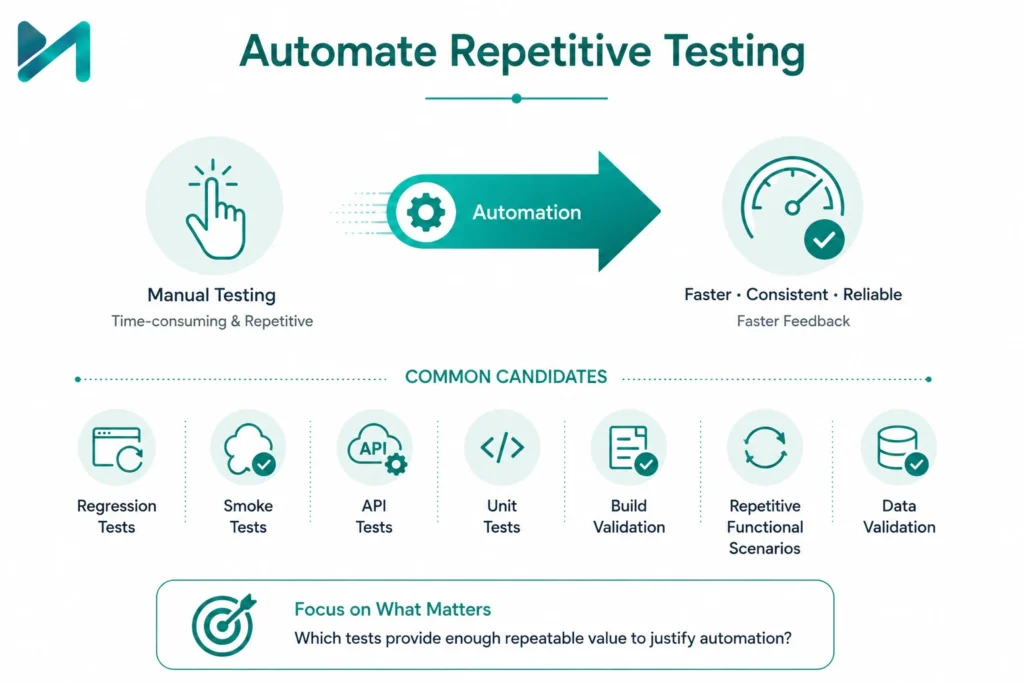
Manual testing remains valuable, particularly for exploratory and usability-focused scenarios.
However, repetitive testing is often a strong candidate for automation.
Common candidates include:
- Regression tests
- Smoke tests
- API tests
- Unit tests
- Build validation
- Repetitive functional scenarios
- Data validation
Automation can provide faster feedback and make repeated testing more consistent.
But automation should not be viewed as a goal by itself.
The better question is:
Which tests provide enough repeatable value to justify automation?
A mature QA team prioritizes automation based on risk, frequency, stability, maintenance effort, and business value.
Is your QA team spending too much time on repetitive testing and manual validation?
MicroGenesis helps organizations modernize quality practices by connecting testing, requirements, traceability, and lifecycle processes through ALM.
Integrate QA Into CI/CD Pipelines
Continuous Integration and Continuous Delivery have changed how modern engineering teams release software.
Instead of waiting for a large release cycle, teams can integrate and validate changes continuously.
A typical quality pipeline can look like:
Code Commit
↓
Build
↓
Static Analysis
↓
Unit Tests
↓
Integration Tests
↓
Security Checks
↓
Acceptance Tests
↓
Release
This allows defects to be identified earlier and provides development teams with faster feedback.
For organizations connecting lifecycle management with DevOps practices, DevOps integration with ALM provides additional context.
Establish Requirements Traceability
For complex software systems, simply knowing that a test passed is not always enough.
Teams may also need to answer:
- Which requirement does this test validate?
- Which design element implements the requirement?
- Which release contains the implementation?
- Which test evidence demonstrates compliance?
- What could be affected if the requirement changes?
This is where requirements traceability becomes critical.
A traceability relationship might look like:
Requirement → Design → Implementation → Test Case → Test Result → Release
This creates a connected view of the development lifecycle.
It is particularly valuable for organizations working with regulated or safety-critical products.
Learn more about the importance of requirements traceability.
Use ALM to Connect QA With the Development Lifecycle
Quality assurance becomes significantly more effective when testing is connected to the rest of the engineering lifecycle.
An ALM platform can bring together activities such as:
- Requirements management
- Development
- Test management
- Defect management
- Change management
- Configuration management
- Traceability
- Reporting
- Compliance evidence
Instead of maintaining requirements in one tool, test cases in another, defects somewhere else, and release evidence in spreadsheets, teams can create a more connected engineering environment.
This is especially important when multiple teams need to collaborate on the same product.
If requirements are still being managed in spreadsheets despite having an ALM platform, Why Requirements Still Live in Excel After Buying an ALM Tool explores the underlying problem.
Integrate Security Into QA
Security should not be treated as a final-stage testing activity.
Modern quality strategies increasingly incorporate security throughout the software development lifecycle.
QA teams can work with security and development teams to introduce:
- Static application security testing
- Dynamic application security testing
- Dependency checks
- API security testing
- Vulnerability scanning
- Security-focused test cases
- Threat-based testing
For organizations adopting cloud-based ALM and DevSecOps practices, Cloud ALM Security and DevSecOps provides a useful extension of this topic.
Design QA for Regulated and Safety-Critical Software
The QA approach required for a consumer application may be very different from the approach required for a medical device, aircraft system, or automotive control system.
In regulated engineering, teams may need stronger controls around:
- Requirements
- Verification
- Validation
- Change management
- Risk management
- Traceability
- Test evidence
- Configuration management
- Auditability
For example, a medical technology organization may need to demonstrate how a product requirement was implemented and verified.
Similarly, automotive and aerospace organizations may need strong lifecycle visibility across engineering teams.
Our article on digital twins and MedTech manufacturing compliance explores how digital engineering approaches can support compliance-focused environments.
For automotive engineering, see the importance of Application Lifecycle Management in the automotive sector.
Measure Quality With the Right Metrics
A QA strategy needs measurable outcomes.
However, measuring the number of test cases executed isn’t enough.
Useful quality metrics can include:
Defect Metrics
- Defect density
- Defect severity
- Defect leakage
- Defect aging
Testing Metrics
- Test execution rate
- Test pass rate
- Automation coverage
- Regression coverage
Delivery Metrics
- Release frequency
- Change failure rate
- Mean time to recovery
- Deployment lead time
Quality Engineering Metrics
- Requirements coverage
- Requirements-to-test traceability
- Escaped defects
- Automation effectiveness
- Test environment stability
The right metrics should help engineering leaders understand risk, reliability, delivery quality, and improvement opportunities rather than simply create additional reporting.
Make QA a Continuous Improvement Process
Quality assurance should not stop when a release goes live.
Teams should continuously evaluate:
- What defects escaped?
- Where did defects originate?
- Which tests failed to detect them?
- Which requirements were unclear?
- Where did teams experience delays?
- Which manual activities should be automated?
- Which processes created unnecessary rework?
This creates a feedback loop:
Build → Test → Release → Measure → Learn → Improve
Over time, this can turn QA from a gate at the end of development into a continuous engineering discipline.
QA Best Practices for Agile Software Development
Agile teams need QA practices that fit short development cycles without compromising quality.
Some practical Agile QA best practices include:
Involve QA During Sprint Planning
Testers should understand acceptance criteria before development starts.
Define Testable Acceptance Criteria
Acceptance criteria should provide clear expectations for both developers and testers.
Test Continuously
Testing should happen throughout the sprint rather than being pushed to the final days.
Automate Regression Tests
Stable, repetitive tests are strong candidates for automation.
Collaborate Across Roles
Developers, testers, product owners, and business stakeholders should work together.
Track Quality Trends
Don’t focus only on the current sprint. Look for recurring defect patterns across releases.
How QA Fits Into the Software Development Life Cycle
Quality assurance should operate across the entire software development life cycle (SDLC).
|
SDLC Stage |
QA Activities |
|
Requirements |
Requirement reviews, acceptance criteria |
|
Architecture |
Design reviews, risk analysis |
|
Development |
Code reviews, unit testing |
|
Integration |
API and integration testing |
|
System Testing |
Functional and non-functional testing |
|
Acceptance |
UAT and validation |
|
Release |
Regression and release verification |
|
Production |
Monitoring, defect analysis, feedback |
|
Improvement |
Root-cause analysis and process optimization |
This lifecycle-based approach is more effective than treating QA as a separate phase after development.
For teams comparing lifecycle approaches, ALM vs. SDLC explains how Application Lifecycle Management relates to the software development lifecycle.
QA in Regulated Software Development
For regulated organizations, quality assurance often needs to provide more than confidence.
It needs to provide evidence.
Consider a healthcare software product.
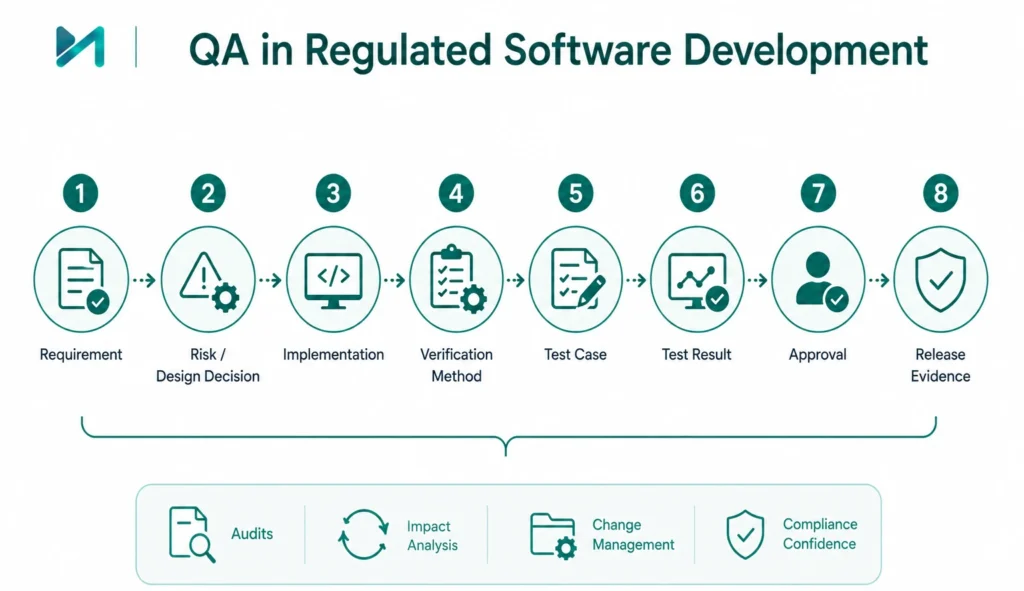
A mature QA process may need to establish:
Requirement
↓
Risk / Design Decision
↓
Implementation
↓
Verification Method
↓
Test Case
↓
Test Result
↓
Approval
↓
Release Evidence
This connected chain can make audits, impact analysis, change management, and compliance activities easier to manage.
For organizations working in regulated engineering environments, regulatory compliance tools can provide additional context.
Managing QA across requirements, testing, compliance, and releases?
If your engineering teams are working across disconnected tools and spreadsheets, an ALM-based approach can provide stronger traceability and lifecycle visibility.
Common Quality Assurance Challenges in Software Development
Even organizations with dedicated QA teams can struggle with several recurring issues.
Testing Starts Too Late
If QA begins only after development is complete, defects can become expensive to resolve.
Better approach: Introduce QA activities during requirements and design.
Requirements Are Unclear
Ambiguous requirements create ambiguity in both development and testing.
Better approach: Establish clear, testable, traceable requirements.
Too Much Manual Testing
Large regression suites can consume significant engineering time.
Better approach: Prioritize high-value automation.
QA and Development Operate in Silos
When developers and testers work independently, defects and communication gaps can increase.
Better approach: Integrate QA into Agile and DevOps workflows.
Testing Data Is Disconnected
Test results, requirements, defects, and releases may exist across different tools.
Better approach: Connect lifecycle data through ALM and integrated test management.
Quality Metrics Focus Only on Test Execution
A high test-pass percentage does not necessarily mean the product is high quality.
Better approach: Combine test metrics with defect trends, traceability, production quality, and delivery metrics.
How to Improve Your Software Quality Assurance Process
If your existing QA process needs improvement, don’t start by purchasing another testing tool.
Start with the process.
Step 1: Assess the Current Lifecycle
Map how requirements move from definition to release.
Step 2: Identify Quality Gaps
Look for:
- Late defect discovery
- Missing requirements
- Manual handoffs
- Poor traceability
- Regression bottlenecks
- Inconsistent test processes
Step 3: Prioritize High-Risk Areas
Focus first on areas with the greatest customer, operational, regulatory, or safety impact.
Step 4: Introduce Automation Strategically
Automate repetitive and stable testing activities where the expected return justifies maintenance effort.
Step 5: Connect QA With ALM
Link requirements, test cases, defects, changes, and releases wherever practical.
Step 6: Measure Results
Track whether the changes actually improve quality and delivery performance.
How ALM Can Improve Software Quality Assurance
For organizations managing complex products, Application Lifecycle Management can provide the foundation for a more connected QA strategy.
An integrated ALM environment can help connect:
Requirements Management
↓
Development
↓
Test Management
↓
Defect Management
↓
Change & Configuration Management
↓
Release Management
This can reduce information silos and improve lifecycle visibility.
It also supports traceability, impact analysis, reporting, and governance.
For organizations implementing ALM, ALM tool implementation best practices provides additional guidance.
And where the standard platform does not fully match existing engineering processes, ALM tool customization and configuration can help explain the considerations involved.
Choosing the Right QA Approach for Your Organization
There is no single software quality assurance methodology that works equally well for every organization.
Your QA strategy should reflect:
- Product complexity
- Release frequency
- Business risk
- Regulatory requirements
- Customer expectations
- Engineering maturity
- Team structure
- Technology stack
- Integration landscape
For a simple web application, a lightweight Agile QA process may be sufficient.
For a medical device, automotive platform, aerospace system, or other safety-critical product, the organization may require much stronger requirements management, verification, traceability, configuration control, and evidence management.
The important thing is to build a QA model that matches the risk and complexity of the product.
Frequently Asked Questions About Quality Assurance in Software Development
What is quality assurance in software development?
Quality assurance in software development is a systematic approach to preventing defects and ensuring that software meets defined functional, technical, security, performance, and business requirements throughout the development lifecycle.
Why is quality assurance important in software development?
QA helps organizations identify defects earlier, improve reliability, reduce release risk, support compliance, and deliver software that better meets customer and business expectations.
What are the best QA practices in software development?
Key QA practices include shift-left testing, risk-based testing, test automation, continuous testing, requirements traceability, CI/CD integration, security testing, comprehensive test coverage, and continuous improvement.
What are the main types of software testing?
Common testing types include unit testing, integration testing, system testing, acceptance testing, regression testing, performance testing, security testing, and usability testing.
How is QA integrated into the software development life cycle?
QA can be integrated at every SDLC stage, beginning with requirements reviews and continuing through design validation, development testing, system testing, acceptance, release verification, and production feedback.
What is the difference between QA and testing?
QA focuses on improving the processes and practices used to build quality software, while testing focuses primarily on evaluating the software to identify defects and verify expected behavior.
How does test automation improve software quality?
Test automation allows repeatable tests to be executed consistently and frequently. It is particularly useful for regression, smoke, unit, API, and other repetitive testing scenarios.
How does ALM improve software quality assurance?
ALM can connect requirements, development, testing, defects, changes, and releases, providing greater lifecycle visibility and traceability.
What is quality engineering?
Quality engineering extends traditional QA by making quality a shared responsibility across the engineering lifecycle. It emphasizes prevention, automation, continuous testing, measurable quality, and early risk identification.
How can organizations improve QA for regulated engineering systems?
Organizations can strengthen QA for regulated systems through controlled requirements, verification and validation processes, traceability, change management, configuration management, test evidence, and appropriate lifecycle governance.
Final Thoughts: Build Quality Into Software Development
Effective software quality assurance is not about testing more at the end of a project.
It is about building quality into the way software is conceived, designed, developed, tested, released, and maintained.
The strongest QA strategies combine:
- Clear requirements
- Shift-left practices
- Risk-based testing
- Test automation
- Continuous testing
- CI/CD integration
- Requirements traceability
- Security validation
- Quality metrics
- ALM
- Continuous improvement
For organizations developing complex or regulated products, the connection between requirements, testing, defects, changes, and releases becomes especially important.
An integrated ALM approach can help engineering teams move beyond disconnected QA activities and establish a more traceable, measurable, and scalable quality process.
Need to Strengthen Your Software QA and ALM Process?
If your organization is dealing with fragmented requirements, disconnected testing tools, limited traceability, manual QA processes, or increasing compliance demands, MicroGenesis can help.
Our ALM services can support organizations with ALM implementation, configuration, integration, requirements management, test management, traceability, DevOps integration, and lifecycle optimization.