

Software quality becomes difficult to manage when testing is treated as a final checkpoint rather than an engineering activity that runs throughout the product lifecycle.
For a simple application, a few manual test cases and a defect tracker may be enough. For a complex product with thousands of requirements, multiple development teams, automated test suites, integrations, and regulatory obligations, that approach quickly becomes difficult to control.
This is where test management becomes important.
Test management provides a structured way to plan, organize, execute, monitor, and report testing activities. It connects testing with requirements, development, defects, releases, and quality objectives so teams can answer practical questions such as:
- What needs to be tested?
- Which requirements have been verified?
- Which tests have passed or failed?
- Which defects are still open?
- Where are the highest product risks?
- Is test coverage sufficient?
- Is the product ready for release?
- Can we demonstrate evidence of testing during an audit?
For organizations working with complex software, embedded systems, automotive products, medical devices, aerospace systems, and other engineering-intensive products, test management should be part of a broader Application Lifecycle Management (ALM) strategy rather than an isolated QA activity.
MicroGenesis helps organizations design and improve test management processes, integrate testing with ALM and DevOps environments, strengthen traceability, and implement tools that support scalable quality engineering.
If your current testing process relies heavily on spreadsheets, disconnected tools, or manual reporting, explore MicroGenesis ALM Services to understand how an integrated approach can improve visibility across the development lifecycle.
What Is Test Management?
Test management is the systematic process of planning, organizing, executing, monitoring, and documenting software testing activities throughout the development lifecycle.
It brings structure to the testing process and helps teams coordinate people, test cases, environments, tools, defects, risks, and reporting.
A typical test management process includes:
Risk analysis
Test estimation
Test planning
Test organization
Test case management
Test execution
Defect management
Test monitoring
Test reporting
Release readiness assessment
The goal is not simply to execute as many tests as possible.
The goal is to make sure that the right tests are performed at the right time against the right product risks, with sufficient evidence to support quality and release decisions.
Why Test Management Matters in Modern Software Development
Modern software products rarely consist of one application running in isolation.
A typical enterprise product may include:
- Web and mobile applications
- APIs
- Microservices
- Cloud infrastructure
- Databases
- Third-party integrations
- Embedded software
- Multiple user interfaces
- External services
- Security components
Each additional dependency increases the number of possible interactions that need to be considered during testing.
A team might have thousands of test cases, but that does not automatically mean it has good test coverage.
For example, imagine an automotive software program with:
- 4,000 requirements
- 6 development teams
- 3 test environments
- Hundreds of integration points
- Automated regression suites
- Manual validation activities
If requirements, tests, defects, and results are stored in separate systems, answering a simple question such as “Which safety-related requirements have successfully passed validation?” can become a manual exercise.
A mature test management environment should make that information much easier to establish.
This is one reason organizations adopt ALM-based approaches that connect requirements, development, testing, and release activities.
Test Management vs. Project Management
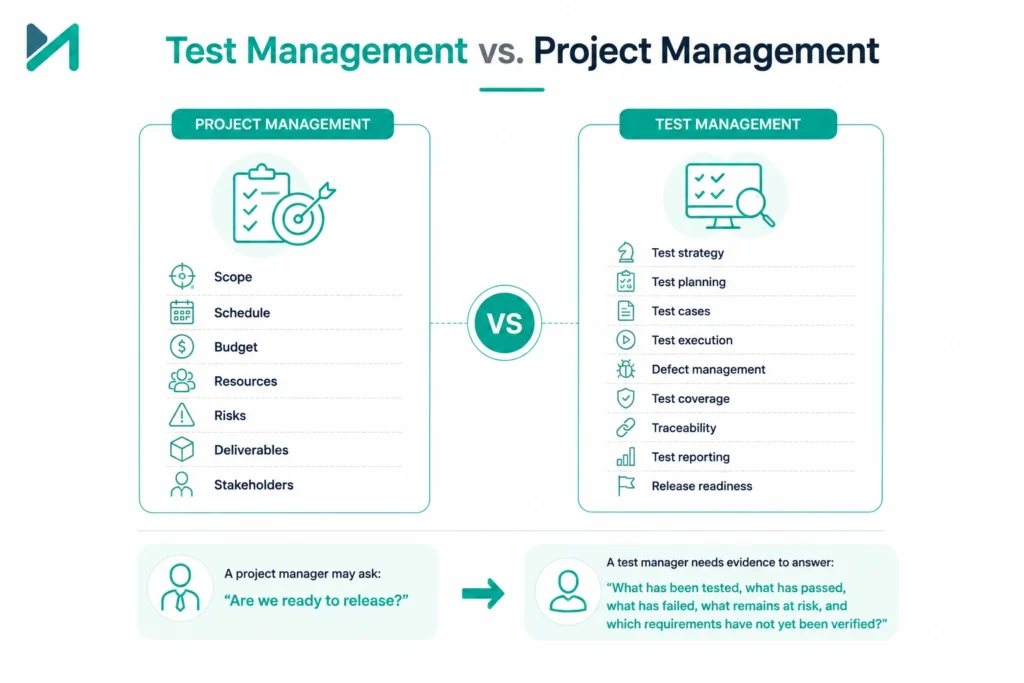
Test management and project management are connected, but they solve different problems.
Project management focuses on the overall project:
- Scope
- Schedule
- Budget
- Resources
- Risks
- Deliverables
- Stakeholders
Test management focuses specifically on quality and verification:
- Test strategy
- Test planning
- Test cases
- Test execution
- Defect management
- Test coverage
- Traceability
- Test reporting
- Release readiness
A project manager may ask:
“Are we ready to release?”
A test manager needs evidence to answer:
“What has been tested, what has passed, what has failed, what remains at risk, and which requirements have not yet been verified?”
That distinction becomes particularly important in complex and regulated environments.
The 2 Core Phases of Test Management
Although organizations may structure their processes differently, test management can broadly be viewed through two major phases:
Planning
and
Execution
Both are equally important.
A strong execution process cannot compensate for poor planning, and a detailed test plan provides little value if execution is not properly monitored.
Test Management Planning
Planning establishes the foundation for the entire testing activity.
It determines what needs to be tested, how testing will be performed, what resources are required, and which risks require special attention.
Risk Analysis
The first question should not be:
“How many test cases do we need?”
It should be:
“Where could this product fail, and what would the impact be?”
Risk analysis may consider:
- Critical functionality
- Safety-related requirements
- Security-sensitive components
- Complex integrations
- Frequently changing functionality
- New technologies
- Third-party dependencies
- Resource constraints
- Tight release schedules
For example, a payment transaction in an enterprise application may require a much higher level of validation than a cosmetic user-interface change.
Risk-based thinking helps teams allocate testing effort where it matters most.
Test Estimation
Test estimation determines the resources, time, and effort needed to execute the testing strategy.
Factors can include:
- Number of requirements
- Number of test cases
- Test complexity
- Number of environments
- Automation scope
- Integration dependencies
- Available testing resources
- Expected regression effort
Poor estimation can result in a familiar situation:
Development finishes → release deadline approaches → testing is compressed.
That is rarely a recipe for reliable software.
A mature test management approach considers testing effort during planning rather than treating it as the final stage before release.
Test Planning
The test plan defines the overall testing approach.
It can establish:
- Testing objectives
- Scope
- Testing types
- Test environments
- Test data
- Roles and responsibilities
- Entry criteria
- Exit criteria
- Defect management
- Reporting requirements
Depending on the product, testing may include:
- Unit testing
- Integration testing
- Functional testing
- Regression testing
- Performance testing
- Security testing
- User acceptance testing
For organizations trying to connect quality activities with a broader ALM environment, testing strategies and techniques in ALM provides a useful related perspective.
Test Organization
Testing requires clear ownership.
Depending on the organization, responsibilities may involve:
- Test managers
- QA leads
- Test engineers
- Automation engineers
- Developers
- Product owners
- Business analysts
- Compliance teams
Clear ownership helps ensure that test planning, execution, defect management, and reporting do not fall between organizational boundaries.
Test Management Execution
Once the testing strategy is established, teams move into execution.
This is where test management provides visibility into what is actually happening.
Monitoring Test Progress
A test manager should be able to see:
- Tests planned
- Tests executed
- Tests passed
- Tests failed
- Tests blocked
- Defects identified
- Defects resolved
- Test coverage
- Remaining testing effort
For example:
Suppose a release contains 1,000 planned test cases.
A basic report might show:
Executed: 850
Passed: 790
Failed: 60
Blocked: 150
That information is useful, but leadership needs more context.
Are the 150 blocked tests related to low-risk functionality?
Or are they associated with critical requirements?
Good test management connects execution results with business and engineering risk.
Defect and Issue Management
Defects should not simply be recorded and forgotten.
A structured process should capture:
- Defect description
- Severity
- Priority
- Environment
- Steps to reproduce
- Expected result
- Actual result
- Owner
- Status
- Resolution
- Retest result
The real value comes when defects are connected with other lifecycle artifacts.
For example:
Requirement → Test Case → Failed Test → Defect → Fix → Retest → Passed
That relationship creates a much clearer picture of product quality.
For organizations where requirements and testing are currently disconnected, improving requirements traceability can be an important part of the broader test management strategy.
Test Reporting and Release Readiness
Test reports help stakeholders understand whether the product is ready for release.
A useful report can include:
- Test execution status
- Pass/fail results
- Defect trends
- Requirement coverage
- Risk areas
- Blocked tests
- Outstanding defects
- Regression results
- Release recommendation
The objective is to turn testing data into a decision.
Instead of saying:
“QA has completed testing.”
stakeholders should be able to understand:
“The critical requirements have been validated, high-severity defects have been addressed, regression testing is complete, and the remaining risks are documented.”
That is a much stronger basis for a release decision.
6 Capabilities to Look for in a Test Management Tool
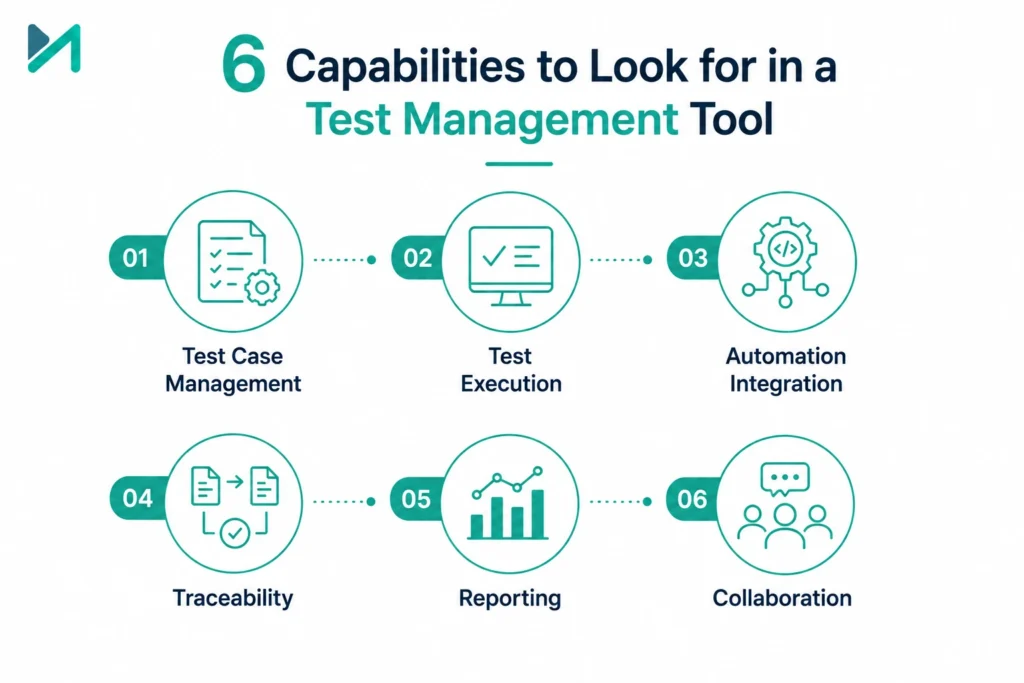
When evaluating a test management solution, do not focus only on the number of features.
Look for capabilities that support your actual engineering process.
Test Case Management
The platform should allow teams to create, organize, reuse, version, and maintain test cases.
Test Execution
Testers should be able to record execution results and supporting evidence efficiently.
Automation Integration
The platform should connect with automated testing frameworks and CI/CD pipelines where appropriate.
Traceability
Requirements should be connectable to tests, defects, and results.
Reporting
Dashboards should provide meaningful visibility into testing progress, quality, and risk.
Collaboration
Developers, testers, product owners, and other stakeholders should be able to work from connected information.
For enterprises already evaluating an ALM platform or planning to modernize their lifecycle environment, ALM integration solutions can help frame the integration requirements that should be considered.
Manual Testing and Automation: You Need Both
Automation is important, but it should not be treated as a replacement for human testing.
Automation works particularly well for:
- Regression tests
- Repetitive validation
- API tests
- Stable functional tests
- Performance testing
- Build verification
Manual testing remains valuable for:
- Exploratory testing
- Usability
- New functionality
- Complex business scenarios
- Unexpected behavior
- Human-centered validation
The question is not:
“Should we automate everything?”
It is:
“Which testing activities provide the greatest value when automated?”
That distinction can prevent organizations from spending significant effort automating tests that provide little long-term benefit.
Test Management and ALM: Why Integration Matters
Test management becomes significantly more powerful when connected with Application Lifecycle Management.
Consider a regulated medical device program.
A requirement might state:
“The device shall detect a specified operating condition within the defined response time.”
That requirement may need to connect to:
Requirement → Design → Implementation → Test Case → Test Execution → Result → Defect
If those artifacts are disconnected, demonstrating traceability can require spreadsheets and manual evidence collection.
With an integrated ALM approach, the relationships can be maintained throughout the lifecycle.
This is especially important for organizations working in safety-critical and regulated industries.
For teams evaluating ALM approaches for these environments, the best ALM software for safety-critical industries is a relevant resource.
5 Test Management Best Practices
Involve Testers Early
Do not wait until development is complete.
Testers should participate in:
- Requirement reviews
- Risk analysis
- Acceptance criteria
- Test planning
- Architecture discussions
Early involvement helps identify ambiguity and quality risks before they become expensive to fix.
Prioritize Tests by Risk
A high-risk feature should not receive the same testing priority as a low-impact feature.
Prioritize based on:
- Business impact
- Safety impact
- Security impact
- Change frequency
- Technical complexity
- Failure probability
This helps teams focus limited testing resources where they matter most.
Introduce Continuous Testing
Testing should increasingly become part of the development workflow rather than a separate phase at the end.
A modern workflow may look like:
Code → Build → Automated Tests → Security Checks → Integration Tests → Deployment → Monitoring
This approach provides faster feedback and reduces the risk of discovering major defects just before release.
Organizations integrating ALM with DevOps should consider DevOps integration with ALM as part of their overall lifecycle strategy.
Automate Repetitive Testing
Look for tests that:
- Run frequently
- Are stable
- Are repetitive
- Take significant manual effort
- Have predictable outcomes
These are generally strong automation candidates.
Automation should increase efficiency and coverage without making the overall test environment unnecessarily complex.
Review Your Test Strategy Regularly
Products change.
Architectures change.
Requirements change.
Testing strategies therefore need to change as well.
Regularly review:
- Test coverage
- Automation effectiveness
- Defect trends
- Test execution time
- Duplicate tests
- Failed tests
- Testing bottlenecks
The objective is continuous improvement rather than maintaining the same testing process indefinitely.
Test Management Challenges in Complex Engineering Environments
For simple applications, test management can often remain relatively straightforward.
For complex engineering products, additional challenges emerge.
Large numbers of requirements
Teams need to understand whether every important requirement has been adequately verified.
Multiple engineering disciplines
Software, hardware, systems, and testing teams may work across different tools and processes.
Regulatory requirements
Testing evidence may need to remain available for audits.
Changing requirements
Changes can create additional regression testing and traceability requirements.
Distributed teams
Teams need a common source of information to collaborate effectively.
Increasing automation
Automated tests generate large amounts of execution data that must be managed and interpreted.
This is why test management becomes more valuable as engineering complexity increases.
Test Management for Safety-Critical and Regulated Products
In regulated industries, “the test passed” may not be enough.
Organizations may need to demonstrate:
- What requirement was tested?
- Who performed the test?
- Which version was tested?
- What environment was used?
- What was the result?
- Was the result reviewed?
- Were defects associated with the requirement?
- Was corrective action completed?
This creates a need for auditable test evidence and lifecycle traceability.
Industries such as medical devices, automotive, aerospace, defense, and other safety-critical sectors can therefore benefit from integrating test management with ALM.
If your organization operates in a regulated environment, compliance and traceability in ALM is particularly relevant when designing the testing and evidence-management process.
How AI Is Changing Test Management
AI is beginning to influence how teams manage and execute testing.
Potential applications include:
- Test case prioritization
- Test generation
- Defect prediction
- Test maintenance
- Test data analysis
- Failure pattern identification
- Test optimization
However, AI should be introduced with appropriate controls.
For safety-critical or regulated products, teams should still be able to understand:
- What was tested
- Why a test was selected
- What evidence was generated
- How results were evaluated
- Who approved the outcome
AI can help teams work more efficiently, but governance and engineering judgment remain important.
When Should You Invest in a Test Management Solution?
A dedicated or integrated test management solution becomes increasingly valuable when you experience problems such as:
- Test cases spread across spreadsheets
- Difficulty tracking test execution
- Poor requirements-to-test traceability
- Duplicate test cases
- Manual reporting
- Increasing regression effort
- Limited visibility into release readiness
- Multiple testing teams
- Complex compliance requirements
- Disconnected ALM and testing tools
For example, if three QA teams maintain separate spreadsheets for the same product, management may have difficulty determining which test cases are current and which results should be trusted.
An integrated test management approach can create a common source of information.
How to Choose the Right Test Management Approach
Before selecting a tool or implementation partner, evaluate five areas.
Your development model
Are you using Agile, DevOps, traditional development, or a hybrid approach?
Product complexity
How many requirements, applications, integrations, and environments must be validated?
Traceability requirements
Do you need relationships between requirements, tests, defects, and results?
Compliance
Do you need auditable testing evidence?
Integration
Does the test management solution need to connect with your ALM, DevOps, requirements, or development tools?
The right solution should fit your engineering process rather than forcing your organization into an unnecessarily complex workflow.
Why Expert Test Management Implementation Matters
Buying a test management tool does not automatically create effective test management.
This is where implementation expertise becomes important.
An experienced implementation partner should be able to help you:
- Assess your current testing process
- Identify gaps
- Define a test management strategy
- Design workflows
- Configure the platform
- Integrate existing tools
- Establish traceability
- Identify automation opportunities
- Build dashboards
- Train teams
- Support adoption
- Improve the process after go-live
For example, an organization may purchase a sophisticated ALM platform but continue using spreadsheets because the test workflow was never properly designed.
The technology was not necessarily the problem.
The implementation approach was.
How MicroGenesis Helps Organizations Improve Test Management
MicroGenesis approaches test management as part of the broader engineering lifecycle rather than as an isolated testing tool implementation.
Our expertise can support organizations across:
Test Management Strategy
We assess your existing testing process and identify opportunities to improve planning, execution, traceability, and reporting.
ALM Integration
We help connect requirements, testing, development, defects, and release activities to create greater lifecycle visibility.
Test Automation
We identify suitable candidates for automation and help integrate automated testing into existing development workflows.
Requirements and Test Traceability
We establish relationships between requirements, test cases, execution results, and defects.
Compliance and Audit Support
For regulated environments, we help structure testing evidence and traceability around applicable quality and compliance needs.
Dashboards and Reporting
We help teams create meaningful visibility into testing progress, coverage, defects, risks, and release readiness.
Tool Implementation and Optimization
Whether you are implementing a new ALM environment or improving an existing one, our team can help align the technology with your engineering process.
If you are looking to strengthen test management as part of a broader lifecycle transformation, explore MicroGenesis ALM Services and see how our ALM expertise can support your engineering organization.
Frequently Asked Questions About Test Management
What is test management in software testing?
Test management is the process of planning, organizing, executing, monitoring, and reporting software testing activities. It provides structure around test cases, execution, defects, risks, resources, coverage, and release readiness.
What are the main phases of test management?
The main phases include planning and execution. Planning covers activities such as risk analysis, estimation, test strategy, and team organization. Execution includes test monitoring, defect management, and reporting.
What is the difference between test management and test automation?
Test management governs the overall testing process, while test automation uses software to execute selected tests automatically. Automation is one component of a broader test management strategy.
How does test management support ALM?
Test management connects testing activities with requirements, development, defects, and releases. This improves traceability and provides a clearer view of product quality throughout the lifecycle.
Is test management important for regulated industries?
Yes. Regulated and safety-critical organizations often need stronger traceability, evidence, documentation, and auditability. Integrating testing with ALM can help establish relationships between requirements, tests, results, and defects.
Final Takeaway
Effective test management is not about creating more test cases.
It is about creating confidence in the product and the evidence behind that confidence.
A mature approach connects:
Requirements
↓
Risk Analysis
↓
Test Planning
↓
Test Cases
↓
Test Execution
↓
Defects
↓
Traceability
↓
Reporting
↓
Release Decision
For modern engineering organizations, test management is becoming increasingly connected with ALM, DevOps, automation, and continuous testing.
The right combination of process, technology, automation, and expertise can help organizations reduce manual effort, improve visibility, strengthen traceability, and make better release decisions.
If your organization is struggling with disconnected testing tools, manual test reporting, limited traceability, growing regression effort, or complex compliance requirements, MicroGenesis can help you evaluate the current environment and build a more structured test management approach.
Explore MicroGenesis ALM Services
The goal of test management is not simply to find defects. It is to give engineering and business teams confidence that the product is ready for the real world.