
Requirements traceability is one of those practices that can seem administrative when a project is small—and become absolutely critical once the product, engineering team, toolchain, or regulatory requirements become more complex.
Consider a simple question from a project manager:
“If this requirement changes today, what exactly will be affected?”
Can your team immediately identify the related design, development work, test cases, defects, verification evidence, and release?
If the answer is yes, you have traceability.
If the answer is “we need to check a few spreadsheets, emails, Jira tickets, documents, and test reports first,” your organization probably has a traceability problem.
For software-intensive products, regulated systems, automotive programs, medical devices, aerospace applications, and complex enterprise software, requirements traceability provides the connective layer between what the business needs and what engineering actually builds and verifies.
This guide explains what requirements traceability is, why it matters, how a requirements traceability matrix works, what tools organizations use, and how to build a scalable traceability strategy with ALM.
What Is Requirements Traceability?
Requirements traceability is the ability to establish and maintain relationships between a requirement and the engineering artifacts associated with it throughout the product lifecycle.
A requirement should not exist as an isolated statement.
It may need to connect to:
Stakeholder Need → Requirement → System Design → Architecture → Development → Test Case → Test Result → Defect → Verification → Release
This creates a connected view of the product lifecycle.
For example, imagine an automotive organization has the requirement:
“The braking system shall warn the driver when a predefined safety condition is detected.”
That requirement may be connected to:
- System requirement
- Safety requirement
- System architecture
- Software component
- Hardware interface
- Development work item
- Test case
- Test result
- Verification evidence
- Change request
- Release
If the requirement changes, the engineering team can use these relationships to understand what else needs to be reviewed.
That is the real value of traceability.
Why Is Requirements Traceability Important?
Requirements traceability is important because modern engineering projects rarely consist of requirements and source code alone.
They involve multiple teams, tools, disciplines, suppliers, versions, tests, changes, and compliance obligations.
A strong traceability strategy helps organizations establish relationships across those moving parts.
The major benefits include:
- Better requirements visibility
- Faster change impact analysis
- Stronger quality assurance
- Improved test coverage
- Better risk management
- Easier regulatory audits
- Reduced requirements ambiguity
- Better collaboration
- More controlled releases
- Stronger lifecycle governance
The key point is that traceability is not simply about tracking requirements.
It is about understanding the relationship between requirements and everything that depends on them.
Requirements Traceability Creates Alignment
Large engineering programs often involve product managers, business analysts, systems engineers, developers, testers, architects, quality teams, compliance specialists, and suppliers.
Each group may look at the product from a different perspective.
Traceability gives them a shared relationship structure.
For example:
Business Need
↓
System Requirement
↓
Software Requirement
↓
Implementation
↓
Test Case
↓
Verification Result
Instead of asking each team to explain how its work connects to the original objective, the relationship is visible in the engineering environment.
This becomes particularly valuable when multiple teams are working on the same product.
If your requirements are still managed primarily through spreadsheets and documents, read Why Requirements Still Live in Excel After Buying an ALM Tool.
Still managing requirements across Excel, documents and disconnected tools?
MicroGenesis helps engineering organizations establish connected requirements, testing and lifecycle processes using modern ALM platforms.
Explore MicroGenesis ALM Services →
Traceability Makes Change Impact Analysis Practical
Change is unavoidable.
A customer changes a requirement.
A regulation changes.
A component becomes unavailable.
A security vulnerability is discovered.
A design decision changes.
A supplier modifies an interface.
The difficult question isn’t simply:
“Can we make this change?”
The more important question is:
“What else will this change affect?”
Without traceability, engineers may need to manually search through documents, spreadsheets, repositories, test cases, and project management systems.
With connected relationships, they can identify potentially affected artifacts much faster.
For example:
Requirement R-104
→ Architecture A-22
→ Software Component SC-18
→ Test Case TC-421
→ Defect D-77
→ Release 4.2
A change to R-104 should trigger a review of those downstream relationships.
This is one of the strongest business cases for requirements traceability software.
Traceability Improves Software Quality Assurance
Traceability and QA are closely connected.
A quality team needs to know:
- What must be tested?
- Why does this test exist?
- Which requirement does it validate?
- Has every critical requirement been verified?
- Which requirements have failed testing?
- What changed since the last release?
A traceability relationship can connect:
Requirement → Test Case → Test Execution → Result
This makes it easier to identify requirements without adequate verification coverage.
Our guide on quality assurance strategies in software development explores this broader quality engineering approach.
Traceability Strengthens Requirements Coverage
One of the simplest questions engineering leaders should be able to answer is:
“Have we tested everything we were required to build?”
Traceability helps answer this.
A basic requirements coverage view might look like:
|
Requirement |
Design |
Development |
Test Case |
Test Result |
|
REQ-001 |
✓ |
✓ |
✓ |
Passed |
|
REQ-002 |
✓ |
✓ |
✓ |
Passed |
|
REQ-003 |
✓ |
✓ |
— |
— |
|
REQ-004 |
✓ |
✓ |
✓ |
Failed |
REQ-003 immediately deserves attention.
Without a relationship between requirements and tests, finding such gaps can become a manual exercise.
This is why requirements traceability software is particularly valuable as product complexity grows.
Traceability Helps Manage Risk
Requirements aren’t all equally important.
Some represent:
- Safety requirements
- Security requirements
- Regulatory obligations
- Customer-critical functionality
- Financial controls
- Performance targets
- Reliability requirements
Traceability allows organizations to connect requirements with related risks and verification activities.
For example:
Safety Requirement
↓
Hazard / Risk
↓
Safety Mechanism
↓
Implementation
↓
Verification
This provides stronger visibility into how identified risks are addressed.
In automotive engineering, connected engineering models can relate requirements to architecture, software, hardware, testing, and verification.
Requirements Traceability Supports Regulatory Compliance
For regulated industries, traceability can become a core part of the evidence structure surrounding engineering activities.
Consider organizations developing:
Medical Devices
Requirements may need to connect to design inputs, verification, validation, risk controls, and evidence.
Automotive Systems
Safety-related requirements may need relationships with architecture, implementation, verification, and validation activities.
Aerospace & Defence
Requirements may need to remain connected to system design, implementation, testing, and verification evidence.
Rail
Safety and system requirements may need to be traced through development and validation.
Financial Services
Functional and regulatory requirements may need to connect to implementation and testing evidence.
The objective isn’t to create links simply because an audit requires them.
The objective is to establish an engineering process where the evidence is created naturally as work progresses.
For more on this topic, see Compliance and Traceability in ALM.
Traceability Improves Communication Between Teams
Imagine a product manager asks:
“Why was this feature implemented this way?”
A developer may explain the implementation.
A tester may explain the test.
A systems engineer may explain the requirement.
A compliance team may explain the applicable control.
Traceability brings these perspectives together.
Instead of relying entirely on meetings and institutional knowledge, teams can follow the relationships between engineering artifacts.
This is especially useful for distributed teams and large programs where knowledge cannot remain inside individual people’s heads.
Traceability Makes Audits Less Disruptive
Audits become difficult when evidence needs to be assembled manually.
A typical request might be:
“Show me the requirement, its implementation, verification evidence, change history and approval.”
In a disconnected environment, this can require considerable manual effort.
In a connected ALM environment, the relationships can be established as part of the normal development workflow.
The objective is not merely to prepare for an audit.
It is to make the engineering process audit-ready by design.
What Is a Requirements Traceability Matrix?
A Requirements Traceability Matrix (RTM) is a structured way of mapping requirements to related engineering artifacts, most commonly test cases.
A basic RTM might look like this:
|
Requirement ID |
Requirement |
Design |
Test Case |
Result |
Status |
|
REQ-101 |
User authentication |
DES-12 |
TC-201 |
Pass |
Verified |
|
REQ-102 |
Password reset |
DES-15 |
TC-204 |
Pass |
Verified |
|
REQ-103 |
Session timeout |
DES-17 |
TC-208 |
Fail |
Action required |
For simple projects, an RTM can be useful.
For complex products, however, maintaining a large traceability matrix manually can become difficult.
This is where requirements traceability tools and ALM platforms become more valuable.
Forward vs. Backward Requirements Traceability
Traceability is often discussed in two directions.
Forward Traceability
Forward traceability tracks requirements toward implementation and verification.
Requirement → Design → Development → Test
It helps answer:
“Have all requirements been implemented and verified?”
Backward Traceability
Backward traceability works in the opposite direction.
Test → Requirement
or:
Implementation → Requirement
It helps answer:
“Why does this feature, test or implementation exist?”
A mature engineering environment often needs both.
What Is Bidirectional Traceability?
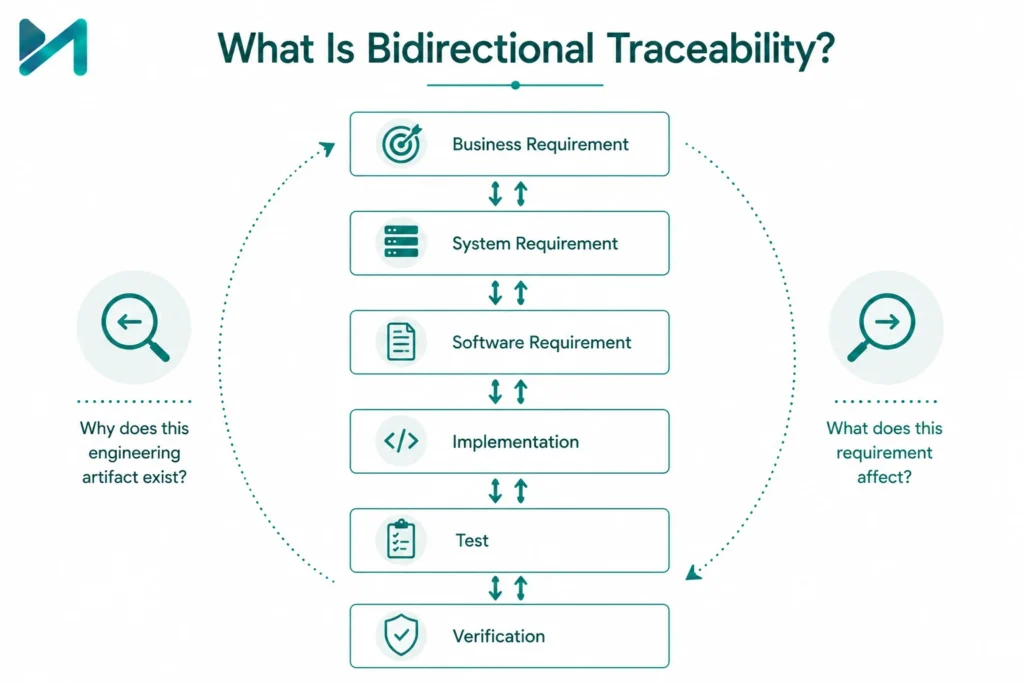
Bidirectional traceability connects requirements both forward and backward across the lifecycle.
For example:
Business Requirement
↕
System Requirement
↕
Software Requirement
↕
Implementation
↕
Test
↕
Verification
This allows teams to navigate the lifecycle in either direction.
It can help answer both:
“What does this requirement affect?”
and
“Why does this engineering artifact exist?”
Requirements Traceability in Software Engineering
In software engineering, traceability can connect:
User Need
→ Requirement
→ Epic
→ User Story
→ Code Change
→ Build
→ Test
→ Defect
→ Release
This becomes particularly useful in Agile and DevOps environments where requirements, development, testing, and releases happen continuously.
For organizations integrating lifecycle management with DevOps, DevOps Integration With ALM explains how these environments can be connected.
Requirements Traceability Across the Product Lifecycle
A mature traceability model goes beyond requirements and test cases.
A more complete lifecycle can look like:
Stakeholder Needs
↓
Requirements
↓
System Architecture
↓
Software / Hardware Design
↓
Development
↓
Testing
↓
Verification
↓
Validation
↓
Release
↓
Change Management
This creates what many organizations refer to as a digital thread.
Our article on Understanding the Digital Thread in ALM and Product Lifecycle explores this broader concept.
Requirements Traceability in Different Industries
Automotive
Automotive programs often need to connect system requirements with architecture, software, hardware, testing, safety and verification.
For organizations working on Software-Defined Vehicles, traceability becomes even more important because software, electronics and systems engineering are increasingly interconnected.
A connected engineering environment can link:
Vehicle Requirement → System Model → Software → Test → Validation
The automotive MBSE material also highlights the value of connecting requirements with architecture, implementation, testing and verification for stronger engineering traceability.
See Importance of Application Lifecycle Management in the Automotive Sector.
Medical Devices
Medical device development requires disciplined requirements, verification, validation and documentation.
Traceability can help connect:
User Need → Design Input → Design Output → Verification → Validation
This provides a structured way to demonstrate how product requirements have been addressed.
Explore MBSE in Medical Device Development.
Aerospace & Defence
Aerospace and defence programs often involve complex systems, multiple engineering disciplines and stringent verification requirements.
Traceability helps teams maintain relationships across:
- Mission requirements
- System requirements
- Architecture
- Software
- Hardware
- Verification
- Validation
Learn more about Application Lifecycle Management in Aerospace and Defence.
Software & Enterprise Applications
For enterprise software, traceability can connect:
Business Requirement → User Story → Development → Test → Release
This helps product and engineering leaders understand what is being delivered and why.
Your requirements may be documented—but are they actually traceable?
MicroGenesis helps organizations connect requirements with development, testing, change management, and verification through integrated ALM environments.
Requirements Traceability Software vs. Spreadsheets
Spreadsheets can work for small, relatively stable projects.
The challenge starts when requirements increase, teams expand, changes become frequent, or compliance becomes important.
|
Spreadsheet-Based Traceability |
ALM-Based Traceability |
|
Manual linking |
Structured relationships |
|
Difficult version control |
Version-aware lifecycle management |
|
Limited impact analysis |
Relationship-based impact analysis |
|
Manual reporting |
Automated views and reports |
|
Higher risk of stale information |
Centralized lifecycle data |
|
Difficult at scale |
Designed for complex programs |
|
Limited integration |
Integrates with engineering toolchains |
This does not mean every organization needs an enterprise ALM platform immediately.
The right question is:
Has the complexity of our engineering process outgrown manual traceability?
What Should You Look for in a Requirements Traceability Tool?
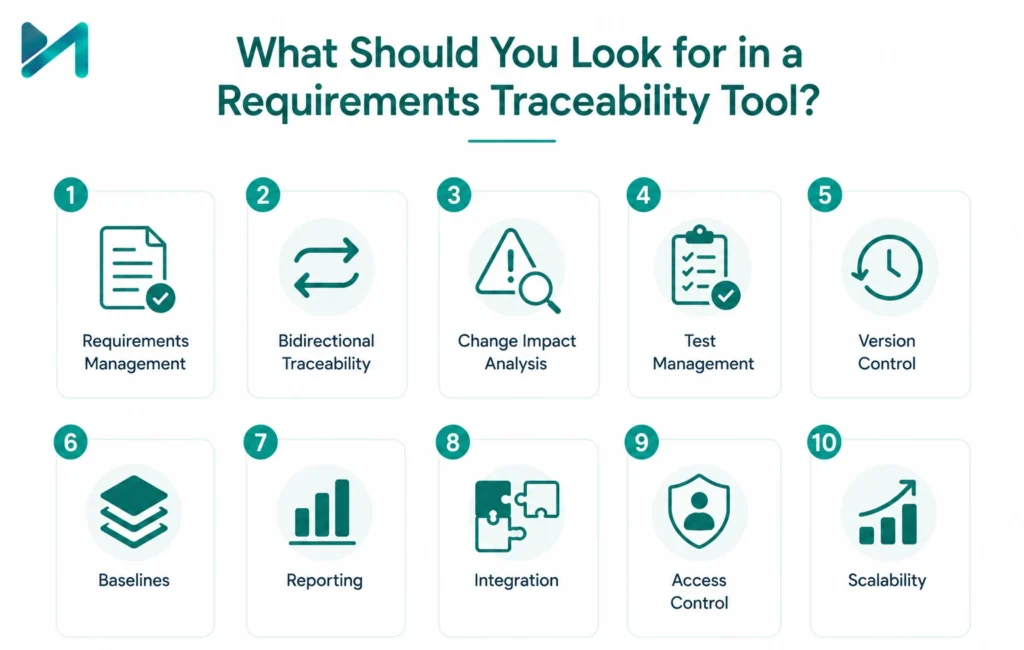
If you’re evaluating requirements traceability software, don’t choose a platform simply because it can create a traceability matrix.
Look for capabilities such as:
Requirements Management
Can the platform capture, organize, version and approve requirements?
Bidirectional Traceability
Can teams navigate relationships forward and backward?
Change Impact Analysis
Can teams identify downstream relationships when requirements change?
Test Management
Can requirements be connected directly to test cases and results?
Version Control
Can teams understand which requirement version was associated with a particular release?
Baselines
Can the organization establish controlled versions of requirements and related artifacts?
Reporting
Can engineering leaders see requirements coverage, testing status and traceability gaps?
Integration
Can the platform connect with development, testing, PLM, DevOps or other engineering tools?
Access Control
Can different teams access the information they need without exposing sensitive information?
Scalability
Can the platform support growing products, teams and engineering programs?
How to Implement Requirements Traceability
Buying a requirements management or ALM platform does not automatically create traceability.
The process matters just as much as the technology.
Step 1: Define the Traceability Scope
Decide what needs to be connected.
For example:
Requirements → Test Cases
may be enough for one project.
Another may require:
Requirements → Architecture → Software → Hardware → Test → Verification → Release
Step 2: Define Artifact Relationships
Establish which relationships are meaningful.
Examples:
- Requirement satisfies business need
- Requirement allocated to system
- Requirement implemented by component
- Requirement verified by test
- Requirement affected by change
Step 3: Establish Governance
Define:
- Ownership
- Naming conventions
- Approval workflows
- Versioning
- Baselines
- Review processes
- Traceability rules
Step 4: Connect Your Tools
A traceability strategy becomes much more powerful when engineering systems are connected.
For example:
Requirements Management
Systems Engineering
Development
Test Management
DevOps
Release Management
The objective is not to connect every tool simply because an integration exists.
The toolchain should support actual engineering workflows.
Step 5: Measure Traceability Quality
Useful indicators can include:
- Requirements with verification coverage
- Unlinked requirements
- Orphaned test cases
- Failed verification relationships
- Requirements affected by changes
- Traceability coverage by release
- Requirements awaiting approval
These metrics help engineering leaders identify gaps rather than simply count requirements.
Common Requirements Traceability Mistakes
Even organizations with an ALM platform can struggle with traceability.
Mistake 1: Treating Traceability as an Audit Exercise
Traceability should support engineering decisions not only compliance documentation.
Mistake 2: Creating Links Without Meaning
More links do not automatically mean better traceability.
Relationships should represent meaningful engineering dependencies.
Mistake 3: Maintaining Traceability Manually
Manual matrices become difficult to maintain as projects grow.
Mistake 4: Ignoring Change Management
Traceability loses much of its value if relationships are not maintained when requirements change.
Mistake 5: Linking Requirements Only to Tests
Testing is important, but complex engineering programs may need relationships across architecture, implementation, risks, changes and releases.
Mistake 6: Buying a Tool Before Defining the Process
Technology should support the engineering model not define it by itself.
When Does an Organization Need Requirements Traceability Software?
You should consider a dedicated requirements traceability tool or ALM platform when:
- Requirements are growing rapidly
- Multiple teams contribute to the product
- Requirements change frequently
- Manual traceability takes significant effort
- Test coverage is difficult to demonstrate
- Compliance requirements are increasing
- Engineering tools are disconnected
- Impact analysis is slow
- Teams rely heavily on spreadsheets
- Audits require substantial evidence preparation
If several of these sound familiar, the problem may no longer be simply requirements management.
It may be an engineering lifecycle management problem.
Why ALM Is Often the Better Long-Term Approach
Requirements traceability becomes considerably more valuable when it is part of a broader ALM environment.
Instead of maintaining:
Requirements in one tool
Testing somewhere else
Defects in another system
Release information in spreadsheets
ALM can create a connected lifecycle.
A typical relationship might look like:
Requirements
↓
Development
↓
Testing
↓
Defects
↓
Change Management
↓
Release
That gives engineering leaders a more complete view of the product.
For organizations evaluating implementation, ALM Tool Implementation Best Practices is a useful next step.
How MicroGenesis Helps With Requirements Traceability
Requirements traceability is not just about configuring links inside a tool.
It requires alignment between:
People + Process + Technology + Governance
MicroGenesis helps organizations build connected engineering and lifecycle environments around requirements management, ALM, systems engineering, testing and traceability.
Our capabilities include:
- Requirements management
- Requirements traceability
- ALM implementation
- ALM integration
- Test management
- Change and configuration management
- Engineering toolchain integration
- Digital thread enablement
- Compliance and traceability support
- ALM customization and optimization
We work with engineering environments involving platforms such as IBM Engineering Lifecycle Management, IBM DOORS Next and PTC Codebeamer, depending on the organization’s requirements.
The objective is not simply to introduce another tool.
It is to create an engineering environment where requirements remain connected to the work required to design, build, test and verify the product.
Frequently Asked Questions About Requirements Traceability
What is requirements traceability?
Requirements traceability is the practice of linking requirements to related engineering artifacts such as design, development, test cases, verification results, defects, changes and releases throughout the product lifecycle.
Why is requirements traceability important?
Requirements traceability improves visibility, change impact analysis, test coverage, quality assurance, communication, risk management and compliance readiness.
Why is traceability important in software engineering?
Software engineering teams use traceability to connect requirements with implementation, testing and releases. This helps teams understand what has been built, why it was built, and what may be affected when requirements change.
What is a requirements traceability matrix?
A Requirements Traceability Matrix, or RTM, is a structured mapping of requirements to related artifacts, commonly including test cases and verification results.
What is bidirectional requirements traceability?
Bidirectional traceability allows teams to navigate both from requirements to downstream artifacts and from downstream artifacts back to their originating requirements.
What is a requirements traceability tool?
A requirements traceability tool helps teams create, manage and maintain relationships between requirements and other engineering artifacts. More advanced ALM platforms can extend this across development, testing, defects, changes and releases.
How does traceability help with change management?
Traceability relationships help teams identify potentially affected requirements, designs, implementations, tests and releases when a requirement changes.
How does ALM improve requirements traceability?
ALM connects requirements with other lifecycle activities, helping organizations maintain relationships between requirements, development, testing, defects, changes and releases.
Is a requirements traceability matrix enough?
An RTM can be useful, but complex engineering programs often need more than a static matrix. A connected ALM environment can maintain relationships dynamically and support impact analysis, versioning, testing and lifecycle governance.
Final Thoughts: Traceability Is About More Than Linking Requirements
Requirements traceability becomes valuable when it answers real engineering questions.
What are we building?
Why are we building it?
Where is it implemented?
Has it been tested?
Has it been verified?
What happens if the requirement changes?
Can we demonstrate the evidence?
For a small project, a simple requirements traceability matrix may be enough.
For a complex software product, medical device, automotive system, aerospace platform, or other regulated engineering program, organizations may need a much more connected approach.
That is where requirements traceability software, requirements management, and ALM become strategic capabilities rather than administrative tools.
The ultimate goal is simple:
Every important requirement should have a clear relationship to the engineering work that implements and verifies it.
When that relationship is maintained throughout the lifecycle, teams gain better visibility, stronger change control, improved quality, and greater confidence in what they are delivering.
Ready to Strengthen Your Requirements Traceability?
If your teams are struggling with disconnected requirements, manual traceability matrices, poor impact analysis, incomplete test coverage, or audit preparation, MicroGenesis can help you assess and modernize your requirements and ALM environment.