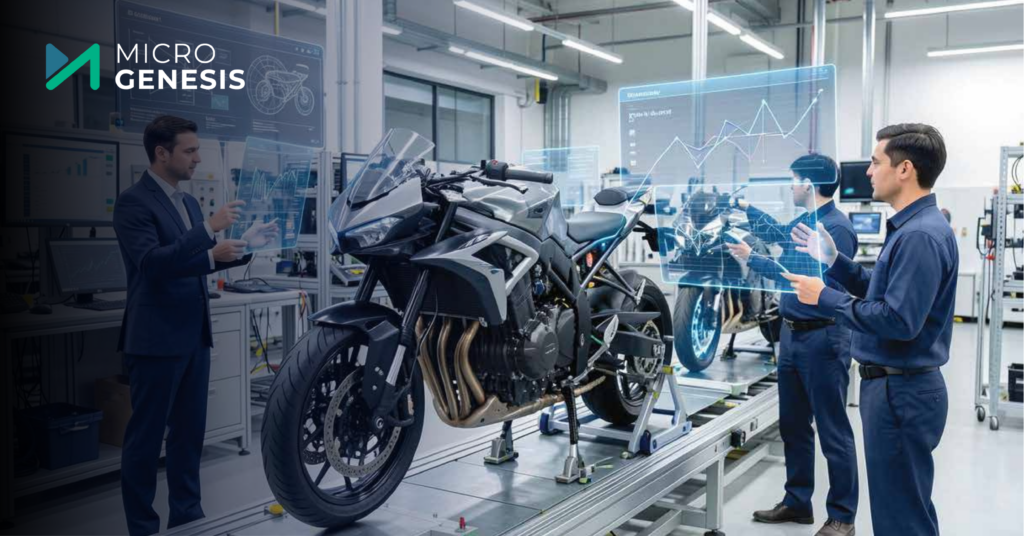

Smart manufacturing is changing how industrial organisations design, operate, and improve their production environments. Connected machines, industrial IoT (IIoT) devices, automated inspection systems, robotics, and digital twins generate valuable operational data. However, making these technologies work together reliably requires more than connecting equipment to a network.
Manufacturers also need to manage the software, system requirements, testing activities, interfaces, and changes behind these connected environments.
Consider an automotive manufacturing plant introducing a new robotic assembly line. The engineering team defines requirements for robot movement, safety interlocks, production cycle times, and communication with the manufacturing execution system (MES). Software teams configure the controllers, integration teams connect the systems, and production teams validate the line before it goes live.
If a requirement changes, the team needs to understand which controller configurations, integration tests, production workflows, and supporting documentation may be affected. When that information sits across separate tools and spreadsheets, identifying the impact can take time and create avoidable risks.
This is where Application Lifecycle Management (ALM) for smart manufacturing becomes valuable. By connecting requirements, development, testing, and change management, ALM helps engineering teams maintain visibility across complex industrial systems.
The key is to extend lifecycle management beyond traditional software development and adapt it to the realities of Industry 4.0.
Why Smart Manufacturing Needs ALM
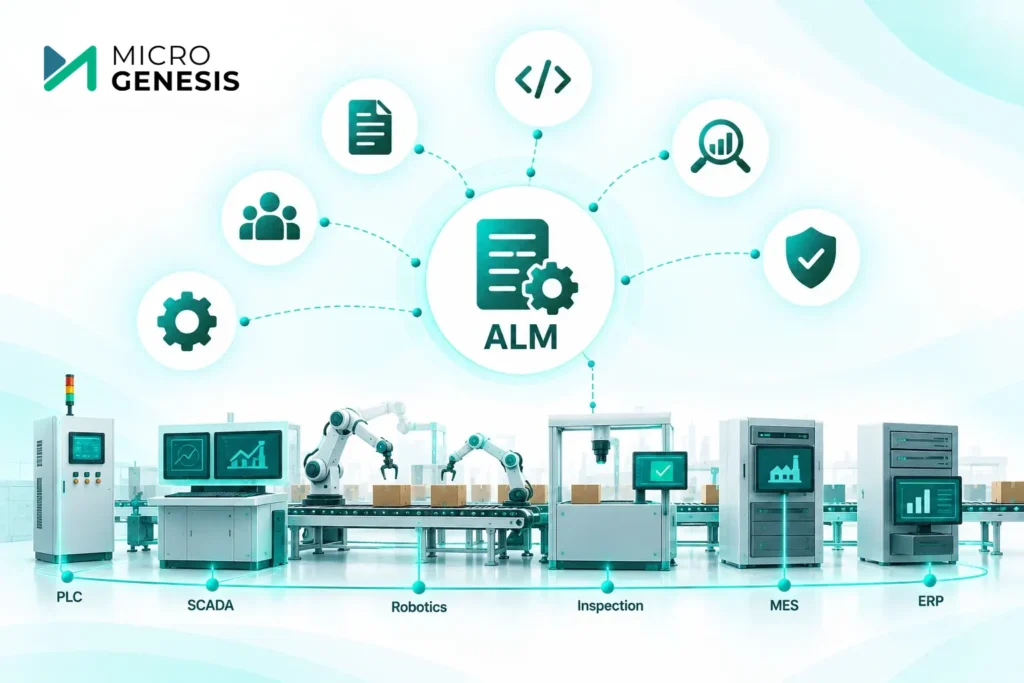
Smart manufacturing environments combine software-controlled equipment, industrial networks, enterprise applications, and physical production processes. Each component has its own lifecycle, but the overall production system depends on their interactions.
A manufacturing line may include programmable logic controllers (PLCs), supervisory control and data acquisition (SCADA) systems, MES platforms, robotics, quality inspection software, and enterprise resource planning (ERP) systems.
A change in one area can affect several others.
For example, changing a PLC program to adjust a conveyor’s operating sequence may affect robot timing, sensor triggers, safety interlocks, and downstream inspection activities. Even if the code change is small, the team may need to review interface assumptions and repeat relevant integration tests.
Without a connected lifecycle process, engineers often rely on emails, spreadsheets, and manual handovers to understand these dependencies.
ALM can help manufacturers:
- Maintain controlled requirements and system specifications.
- Link requirements to design decisions, software changes, and test evidence.
- Track defects, approvals, and configuration changes.
- Coordinate engineering work across teams and suppliers.
- Preserve evidence needed for reviews and controlled releases.
For manufacturers reviewing their existing lifecycle practices, MicroGenesis ALM services can help assess requirements management, toolchain integration, and workflow improvements.
Connecting Requirements, Testing, and Production/IIoT Data
One of the biggest opportunities in smart manufacturing is connecting engineering intent with actual system behaviour.
Requirements describe what a system must do. Testing checks whether it meets those expectations. Production and IIoT data can provide additional insight into how equipment behaves during real operation.
When these information sources remain disconnected, teams may struggle to determine whether a production issue is linked to a software change, an incorrect configuration, an interface problem, or an unmet requirement.
Connecting requirements with testing
Manufacturing requirements may cover machine cycle times, positioning accuracy, communication response, product inspection criteria, or equipment fault handling.
Each requirement should have an appropriate verification approach. For example, a requirement specifying that a robotic station must complete a defined operation within a target cycle time may need simulation, integration testing, and production validation.
A connected ALM workflow can link that requirement to its test cases, execution results, defects, and approved configuration. When the requirement changes, engineers can identify potentially affected tests and decide what needs to be repeated.
This is particularly useful when manufacturers operate several similar production lines with different equipment configurations.
Explore the complete guide to digital requirements management to understand how structured requirements practices support complex engineering projects.
Connecting lifecycle information with IIoT data
IIoT platforms collect information such as equipment temperature, vibration, operating cycles, downtime, and production output. This data can help teams identify performance trends and investigate unexpected behaviour.
However, operational data and ALM data serve different purposes. An ALM platform manages engineering requirements, changes, and verification records, while industrial data platforms collect and process operational information.
Integrating them can provide useful context, provided the connection is designed carefully.
For example, suppose a packaging line begins experiencing intermittent cycle-time delays after a controller update. Engineers could correlate production timestamps and equipment events with the relevant software version, change record, and integration test results.
This does not automatically prove that the software update caused the problem. It gives the team a more structured starting point for investigation.
A practical integration should establish which operational data is useful, how it is associated with engineering configurations, who owns the data, and how access and retention are managed.
Want to connect engineering requirements and verification workflows more effectively? Explore IBM Engineering Lifecycle Management to learn about lifecycle management capabilities that can support requirements, testing, and engineering collaboration.
Toolchain Integration for Industry 4.0 Environments
Smart manufacturing rarely operates on a single software platform. Engineering teams may use requirements management tools, simulation software, source control, automated testing environments, industrial data platforms, and manufacturing applications.
The challenge is making these tools work together without losing control of information.
Common integration challenges
Disconnected engineering systems: Requirements, software changes, and test results are maintained separately, making it difficult to establish a complete history.
Manual data transfers: Engineers export spreadsheets or copy information between tools, increasing the risk of outdated records and inconsistent identifiers.
Limited configuration visibility: Teams cannot easily determine which software version, PLC program, or equipment configuration is installed on a specific production line.
Unclear change ownership: A change in one engineering system may require updates elsewhere, but the affected teams are not always notified.
Difficult troubleshooting: When a production issue occurs, engineers spend time collecting information from different systems before they can begin analysing the problem.
How to build a connected toolchain
A successful integration strategy begins with the engineering process, not the number of available connectors.
Map the current environment. Identify the systems used for requirements, development, testing, configuration, and production monitoring.
Define authoritative data sources. Establish which system owns each record and which system is responsible for updates.
Identify critical relationships. Prioritise connections between requirements, changes, test evidence, software releases, and relevant equipment configurations.
Choose suitable integration methods. Use native integrations, APIs, connectors, or middleware according to technical and operational needs.
Define synchronization rules. Decide how changes, errors, permissions, and conflicting updates will be handled.
Pilot before scaling. Start with one production line or engineering workflow, validate the integration, and expand based on the results.
For example, a manufacturer may connect its ALM environment with a test management system and source control platform before attempting broader integration with production monitoring systems. This creates a foundation for reliable engineering traceability.
Read more about ALM integration solutions and DevOps integration with ALM.
If your organisation is evaluating an ALM platform for a complex manufacturing toolchain, Codebeamer ALM is worth exploring for requirements, testing, and lifecycle management needs. The suitability of any platform depends on your existing systems, integration requirements, and engineering workflows.
Scaling ALM Across Multiple Manufacturing Lines
Implementing ALM for one production line is different from deploying it across an entire manufacturing operation.
A company may operate multiple plants, product families, equipment generations, and production lines. Some requirements and engineering practices are common, while others depend on local processes, machinery, or product configurations.
The challenge is to standardise what should be standardised without forcing every team into an unsuitable workflow.
Establish reusable engineering practices
Manufacturers can create common templates for requirements, change requests, test plans, defect records, and approval workflows. These provide a consistent starting point for new lines and projects.
However, reusable templates should still allow for legitimate differences between equipment and production processes.
For example, two assembly lines may use the same robot platform but different grippers, sensor arrangements, and cycle-time requirements. Common lifecycle practices can be reused, while the specific requirements, configurations, and verification evidence remain distinct.
Manage configurations and changes carefully
Before rolling out a software update across several lines, engineering teams should establish where the change applies and what validation is required for each configuration.
A change approved for one line should not automatically be treated as suitable for every line.
A controlled rollout can include a pilot installation, verification against relevant requirements, monitoring of initial production behaviour, and approval before broader deployment.
Measure adoption and engineering effectiveness
Useful indicators include:
- Percentage of requirements linked to appropriate verification evidence.
- Number of unresolved changes affecting production configurations.
- Time required to assess change impact.
- Frequency of manual data reconciliation.
- Defects discovered during integration or production validation.
- Consistency of lifecycle practices across manufacturing lines.
These indicators should help teams identify bottlenecks and improve the process, rather than becoming reporting exercises with no clear owner.
For implementation guidance, see ALM tool implementation best practices.
MicroGenesis Implementation Approach for Smart Manufacturing
Introducing ALM into a smart manufacturing environment requires an understanding of both engineering workflows and the systems that support production. A platform should fit the organization’s lifecycle needs, integration architecture, and operational constraints.
MicroGenesis can support organization’s in assessing and improving their ALM practices through consulting, implementation, and toolchain integration.
A practical implementation approach can be structured around five stages.
1. Assess the current environment
Review existing engineering tools, requirements processes, testing workflows, system interfaces, and production-related dependencies. Identify where teams rely on manual handovers or lack visibility into changes.
2. Define the target lifecycle and integrations
Establish requirements ownership, traceability expectations, configuration rules, and the integrations that offer the greatest engineering value.
3. Configure the ALM environment
Configure workflows, roles, templates, traceability relationships, and reporting to support the agreed engineering process.
4. Pilot and validate
Test the workflow with a selected engineering team or production line. Confirm that requirements, changes, and test evidence remain connected and that the integrations behave as intended.
5. Scale and continuously improve
Expand the proven approach across additional lines or plants, train users, and review adoption and engineering performance indicators.
The implementation should be proportionate to the manufacturer’s needs. Not every organisation needs a large-scale integration program immediately. A focused pilot addressing a high-impact traceability or change-management problem can help establish value before broader investment.
To discuss your requirements, explore MicroGenesis ALM services. Organisations evaluating specific platforms can also learn about IBM Engineering Lifecycle Management and Codebeamer ALM.
Final Thoughts
Smart manufacturing depends on more than connected machines. It also depends on connected engineering information, reliable verification, controlled changes, and collaboration across software, automation, and production teams.
ALM can help manufacturers connect requirements, development, testing, and change management. Integrating selected engineering records with production and IIoT data can add valuable context when investigating issues or validating system behaviour.
The most effective approach is to begin with a clear understanding of current workflows, prioritise the integrations that address real engineering problems, and scale proven practices across production lines.
The goal is to create a connected engineering lifecycle where teams can understand what a system must do, how it was verified, which configuration is deployed, and what needs to be reviewed when something changes.