Choosing a DevOps consulting partner is not the same as choosing another IT vendor.
A DevOps partner can influence how your organization builds software, manages infrastructure, secures applications, deploys releases, responds to incidents, controls cloud costs, and scales engineering operations.
The right partner can do something very different: help your internal teams move faster while building a DevOps operating model that your organization can actually sustain.
In other words, DevOps consulting is no longer simply about setting up a CI/CD pipeline.
It is about making a complex engineering environment faster, safer, more reliable, and easier to operate.
So before you sign a contract, ask these 10 questions.
What Should You Look for in an Enterprise DevOps Consulting Partner?
A strong partner should be able to demonstrate five things:
- Relevant technical expertise
- Experience solving problems similar to yours
- A measurable approach to transformation
- Strong security and governance practices
- A clear path for knowledge transfer and long-term ownership
Do not select a partner simply because it has the largest technology portfolio or the longest list of certifications.
Ask what it can actually change in your environment.
1. Have You Solved a DevOps Problem Like Ours Before?
Not Sure What to Look for in a DevOps Consulting Partner?
The right partner should do more than provide engineers or recommend tools. You need a team that can understand your current environment, identify the highest-impact gaps, and connect DevOps improvements to measurable business outcomes.
MicroGenesis helps enterprises assess their DevOps landscape, identify transformation priorities, and build a practical roadmap around their existing people, processes, and technology.
Explore MicroGenesis DevOps Services
This should be your first question.
Not:
How many years have you been providing DevOps services?
Instead ask:
Show us examples of organizations with a technology environment and business challenge similar to ours.
A partner working with a small SaaS company may have excellent technical skills but still lack experience with a large enterprise environment.
Your situation might involve:
- Hundreds of applications
- Hybrid or multi-cloud infrastructure
- Legacy applications
- Kubernetes
- Regulated workloads
- Embedded software
- Multiple development teams
- Complex CI/CD pipelines
- DevSecOps requirements
- Distributed engineering teams
- Existing enterprise ALM or ITSM platforms
These environments require different approaches.
What to ask
Request 2 to 3 relevant case studies and ask:
- What was the customer’s starting point?
- What problem were they trying to solve?
- What technologies were involved?
- What did the consulting team actually change?
- How long did the transformation take?
- What measurable results were achieved?
- What remained under the customer’s ownership?
A good partner should be comfortable discussing the difficult parts, not only the success story.
2. How Will You Assess Our Current DevOps Maturity?
Be cautious if a consulting partner starts recommending tools before understanding your environment.
A mature engagement should begin with an assessment.
That assessment may examine:
People
- DevOps skills
- Team structures
- Ownership
- Collaboration
- Training
Process
- Development workflows
- Release management
- Change management
- Incident management
- Governance
Technology
- CI/CD
- Cloud
- Infrastructure as Code
- Containers
- Kubernetes
- Security
- Monitoring
- Observability
Architecture
- Application dependencies
- Legacy systems
- Microservices
- Hybrid environments
- Platform architecture
Measurement
- Deployment frequency
- Lead time for changes
- Change failure rate
- Time to restore service
- Reliability
These measurements are closely aligned with the DORA framework for evaluating software delivery performance.
The important point is that the partner should establish a baseline before promising improvement.
3. What Will You Actually Deliver in the First 90 Days?
This question separates strategic consultants from resource providers.
Ask for a practical 30-60-90 day plan.
First 30 days: Understand
The partner should typically focus on:
- Current-state assessment
- Stakeholder interviews
- Toolchain discovery
- Architecture review
- Pipeline analysis
- Security review
- Cloud assessment
Days 31-60: Design and Pilot
This could include:
- Target DevOps architecture
- CI/CD improvements
- Automation opportunities
- Security integration
- Pilot pipelines
- Infrastructure automation
- Monitoring improvements
Days 61-90: Prove and Scale
The focus should move toward:
- Production implementation
- Measurable improvements
- Documentation
- Team enablement
- Governance
- Scale-out roadmap
The exact timeline will vary by organization, but the principle is important:
You should know what will be assessed, changed, measured, and delivered before the engagement starts.
4. Which DevOps Technologies Do You Recommend, and Why?
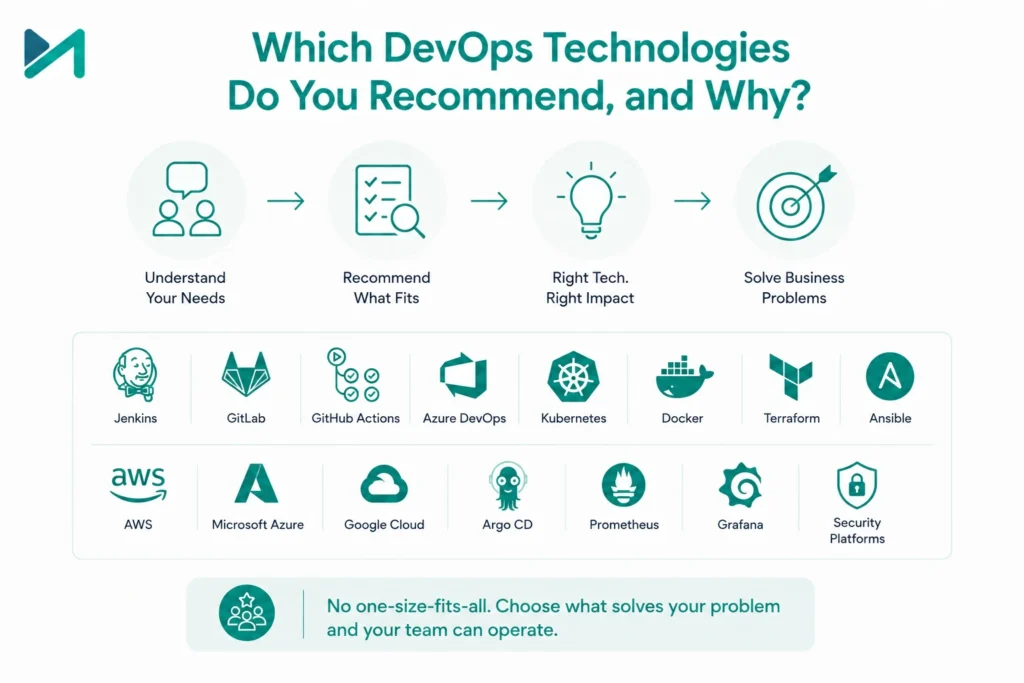
A good DevOps consulting partner should not be a reseller disguised as a consultant.
If the first recommendation is:
Here are the five tools we sell.
you should ask more questions.
Your partner should first understand your requirements and then recommend the appropriate technology.
Your environment may involve:
- Jenkins
- GitLab
- GitHub Actions
- Azure DevOps
- Kubernetes
- Docker
- Terraform
- Ansible
- AWS
- Microsoft Azure
- Google Cloud
- Argo CD
- Prometheus
- Grafana
- Security platforms
There is rarely one universal toolchain.
For example, Kubernetes is now widely established in production environments. CNCF reports that 82% of container users run Kubernetes in production, up from 66% in 2023.
But that does not mean every organization should immediately adopt Kubernetes.
The right question is:
Does this technology solve our business problem, and can we operate it effectively?
💡
5. How Will You Measure DevOps Transformation?
This is one of the most important questions to ask before signing.
“Improved DevOps” is not a measurable outcome.
Ask your partner to define specific KPIs.
Delivery metrics
- Deployment frequency
- Lead time for changes
- Release predictability
Stability metrics
- Change failure rate
- Time to restore service
- Production incidents
Automation metrics
- Pipeline automation
- Infrastructure automation
- Environment provisioning time
Engineering productivity
- Developer waiting time
- Manual deployment effort
- Repetitive operational work
- Pipeline troubleshooting
Financial metrics
- Cloud utilization
- Infrastructure cost
- Tool consolidation
- Engineering capacity
DORA continues to emphasize delivery throughput and stability rather than treating speed alone as the definition of high-performing software delivery.
That is an important distinction.
A partner that doubles deployment frequency but also increases production failures has not necessarily delivered a successful transformation.
6. How Will You Handle Security and DevSecOps?
Security cannot be something added after the pipelines are already built.
Ask the consulting partner how security will be incorporated into:
- Source code
- Dependencies
- Build pipelines
- Infrastructure
- Containers
- Secrets
- Deployment
- Runtime environments
Your partner should be able to discuss:
Application security
- SAST
- DAST
- Dependency scanning
- Secret detection
Infrastructure security
- Infrastructure as Code scanning
- Configuration management
- Identity and access controls
Container security
- Image scanning
- Runtime security
- Registry controls
Governance
- Compliance
- Audit trails
- Policy enforcement
- Security gates
This becomes even more important as AI-generated code enters development workflows.
DORA’s 2025 research found that 90% of technology professionals surveyed use AI at work, and more than 80% believe AI has increased their productivity. However, DORA also found that AI can amplify existing organizational weaknesses.
That means faster code generation needs stronger engineering controls around it.
A good DevOps consulting partner should understand that relationship.
7. Can You Work With Our Existing Tools Instead of Replacing Everything?
This question can save you a considerable amount of money.
Many enterprises already have a large technology investment.
You may already use:
- Jenkins
- GitLab
- Jira
- Bitbucket
- Azure
- AWS
- Kubernetes
- Terraform
- ServiceNow
- Artifactory
- SonarQube
- Existing monitoring platforms
The consulting partner should evaluate what is working before recommending replacement.
For example, if your Jenkins environment is stable and supports hundreds of applications, replacing it simply because another tool is newer may create unnecessary migration risk.
On the other hand, if your environment contains dozens of disconnected tools and manual processes, consolidation may create significant value.
Your consulting partner should therefore be able to answer:
What should we keep, what should we modernize, and what should we retire?
Your Existing Tools May Not Be the Problem. Your Operating Model Might Be.
You do not necessarily need to replace your entire DevOps toolchain to improve engineering performance.
MicroGenesis takes an environment-first approach, helping enterprises determine which technologies should be retained, integrated, modernized, consolidated, or replaced based on business value and technical requirements.
Discuss Your DevOps Modernization Strategy
8. Who Will Actually Work on Our Environment?
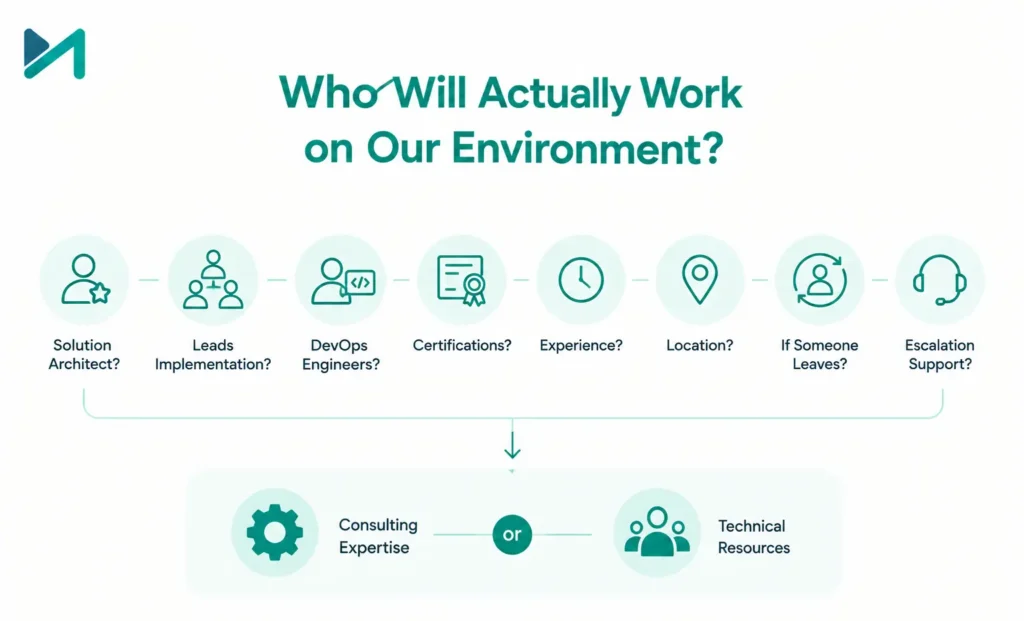
Do not assume that the senior consultant presenting during the sales process will be the person delivering the project.
Ask:
- Who is our solution architect?
- Who leads implementation?
- How many DevOps engineers are assigned?
- What are their certifications?
- What is their relevant experience?
- Where are they located?
- What happens if a key engineer leaves?
- Who provides escalation support?
Also ask whether you are buying:
Consulting expertise
or simply:
A group of technical resources.
They are not the same thing.
A consulting engagement should provide architecture, recommendations, implementation guidance, governance, and measurable outcomes rather than simply filling engineering seats.
💡
9. What Happens After Implementation?
This is one of the most overlooked questions.
Your DevOps environment will not remain static.
New applications will arrive.
Cloud infrastructure will change.
Security requirements will evolve.
Teams will adopt new technologies.
AI will change development workflows.
Kubernetes clusters will require upgrades.
CI/CD pipelines will evolve.
So ask:
“What happens after the initial transformation?”
A mature partner should have options for:
Knowledge transfer
Your internal teams understand the new environment.
Managed support
The partner provides ongoing operational assistance where required.
Optimization
The environment is continuously improved.
Governance
Standards and architecture remain consistent.
Skills development
Internal engineers become more capable over time.
This is particularly important if you want to avoid long-term dependency on an external provider.
The best partner should make your organization more capable, not permanently dependent.
10. How Do You Handle Knowledge Transfer and Exit?
This may be the most revealing question of all.
Ask:
“If we decide to operate this capability internally three years from now, how will you help us transition?”
A confident consulting partner should not be afraid of that question.
Your contract should address:
- Documentation
- Architecture diagrams
- Runbooks
- Pipeline documentation
- Infrastructure documentation
- Knowledge sessions
- Training
- Access management
- Configuration ownership
- Source code ownership
- Handover procedures
The objective should be:
Partner expertise → Internal capability
not:
Partner dependency → Permanent outsourcing
This is particularly important for enterprise environments where technology knowledge must remain available even when vendors change.
The 10 Questions at a Glance
Before signing a DevOps consulting contract, ask:
| No. | Question | What You Are Evaluating |
| 1 | Have you solved a problem like ours? | Relevant experience |
| 2 | How will you assess our maturity? | Discovery approach |
| 3 | What will you deliver in 90 days? | Execution plan |
| 4 | Why are you recommending these technologies? | Technical independence |
| 5 | How will you measure improvement? | Business outcomes |
| 6 | How will you handle DevSecOps? | Security maturity |
| 7 | Can you work with our existing tools? | Integration strategy |
| 8 | Who will actually deliver the work? | Team quality |
| 9 | What happens after implementation? | Long-term support |
| 10 | How will knowledge transfer work? | Organizational independence |
If a prospective partner struggles to answer several of these questions clearly, treat that as a warning sign.
7 Red Flags When Choosing an Enterprise DevOps Consulting Partner
The following should make you pause.
1. They promise transformation without assessing your environment
DevOps transformation is not a template.
2. They focus on tools instead of outcomes
Buying Kubernetes or implementing a CI/CD platform is not the same as improving software delivery.
3. They cannot provide relevant case studies
A long customer list does not replace relevant experience.
4. They avoid measurable KPIs
If success cannot be measured, it becomes difficult to demonstrate ROI.
5. Their senior experts disappear after the sales meeting
Ask who will actually deliver the engagement.
6. They cannot explain security responsibilities
DevSecOps requires clearly defined ownership.
7. They create dependency instead of capability
A partner should transfer knowledge and establish sustainable operating practices.
What Does a Strong DevOps Consulting Engagement Look Like?
A mature engagement usually follows a progression similar to:
Assess
↓
Prioritize
↓
Architect
↓
Pilot
↓
Implement
↓
Measure
↓
Optimize
↓
Enable Internal Teams
This is much more effective than:
Buy tools → Install tools → Declare DevOps transformation complete
DevOps is an operating model, not a software installation project.
When Should You Hire a DevOps Consulting Partner?
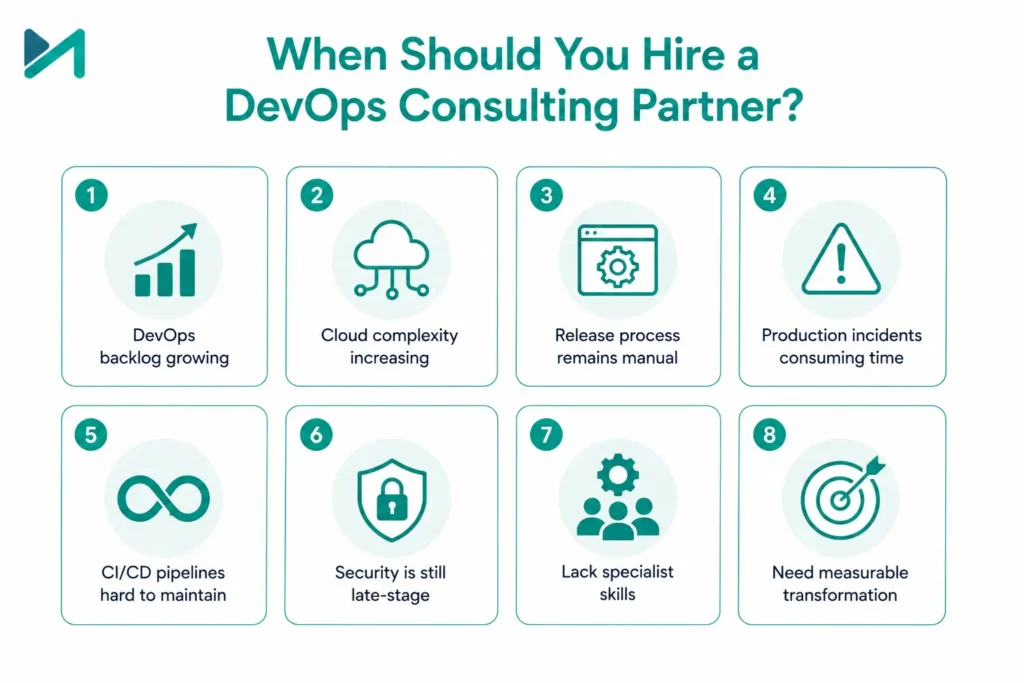
You may have reached the point where external expertise can create value if:
Your DevOps backlog is growing
Your internal team cannot keep pace with transformation requirements.
Cloud complexity is increasing
You are operating multiple accounts, subscriptions, regions, clouds, or platforms.
Your release process remains manual
Teams still depend on manual approvals, scripts, or environment configuration.
Production incidents are consuming engineering time
Your engineers spend too much time firefighting.
CI/CD pipelines have become difficult to maintain
The platform has grown organically without consistent architecture.
Security is still a late-stage activity
Security testing happens after development instead of throughout the lifecycle.
You lack specialist skills
You need expertise in Kubernetes, cloud, DevSecOps, platform engineering, automation, or observability.
Leadership needs measurable transformation
You need a structured roadmap rather than another collection of tools.
How to Calculate the Business Case for DevOps Consulting
Do not build your business case around:
We need DevOps because everyone else has it.
Build it around measurable business problems.
For example:
Current state
- 5-hour average environment provisioning
- 2-day release preparation
- High manual deployment effort
- Frequent pipeline failures
- Growing cloud spend
- Limited production visibility
Target state
- Automated environment provisioning
- Standardized CI/CD
- Automated security gates
- Infrastructure as Code
- Centralized observability
- Measurable delivery performance
Then calculate the value.
If automation saves 20 engineers two hours per week, that represents:
20 × 2 × 52 = 2,080 engineering hours per year
That is equivalent to more than one full-time engineer-year of capacity.
The actual financial value depends on your organization’s loaded engineering cost, but the principle is straightforward:
Measure the engineering capacity returned to the business, not simply the number of tools implemented.
Why DevOps Consulting Needs to Include Cloud Economics
A DevOps partner should understand cloud cost as well as engineering automation.
Flexera’s 2026 research found that cloud cost remains the top challenge for 85% of organizations, while 63% have established FinOps teams.
That means your consulting partner should be able to discuss:
- Resource utilization
- Environment lifecycle
- Autoscaling
- Infrastructure as Code
- Cost visibility
- Workload optimization
- Cloud governance
- FinOps collaboration
A pipeline that deploys faster but continuously creates unnecessary cloud resources is not an optimized DevOps environment.
Why Platform Engineering Should Be Part of the Conversation
Modern DevOps consulting increasingly overlaps with platform engineering.
DORA’s 2025 research found that 90% of organizations surveyed had adopted at least one platform, and its research linked higher-quality internal platforms with the ability to realize greater value from AI.
That means your consulting partner should be able to discuss more than CI/CD.
Ask about:
- Internal developer platforms
- Self-service environments
- Golden paths
- Standardized pipelines
- Infrastructure automation
- Developer experience
- Platform governance
The goal is to make the “right way” of delivering software easier for engineering teams.
How MicroGenesis Can Help
Choosing a DevOps consulting partner ultimately comes down to one question:
Can this partner help us turn DevOps from a collection of tools and practices into a measurable engineering capability?
MicroGenesis approaches DevOps consulting around that broader objective.
Our capabilities include:
- DevOps assessment
- DevOps transformation
- CI/CD implementation
- Cloud DevOps
- Infrastructure as Code
- DevSecOps
- Kubernetes and containerization
- Automation
- Monitoring and observability
- Platform engineering
- DevOps implementation
- Ongoing DevOps support
Explore MicroGenesis DevOps Services
For organizations looking for a location-specific engagement, MicroGenesis also provides DevOps Services in Bangalore.
For organizations developing embedded and software-intensive products, Embedded DevOps Services can address the additional requirements around embedded software development and delivery.
The approach should begin with understanding your environment rather than immediately prescribing a technology.
That means looking at:
People → Process → Technology → Architecture → Security → Cloud → Metrics
and then defining where intervention will create the greatest business value.
Frequently Asked Questions
What should I ask a DevOps consulting partner before hiring them?
Ask about relevant experience, assessment methodology, delivery team, technology recommendations, security practices, measurable KPIs, implementation roadmap, post-implementation support, knowledge transfer, and ownership.
How do I know if a DevOps consulting partner is experienced?
Look for relevant case studies, experienced architects, technical certifications, references, measurable outcomes, and evidence that the team has solved problems similar to yours.
What are the biggest signs that an enterprise needs DevOps consulting?
Common signs include slow releases, manual deployment processes, growing cloud complexity, frequent production incidents, inconsistent pipelines, lack of DevSecOps integration, high operational toil, and insufficient specialist expertise.
Should a DevOps consulting partner replace our existing tools?
Not necessarily. A good partner should first assess your current environment and determine which tools should be retained, integrated, modernized, consolidated, or replaced.
How long does a DevOps transformation take?
There is no universal timeline. A focused CI/CD improvement can take weeks, while an enterprise-wide transformation involving cloud, platform engineering, security, legacy applications, and multiple teams can take considerably longer. A good partner should define milestones rather than promise a generic transformation timeline.
How should DevOps consulting ROI be measured?
Measure delivery speed, reliability, automation, engineering productivity, cloud efficiency, security, incident reduction, and business outcomes. DORA’s established metrics provide a useful foundation for measuring software delivery performance.
Final Checklist Before You Sign
Before approving a DevOps consulting partner, make sure you can answer yes to these questions:
- Have they demonstrated relevant enterprise experience?
- Have they assessed our current DevOps maturity?
- Is there a clear roadmap?
- Are the first 90 days clearly defined?
- Are measurable KPIs included?
- Is security part of the architecture from the beginning?
- Have they evaluated our existing tools before recommending replacements?
- Do we know who will actually deliver the engagement?
- Are responsibilities clearly documented?
- Is knowledge transfer included?
- Is post-implementation support defined?
- Do we understand the expected business value?
If you cannot answer these questions before signing, you probably do not have enough information to make the decision.
Final Takeaway
Choosing a DevOps consulting partner is ultimately a business and engineering decision, not a procurement exercise.
The right partner should help you answer difficult questions:
Where is our delivery process slowing down?
Which engineering activities should we automate?
Where are we carrying unnecessary cloud and operational costs?
How mature is our security model?
What should our internal teams own?
Where do we need specialist expertise?
How will we measure improvement?
And perhaps most importantly:
What will our organization be capable of doing after the consulting engagement that it cannot do effectively today?
That is the real test.
With cloud native adoption now mainstream, Kubernetes operating in production across 82% of container-using organizations, and AI becoming part of everyday software development, the complexity of the modern engineering environment is only increasing.
The best DevOps consulting partner will not simply add another tool or another team.
It will help you build a better way of engineering software.
If you are evaluating your DevOps maturity, modernizing CI/CD, improving cloud operations, implementing DevSecOps, or building a platform engineering capability, MicroGenesis can help you assess the current state, define the target state, and build a practical roadmap to get there.
Explore MicroGenesis DevOps Consulting Services
Choose a partner for the transformation you want to achieve, not simply the technologies you want to implement.