
Modern engineering projects are more complex than ever. Whether developing enterprise software, connected vehicles, medical devices, aerospace systems, or industrial equipment, organizations must manage thousands of evolving requirements across multiple teams, suppliers, and stakeholders. Without a structured approach, changing requirements, poor communication, and inconsistent documentation can quickly lead to project delays, increased costs, compliance risks, and product quality issues.
This is where Requirements Management becomes essential.
Requirements Management is the discipline of capturing, analyzing, organizing, prioritizing, approving, tracing, and maintaining requirements throughout the product or software development lifecycle. Rather than treating requirements as static documents, modern organizations manage them as living assets that evolve alongside the project.
As engineering becomes increasingly digital, businesses are adopting Digital Requirements Management to replace spreadsheets, disconnected documents, and email-based reviews with collaborative platforms that provide version control, traceability, change management, and real-time visibility.
Whether you’re a systems engineer, product manager, software architect, business analyst, or engineering leader, understanding how to manage requirements effectively is critical to delivering successful products on time and within budget.
In this guide, you’ll learn:
- What Requirements Management is
- Why Requirements Management is important
- The Requirements Management process
- Digital Requirements Management
- Requirements traceability
- Change and variant management
- Best practices for writing quality requirements
- Requirements Management software and tools
- Industry applications
- How IBM Engineering Requirements Management (DOORS Next) supports modern engineering teams
If you’re new to IBM’s requirements engineering ecosystem, understanding how IBM DOORS Next modernizes traditional requirements management is a good place to start.
What Is Requirements Management?
Requirements Management is the process of identifying, documenting, analyzing, organizing, validating, tracking, and maintaining stakeholder requirements throughout the lifecycle of a project or product.
A requirement describes what a product, system, or application must do and the conditions it must satisfy. These requirements become the foundation for design, development, testing, verification, validation, and compliance.
Instead of treating requirements as isolated documents, modern Requirements Management Systems maintain every requirement in a centralized repository where it can be reviewed, updated, linked, and traced throughout development.
An effective Requirements Management process helps organizations:
- Capture stakeholder expectations
- Define functional and non-functional requirements
- Prioritize engineering work
- Control requirement changes
- Maintain end-to-end traceability
- Improve collaboration
- Reduce project risks
- Ensure regulatory compliance
Requirements Management plays a central role in software engineering, systems engineering, and product development by ensuring that every engineering decision aligns with customer and business objectives.
Types of Requirements
Successful projects depend on capturing different types of requirements accurately. Each category contributes to delivering a complete, reliable, and compliant product.
Functional Requirements
Functional requirements describe what the system must do. They define the features, capabilities, and expected behaviors of a product.
Examples include:
- A customer can reset their password.
- The application shall generate monthly reports.
- The system shall process online payments.
- Users shall authenticate using multi-factor authentication.
These requirements directly influence application functionality and user experience.
Non-Functional Requirements
Non-functional requirements define how well the system should perform rather than what it should do.
Examples include:
- Response time under two seconds
- 99.99% system availability
- Data encryption using AES-256
- Support for 10,000 concurrent users
- Compliance with ISO 26262 or DO-178C
These requirements often determine system reliability, scalability, performance, and security.
Business Requirements
Business requirements describe organizational objectives, business outcomes, or strategic goals.
Examples include:
- Reduce order processing time by 30%
- Improve customer satisfaction scores
- Support expansion into new markets
- Meet regulatory compliance requirements
Business requirements guide project priorities and investment decisions.
Stakeholder Requirements
Stakeholder requirements capture the expectations of customers, users, regulators, suppliers, and internal teams. They often become the source for functional and system requirements.
A structured Requirements Management System ensures that stakeholder needs remain connected to design decisions, implementation, verification, and testing throughout the project lifecycle.
Why Is Requirements Management Important?
Requirements are the foundation of every successful engineering project. Poorly defined, incomplete, or constantly changing requirements are among the leading causes of budget overruns, delayed releases, and product failures.
Without a structured Requirements Management process, teams often experience:
- Miscommunication between departments
- Conflicting stakeholder expectations
- Duplicate or inconsistent requirements
- Scope creep
- Costly engineering rework
- Delayed product releases
- Compliance challenges
- Poor traceability between requirements and testing
By implementing modern Digital Requirements Management, organizations establish a single source of truth that keeps engineering, product, quality, testing, and compliance teams aligned throughout the development lifecycle.
Common Challenges in Traditional Requirements Management
Many organizations still rely on spreadsheets, Word documents, emails, and disconnected repositories to manage requirements. While these methods may work for small projects, they become difficult to maintain as products grow in complexity.
Some of the most common challenges include:
Lack of Collaboration
Different teams often maintain separate versions of the same requirements, leading to inconsistencies and communication gaps.
Limited Traceability
Without proper traceability, it becomes difficult to determine which requirements have been implemented, verified, or tested.
Poor Change Management
Requirement changes may not reach all stakeholders, resulting in outdated designs, duplicate work, and costly rework.
Version Control Issues
Manual document management makes it difficult to identify the latest approved requirement or understand the history of changes.
Compliance Risks
Industries such as automotive, aerospace, healthcare, and defense require complete documentation and traceability. Manual processes make compliance audits significantly more challenging.
Modern Digital Requirements Management platforms address these challenges by providing centralized repositories, automated workflows, traceability, version control, collaboration, and reporting capabilities.
What Is Digital Requirements Management?
Digital Requirements Management (DRM) is the practice of managing requirements using centralized software platforms rather than disconnected documents and spreadsheets.
A Digital Requirements Management System enables organizations to create, review, approve, trace, version, and manage requirements throughout the entire engineering lifecycle while allowing multiple stakeholders to collaborate in real time.
Key capabilities include:
- Centralized requirements repository
- Real-time collaboration
- Workflow automation
- Version and baseline management
- End-to-end traceability
- Impact analysis
- Review and approval workflows
- Compliance reporting
- Integration with engineering and testing tools
Digital Requirements Management helps engineering teams maintain consistency, improve quality, and accelerate product development while reducing manual effort and project risks.
Organizations implementing Digital Requirements Management often integrate it with broader Engineering Lifecycle Management (ELM) platforms to connect requirements with architecture, development, testing, and quality processes.
The Requirements Management Process
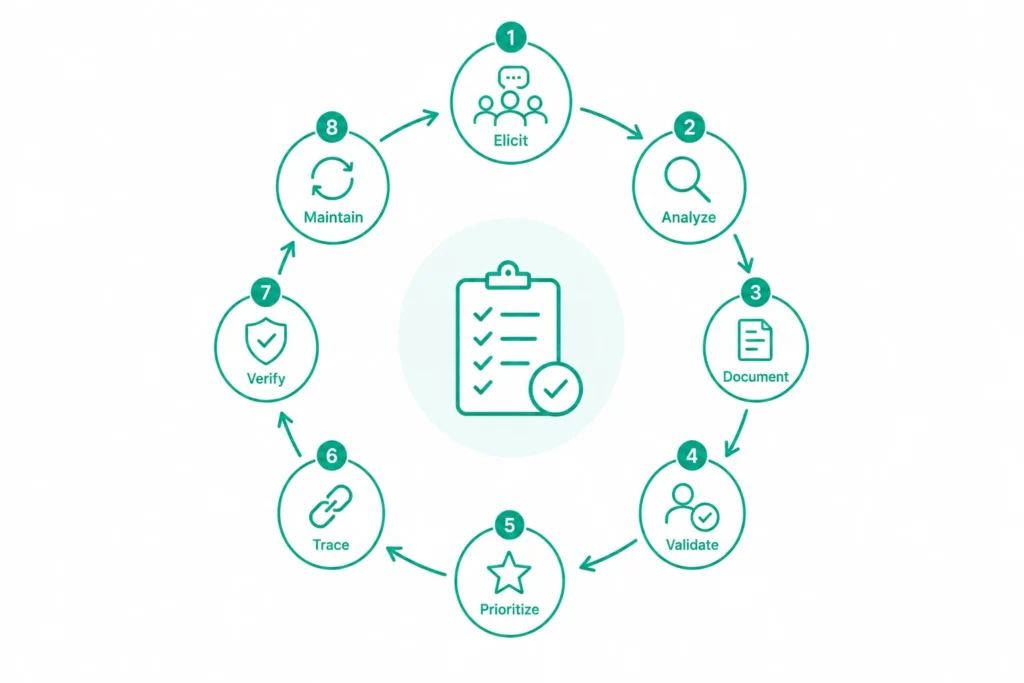
An effective Requirements Management process ensures that every requirement is captured, validated, approved, implemented, tested, and maintained throughout the product lifecycle. Rather than treating requirements as static documents, modern organizations manage them as living assets that evolve alongside the project.
A well-defined requirements management process in software engineering helps teams reduce misunderstandings, improve collaboration, maintain compliance, and deliver products that meet both customer expectations and business objectives.
Although every organization has its own methodology, most requirements management processes follow these key stages.
1. Requirements Elicitation
The process begins with gathering requirements from all relevant stakeholders. These may include customers, business leaders, product managers, engineers, regulatory authorities, suppliers, and end users.
Common elicitation techniques include:
- Stakeholder interviews
- Workshops
- Brainstorming sessions
- User observations
- Surveys
- Market research
- Existing system analysis
The objective is to understand business goals, customer expectations, technical constraints, and regulatory obligations before development begins.
2. Requirements Analysis
Once requirements are collected, they must be analyzed to ensure they are complete, feasible, and consistent.
During this stage, engineering teams identify:
- Duplicate requirements
- Conflicting requirements
- Missing information
- Technical feasibility
- Business priorities
- Compliance considerations
Analyzing requirements early helps prevent costly engineering changes later in the project.
3. Requirements Documentation
Approved requirements are documented using standardized templates and naming conventions to improve clarity and consistency.
Each requirement should include:
- Unique identifier
- Requirement description
- Business justification
- Priority
- Owner
- Source
- Acceptance criteria
- Status
- Version history
Maintaining standardized documentation makes requirements easier to review, trace, and update throughout the project lifecycle.
4. Validation and Approval
Before implementation begins, requirements should be reviewed and approved by all relevant stakeholders.
Validation answers questions such as:
- Does this requirement solve the intended business problem?
- Is the requirement technically feasible?
- Is it clear and unambiguous?
- Can it be tested?
- Does it comply with applicable standards?
Formal approval workflows reduce misunderstandings and ensure everyone is working toward the same objectives.
5. Prioritization
Not every requirement has the same business value. Prioritizing requirements helps development teams focus on the most important work first.
Common prioritization techniques include:
- MoSCoW Method
- Business Value Scoring
- Risk-Based Prioritization
- Cost vs. Value Analysis
- Kano Model
Prioritization enables organizations to deliver incremental value while managing limited development resources effectively.
6. Traceability
Traceability is one of the most important aspects of Digital Requirements Management.
Every requirement should be linked to:
- Business objectives
- System architecture
- Design artifacts
- Development tasks
- Test cases
- Validation results
- Defects
- Change requests
End-to-end traceability ensures every requirement can be followed throughout the engineering lifecycle.
Organizations implementing IBM Engineering Lifecycle Management often use OSLC integrations to connect requirements with development and testing activities.
7. Verification and Testing
Requirements should not only be documented—they must also be verified during development.
Verification ensures that:
- Every requirement has associated test cases.
- Product functionality matches documented requirements.
- Defects are linked back to affected requirements.
- Coverage gaps are identified before release.
Maintaining traceability between requirements and testing improves product quality while simplifying regulatory audits.
8. Ongoing Maintenance
Requirements continue evolving even after deployment.
Organizations should establish processes for:
- Updating requirements
- Managing revisions
- Archiving obsolete requirements
- Maintaining baselines
- Tracking approval history
- Reviewing requirement quality
This continuous maintenance ensures requirements remain accurate throughout the product lifecycle.
Requirements Management Process Flow
The following workflow illustrates how requirements move through a modern engineering lifecycle.
Stakeholder Needs
│
▼
Requirements Gathering
│
▼
Requirements Analysis
│
▼
Documentation
│
▼
Review & Approval
│
▼
Prioritization
│
▼
Implementation
│
▼
Verification & Testing
│
▼
Change Management
│
▼
Continuous Improvement
Each stage builds on the previous one, creating a structured framework for managing requirements from concept through deployment and maintenance.
End-to-End Requirements Traceability
One of the biggest advantages of a Requirements Management System is its ability to maintain complete traceability throughout the development lifecycle.
Traceability connects every engineering artifact, allowing teams to understand how requirements evolve and how changes affect downstream activities.
A typical traceability chain looks like this:
Business Need
│
▼
Stakeholder Requirement
│
▼
System Requirement
│
▼
Design
│
▼
Development
│
▼
Testing
│
▼
Verification
│
▼
Release
With complete traceability, organizations can:
- Verify implementation status
- Identify missing test coverage
- Analyze the impact of changes
- Demonstrate regulatory compliance
- Improve engineering collaboration
- Reduce project risks
Traceability is especially important for industries governed by standards such as ISO 26262, DO-178C, IEC 62304, and ASPICE.
Why Change Management Is Critical
Requirements rarely remain unchanged throughout a project. Customer feedback, market conditions, regulatory updates, and technical discoveries often introduce new requirements or modify existing ones.
Without a structured change management process, engineering teams may experience:
- Scope creep
- Conflicting documentation
- Duplicate development
- Missed deadlines
- Increased costs
- Product defects
Modern Requirements Management Software provides structured workflows for reviewing, approving, implementing, and tracking every change request.
Effective change management typically includes:
- Change request submission
- Impact analysis
- Stakeholder review
- Approval workflow
- Version updates
- Traceability updates
- Implementation tracking
This structured approach ensures changes are evaluated before implementation rather than disrupting development unexpectedly.
Variant Management in Requirements Engineering
Organizations developing configurable products often manage multiple product variants that share common functionality while supporting market-specific or customer-specific differences.
Examples include:
- Automotive vehicle models
- Aircraft configurations
- Medical device product families
- Industrial automation systems
- Consumer electronics
Managing separate requirement documents for every product variant quickly becomes difficult.
Variant Management allows organizations to reuse common requirements while maintaining unique requirements only where necessary.
Benefits include:
- Reduced duplication
- Faster product development
- Improved consistency
- Better traceability
- Lower maintenance effort
- Easier compliance management
Variant management is particularly valuable for organizations building product lines rather than individual products.
Benefits of Digital Requirements Management
Organizations transitioning from manual documentation to Digital Requirements Management often experience measurable improvements across engineering, quality, and project management.
Some of the key benefits include:
- Improved collaboration across distributed teams
- Faster requirement reviews and approvals
- Better traceability throughout the lifecycle
- Reduced engineering rework
- Stronger regulatory compliance
- Improved visibility into project status
- Simplified change management
- Better version control
- Increased engineering productivity
- Faster time-to-market
Modern digital platforms also improve reporting by providing real-time dashboards, requirement coverage analysis, and impact assessments.
Requirements Management Best Practices
Implementing a Requirements Management System is only the first step. The real value comes from following proven practices that improve requirement quality, collaboration, traceability, and project outcomes.
Organizations with mature requirements management processes consistently deliver projects faster, reduce engineering rework, and maintain better compliance because they establish disciplined methods for managing requirements throughout the lifecycle.
The following best practices can help engineering teams maximize the value of their requirements management efforts.
1. Define Clear and Measurable Requirements
Every requirement should be specific, testable, and easy to understand.
Poorly written requirements often contain ambiguous language that leads to different interpretations among engineering teams.
Instead of writing:
“The application should load quickly.”
Write:
“The application shall load within two seconds under normal operating conditions.”
Good requirements should be:
- Clear
- Complete
- Consistent
- Feasible
- Verifiable
- Traceable
- Unambiguous
- Necessary
Using standardized writing guidelines improves communication and reduces costly misunderstandings later in the project.
2. Maintain a Single Source of Truth
One of the biggest challenges organizations face is maintaining multiple copies of requirements across spreadsheets, Word documents, emails, and local files.
A centralized Requirements Management System ensures:
- Everyone works from the latest approved requirements.
- Duplicate documentation is eliminated.
- Changes are immediately visible.
- Version conflicts are avoided.
Modern digital platforms allow engineering, quality, testing, and management teams to collaborate using the same repository.
3. Establish End-to-End Traceability
Traceability is not only useful for compliance—it also improves project visibility.
Every requirement should be linked to:
- Business objectives
- Customer needs
- Design specifications
- Architecture models
- Development tasks
- Test cases
- Verification activities
- Defects
- Releases
Complete traceability helps organizations understand the downstream impact of every change.
4. Standardize Review and Approval Workflows
Formal reviews improve requirement quality while ensuring all stakeholders agree before implementation begins.
Typical review workflows include:
- Author review
- Technical review
- Business approval
- Compliance validation
- Final release approval
Workflow automation reduces manual effort while maintaining complete audit trails.
5. Prioritize Requirements Continuously
Business priorities change throughout development.
Regular backlog reviews help teams:
- Remove obsolete requirements
- Reprioritize features
- Reduce unnecessary work
- Align engineering with business goals
Continuous prioritization enables agile organizations to respond quickly to changing market conditions.
6. Integrate Requirements Across the Engineering Lifecycle
Requirements should never exist in isolation.
They should connect seamlessly with:
- System architecture
- Product planning
- Development
- Testing
- Quality management
- Release management
Organizations adopting Engineering Lifecycle Management (ELM) platforms gain significantly greater visibility because every engineering artifact remains connected throughout development.
Common Mistakes in Requirements Management
Even experienced engineering teams encounter challenges when managing complex requirements.
Some of the most common mistakes include:
| Mistake | Impact |
| Vague requirements | Misinterpretation and defects |
| Duplicate requirements | Conflicting implementations |
| Missing traceability | Difficult impact analysis |
| Poor stakeholder collaboration | Delayed approvals |
| Manual document management | Version conflicts |
| Ignoring requirement changes | Scope creep |
| Weak validation process | Increased rework |
| No baseline management | Compliance risks |
Avoiding these issues significantly improves project success rates.
AI in Requirements Management
Artificial Intelligence is transforming how organizations manage requirements.
Modern Requirements Management Software increasingly uses AI to improve requirement quality, reduce manual effort, and accelerate engineering reviews.
AI can assist engineering teams by:
- Detecting ambiguous wording
- Identifying duplicate requirements
- Flagging incomplete statements
- Recommending clearer language
- Checking compliance with writing standards
- Predicting change impacts
- Automating requirement classification
- Supporting intelligent search across repositories
Instead of replacing requirements engineers, AI acts as an intelligent assistant that helps improve consistency and quality.
As organizations adopt AI-powered engineering workflows, requirements become more accurate, easier to maintain, and better aligned with business objectives.
Requirements Management Across Industries
Although the core principles remain the same, different industries apply Requirements Management in unique ways depending on regulatory requirements, product complexity, and development methodologies.
Automotive Requirements Management
Modern vehicles combine mechanical, electrical, electronic, and software systems that must work together reliably.
Requirements Management helps automotive manufacturers:
- Manage vehicle variants
- Maintain ASPICE compliance
- Support ISO 26262 functional safety
- Improve software traceability
- Coordinate global engineering teams
As software-defined vehicles continue to evolve, digital requirements management becomes essential for managing increasing system complexity.
Related Reading: Addressing Complexity in Electric Vehicle (EV) System Design and Development Using IBM ELM
Aerospace Requirements Management
Aerospace organizations develop highly regulated systems where every requirement must be fully documented, implemented, verified, and audited.
Requirements Management supports:
- DO-178C compliance
- ARP4754A processes
- Configuration management
- Complete traceability
- Safety-critical development
Digital traceability significantly reduces certification effort while improving engineering efficiency.
Industrial Manufacturing
Manufacturers increasingly build configurable products that require managing thousands of reusable requirements across multiple product variants.
Requirements Management helps manufacturers:
- Reduce engineering duplication
- Reuse proven requirements
- Improve product quality
- Accelerate product development
- Manage configuration complexity
Medical Device Development
Medical device manufacturers must comply with stringent regulatory standards while maintaining complete documentation throughout product development.
Requirements Management enables organizations to:
- Maintain design history files
- Demonstrate regulatory compliance
- Connect requirements with risk analysis
- Improve verification activities
- Simplify audits
Choosing the Right Requirements Management Software
Selecting the right Requirements Management Software depends on project size, regulatory requirements, collaboration needs, and engineering complexity.
When evaluating solutions, organizations should look for capabilities such as:
- Centralized requirements repository
- Real-time collaboration
- Version control
- End-to-end traceability
- Workflow automation
- Change management
- Variant management
- AI-assisted requirement analysis
- Integration with development and testing tools
- Compliance reporting
The right platform should support both current engineering needs and future scalability.
IBM Engineering Requirements Management DOORS Next
Among enterprise-grade Requirements Management Systems, IBM Engineering Requirements Management DOORS Next is widely used by organizations developing complex products in industries such as automotive, aerospace, defense, electronics, industrial manufacturing, and healthcare.
Key capabilities include:
- Centralized digital requirements repository
- Real-time collaboration
- End-to-end lifecycle traceability
- Baselines and version management
- Configurable review workflows
- Change impact analysis
- OSLC-based integrations
- AI-assisted requirement quality analysis
- Compliance reporting
- Support for distributed engineering teams
Unlike traditional document-based approaches, DOORS Next enables organizations to manage requirements as interconnected digital assets throughout the engineering lifecycle.
For organizations evaluating enterprise solutions, it’s also helpful to compare different platforms based on collaboration capabilities, integrations, scalability, and lifecycle support.
Related Reading: IBM DOORS Next vs Polarion: Which Requirements Management Solution Is Right for You?
IBM Requirements Quality Assistant
Creating high-quality requirements consistently can be challenging, especially in large engineering projects involving multiple authors.
IBM Requirements Quality Assistant (RQA) uses artificial intelligence to evaluate requirement quality by identifying issues such as:
- Ambiguous language
- Passive voice
- Compound requirements
- Missing units
- Missing tolerances
- Incomplete statements
- Unspecified quantities
- Weak actors
- Negative requirements
- Escape clauses
By providing real-time recommendations, RQA helps engineering teams produce requirements that are clearer, more consistent, and easier to verify, ultimately reducing downstream defects and rework.
Why Organizations Choose IBM Engineering Requirements Management DOORS Next
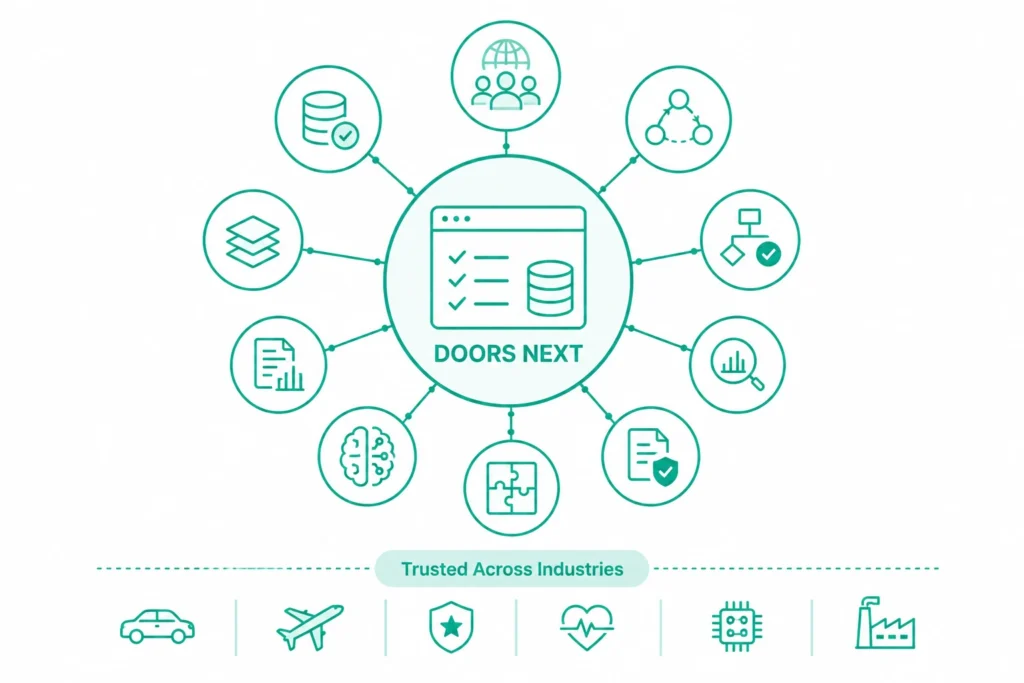
As products become increasingly software-driven and engineering teams become more distributed, organizations need more than a repository for storing requirements. They need a platform that supports collaboration, traceability, governance, and lifecycle management across multiple disciplines.
IBM Engineering Requirements Management DOORS Next is designed to meet these needs by helping organizations manage requirements throughout the entire engineering lifecycle. It enables teams to create, review, approve, version, and trace requirements while integrating seamlessly with architecture, development, testing, and quality management tools.
Key capabilities include:
- Centralized requirements repository
- Real-time collaboration across global teams
- End-to-end lifecycle traceability
- Configurable workflows and approvals
- Version and baseline management
- Change impact analysis
- AI-assisted requirement quality checks
- Compliance reporting
- OSLC-based integrations
- Scalable support for complex engineering programs
Organizations in automotive, aerospace, defense, healthcare, electronics, and industrial manufacturing use DOORS Next to improve engineering efficiency while maintaining compliance with industry standards.
For organizations still using legacy Migrating IBM DOORS to Doors Next enhanced collaboration, browser-based access, modern lifecycle management capabilities, and easier integration with the IBM Engineering Lifecycle Management ecosystem.
Tips for Successfully Implementing Requirements Management
Technology alone does not guarantee successful requirements management. Organizations should establish governance, standardized processes, and stakeholder collaboration from the beginning.
Some practical implementation recommendations include:
Define a Standard Requirements Process
Establish clear workflows for:
- Requirement creation
- Review
- Approval
- Versioning
- Change requests
- Traceability
- Validation
Standardized processes improve consistency across projects.
Engage Stakeholders Early
Successful requirements begin with active stakeholder participation.
Include representatives from:
- Business
- Engineering
- Product Management
- Quality Assurance
- Compliance
- Customers
- Suppliers
Early collaboration reduces misunderstandings and costly changes later in development.
Maintain Requirement Quality
Every requirement should remain:
- Clear
- Concise
- Complete
- Testable
- Traceable
- Measurable
Periodic reviews help maintain documentation quality throughout long development cycles.
Build Complete Traceability
Link requirements to:
- Business goals
- Architecture
- Design
- Source code
- Test cases
- Defects
- Releases
Complete traceability significantly simplifies audits and impact analysis.
Use Dashboards and Reporting
Real-time dashboards provide visibility into:
- Requirement status
- Review progress
- Test coverage
- Change requests
- Compliance readiness
Organizations relying on reporting for decision-making should also understand common reporting challenges within IBM ELM environments.
Train Engineering Teams
Requirements Management is as much about people as technology.
Provide regular training on:
- Writing quality requirements
- Traceability
- Change management
- Review workflows
- Tool usage
- Industry standards
Consistent training ensures teams follow established best practices.
For organizations planning an enterprise rollout, following proven implementation practices can significantly reduce adoption challenges.
Related Reading: Tips for Successful IBM ELM Implementation
Why Choose MicroGenesis TechSoft for Requirements Management?
Implementing a robust Requirements Management strategy requires expertise in engineering processes, digital transformation, and lifecycle management. MicroGenesis TechSoft helps organizations modernize requirements management by combining domain expertise with proven IBM Engineering Lifecycle Management solutions.
MicroGenesis supports customers across industries such as automotive, aerospace, defense, industrial manufacturing, electronics, and healthcare by helping them:
- Assess existing requirements management practices
- Migrate from legacy requirements tools
- Implement IBM Engineering Requirements Management DOORS Next
- Improve requirements quality and traceability
- Integrate requirements with development, testing, and quality management tools
- Configure workflows, reporting, and governance
- Train engineering teams on best practices
- Accelerate digital engineering initiatives
With extensive experience in IBM Engineering Lifecycle Management implementations, MicroGenesis enables organizations to improve collaboration, reduce engineering risks, and deliver high-quality products more efficiently.
Frequently Asked Questions (FAQs)
What is Requirements Management?
Requirements Management is the process of capturing, documenting, organizing, analyzing, tracking, and maintaining requirements throughout the product or software development lifecycle to ensure that business and customer needs are successfully implemented.
Why is Requirements Management important?
Requirements Management helps reduce project risks, improve collaboration, maintain traceability, control requirement changes, and ensure products meet customer expectations and regulatory requirements.
What is Digital Requirements Management?
Digital Requirements Management replaces spreadsheets and manual documentation with centralized software platforms that provide collaboration, version control, traceability, workflow automation, and reporting throughout the engineering lifecycle.
What is the difference between Requirements Engineering and Requirements Management?
Requirements Engineering focuses on eliciting, analyzing, documenting, and validating requirements, while Requirements Management ensures those requirements remain controlled, traceable, and maintained throughout the project lifecycle.
What is a Requirements Management System?
A Requirements Management System is software that helps organizations capture, organize, review, version, trace, and manage requirements while integrating with development, testing, and engineering tools.
Which industries benefit from Requirements Management?
Requirements Management is widely used in:
- Automotive
- Aerospace
- Defense
- Industrial Manufacturing
- Medical Devices
- Electronics
- Telecommunications
- Software Development
These industries rely on strong traceability and compliance throughout complex product development lifecycles.
What are the benefits of Requirements Management Software?
Requirements Management Software helps organizations:
- Improve collaboration
- Maintain version control
- Automate workflows
- Strengthen traceability
- Simplify compliance
- Reduce engineering rework
- Improve product quality
- Accelerate time-to-market
Conclusion
As products become more connected, software-intensive, and subject to evolving regulatory requirements, Requirements Management has become a strategic capability rather than simply a documentation activity. Organizations that establish structured requirements management processes can improve collaboration, reduce development risks, maintain compliance, and deliver higher-quality products with greater confidence.
Transitioning from document-based approaches to Digital Requirements Management enables engineering teams to manage requirements as living assets throughout the entire product lifecycle. Features such as end-to-end traceability, version control, change management, AI-assisted quality analysis, and lifecycle integration help organizations respond more effectively to changing business and customer needs.
For enterprises developing complex systems, platforms such as IBM Engineering Requirements Management DOORS Next provide the scalability, governance, and collaboration required to manage modern engineering programs successfully.
Whether you’re beginning your digital engineering journey or modernizing an existing requirements management strategy, investing in the right processes, best practices, and technology lays the foundation for delivering innovative, compliant, and high-quality products. For organizations looking to maximize the value of IBM Engineering Lifecycle Management, understanding the broader benefits of the platform can help shape a successful long-term engineering strategy.