

Choosing a Salesforce implementation partner is one of the most important decisions you will make when introducing or expanding Salesforce across your organization.
The platform itself offers powerful capabilities for managing customer relationships, sales processes, service operations, and business data. But the value your business receives depends heavily on how Salesforce is implemented.
Consider two companies investing in the same Salesforce products.
The first works with a consulting team that understands its sales processes, existing applications, data challenges, and long-term business goals.
The second selects a provider based mainly on price and a promise of quick deployment.
Both companies may successfully launch Salesforce. However, their experiences after go-live could be very different.
One may have a CRM that supports daily operations and connects with existing systems. The other may struggle with incomplete integrations, duplicate customer records, complicated workflows, and employees who continue using spreadsheets.
The difference often comes down to implementation planning, technical expertise, and the quality of the delivery partnership.
If you are wondering how to choose a Salesforce implementation partner, this guide explains the selection criteria, questions to ask, common mistakes to avoid, and how to evaluate potential consulting providers before making a decision.
Why Choosing the Right Salesforce Implementation Partner Matters
Salesforce implementation involves more than configuring CRM features.
For enterprise businesses, it may require connecting multiple departments, migrating customer information, integrating existing applications, and introducing new processes across the organization.
An implementation partner should help you understand these requirements before recommending a solution.
For example, a manufacturing company may need Salesforce Sales Cloud to manage opportunities while its ERP system continues handling orders, inventory, and invoicing.
The implementation must account for how customer and order information moves between the two systems.
A partner who focuses only on Salesforce configuration may overlook important integration and data management requirements.
A suitable Salesforce consulting partner should therefore understand both the platform and the business environment in which it will operate.
Our Salesforce Implementation Services Guide for Enterprise Businesses explains how CRM strategy, architecture, integration, migration, and deployment fit together.
8 Key Criteria for Choosing a Salesforce Implementation Partner
Not every Salesforce consulting company offers the same expertise, delivery model, or level of support.
The right choice depends on your implementation scope, existing technology environment, and internal capabilities.
Here are eight important factors to evaluate.
1. Relevant Salesforce Implementation Experience
Start by understanding the provider’s experience with projects similar to yours.
A consultant may have extensive experience implementing Salesforce for small sales teams but limited exposure to enterprise environments involving multiple departments and integrations.
Ask about projects involving comparable business processes, Salesforce products, and technical complexity.
Questions to consider:
Have they implemented Salesforce for organizations of similar size?
Have they worked with Sales Cloud, Service Cloud, or Experience Cloud?
Can they explain how they managed complex implementation challenges?
Can they provide relevant project examples or customer references?
For example, if your business operates across multiple countries, experience with regional workflows, access permissions, and centralized reporting may be particularly valuable.
Look for relevant experience rather than simply the number of projects completed.
2. Salesforce Certifications and Technical Expertise
Salesforce certifications can help demonstrate knowledge of particular platform capabilities.
Depending on your requirements, relevant credentials may include Salesforce Administrator, Platform Developer, Application Architect, or other role-specific certifications.
However, certification alone does not guarantee successful project delivery.
You should also evaluate whether the proposed team can translate technical knowledge into practical business solutions.
Ask which certified professionals will work directly on your project and what responsibilities they will hold.
If a company claims to be a Salesforce Certified Consulting Partner, verify its current partner status through official Salesforce partner information rather than relying only on website claims.
The objective is to confirm both credentials and delivery capability.
3. Understanding of Your Business Processes
A good Salesforce implementation partner should ask detailed questions about how your organization operates.
They should want to understand your sales cycle, customer service processes, reporting requirements, and operational challenges.
Be cautious if a provider recommends specific Salesforce features before discussing your business needs.
Practical example:
A B2B engineering company manages long sales cycles involving technical evaluations, proposals, commercial negotiations, and multiple decision-makers.
A standard opportunity workflow may not adequately represent these stages.
An experienced consultant should first understand the sales process and then recommend suitable Salesforce configuration.
The goal is not to force every business activity into a generic CRM template.
4. Enterprise Integration Capabilities
For many enterprises, Salesforce must work with existing applications.
These may include ERP platforms, finance systems, marketing tools, customer support applications, and internal databases.
Integration requirements should be evaluated before implementation begins.
Ask prospective partners how they approach:
API and middleware integration.
Data synchronization between applications.
Security and access controls.
Error handling and monitoring.
Data ownership and duplicate records.
Future integration requirements.
For example, a company may need approved opportunities in Salesforce to trigger downstream order-processing activities in its ERP system.
The partner must understand the complete business process, not just the Salesforce portion.
This is particularly important when evaluating top Salesforce consulting partners for enterprises, where integration complexity can be a major differentiator.
Need Salesforce to connect with existing enterprise systems? Discuss your Salesforce consulting requirements with MicroGenesis to explore an implementation approach that considers your broader technology environment.
5. Data Migration and Quality Management
Moving customer data into Salesforce can become complicated when information is distributed across multiple systems.
Before selecting a partner, understand how they plan to assess and migrate your data.
A reliable migration approach should include source analysis, data mapping, cleansing, trial migrations, validation, and reconciliation.
For example, an organization may have the same customer listed under different names in its legacy CRM and finance system.
Migrating both records without reviewing duplicates could affect reporting and account management.
Ask the provider who will be responsible for data cleansing and how migration accuracy will be validated.
A clear answer indicates that the partner understands the operational importance of data quality.
6. Implementation Methodology and Project Governance
A well-defined delivery approach helps organizations manage requirements, responsibilities, timelines, and risks.
Ask the consulting provider to explain how it handles discovery, solution design, configuration, testing, deployment, and post-go-live support.
Look for clear project milestones, defined responsibilities, and regular progress reviews.
An implementation plan should also explain how changes to the original scope will be evaluated and approved.
Our article on seven common Salesforce implementation challenges and how to avoid them explores problems that can arise when requirements, integrations, and project responsibilities are not managed effectively.
7. User Adoption and Training Support
A successful Salesforce implementation depends on whether employees can use the platform effectively.
A consulting partner should consider user adoption during solution design, not only after deployment.
Ask how the provider involves business users, conducts training, and gathers feedback.
For example, if sales representatives must navigate several screens to update a simple opportunity, they may return to spreadsheets.
A partner should identify such usability problems during testing and improve workflows before go-live.
Training should also reflect different user roles.
Sales representatives, service agents, administrators, and managers do not need identical training.
Our guide to Salesforce implementation mistakes that affect user adoption explains how workflow complexity and insufficient user involvement can affect CRM adoption.
8. Post-Implementation Support and Managed Services
Salesforce requirements continue to change after implementation.
Organizations may introduce new workflows, add integrations, modify reports, or expand Salesforce to additional teams.
Before signing a contract, understand what happens after go-live.
Does the provider offer hypercare? Can it support enhancements? Who handles administration and integration issues?
A partner with relevant managed services capabilities may be useful when your organization requires ongoing operational support.
However, the scope, response expectations, and responsibilities should be clearly defined.
Salesforce Implementation Partner Selection Checklist
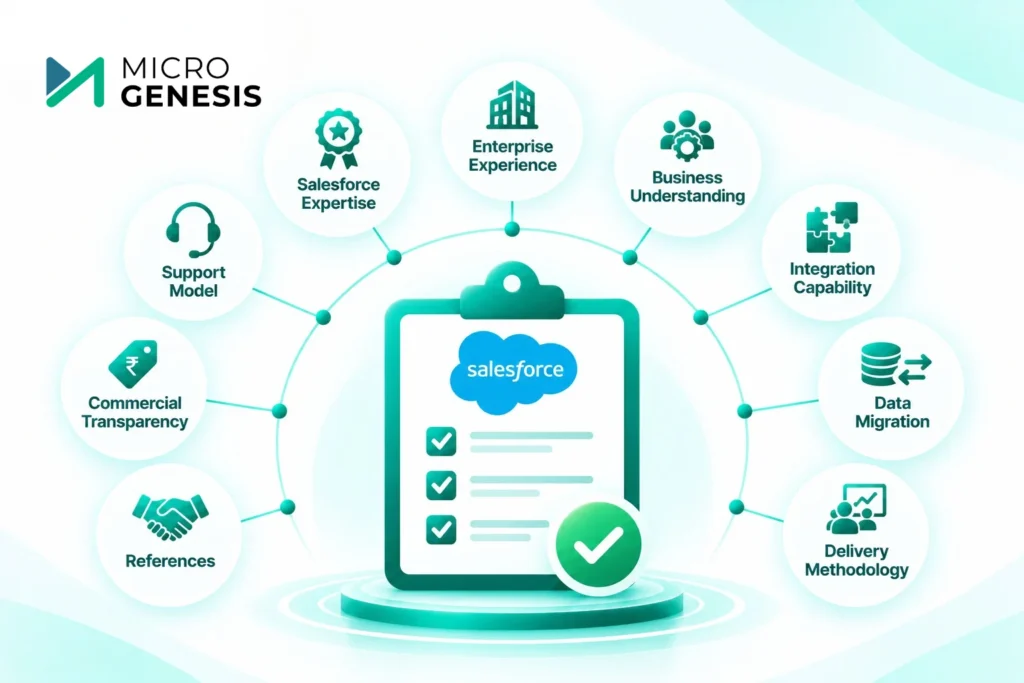
A structured evaluation makes it easier to compare providers consistently.
Use the following checklist during your selection process.
| Evaluation criteria | What to verify | Priority |
|---|---|---|
| Salesforce expertise | Relevant product knowledge and verified certifications | High |
| Enterprise experience | Similar implementation scope and complexity | High |
| Business understanding | Ability to translate processes into CRM requirements | High |
| Integration capability | Experience connecting enterprise applications | High |
| Data migration | Defined migration and validation approach | High |
| Delivery methodology | Clear milestones, testing and governance | High |
| User adoption | Training and change management approach | High |
| Support model | Hypercare, administration and ongoing assistance | Medium to high |
| Commercial transparency | Clear scope, assumptions and pricing | High |
| References | Relevant and verifiable customer experience | High |
You can adapt these criteria based on your project.
For example, integration expertise may carry more weight for a business connecting Salesforce with several enterprise applications, while training and adoption may be the main concern for a company replacing a widely used legacy CRM.
Questions to Ask a Salesforce Consulting Partner Before Hiring
A proposal presentation can make almost any provider look capable.
The real evaluation begins when you ask how the team would handle your specific requirements.
Here are ten practical questions worth discussing.
1. What Salesforce implementations have you completed that are similar to ours? Ask for relevant examples and the challenges addressed.
2. Who will actually work on our project? Understand the proposed team’s experience, certifications, roles, and availability.
3. How will you assess our existing business processes? Look for a structured discovery approach rather than immediate configuration recommendations.
4. How do you decide between standard Salesforce configuration and custom development? The answer should consider maintainability and business requirements.
5. How will you integrate Salesforce with our existing applications? Ask about data ownership, synchronization, security, and error handling.
6. What is your approach to data migration? Discuss cleansing, mapping, testing, and reconciliation.
7. How will you manage project scope and changing requirements? Look for clear approval and change-control practices.
8. What testing will be completed before go-live? Confirm functional, integration, data, and user acceptance testing.
9. How will you support user adoption? Ask about training, business-user involvement, and post-launch feedback.
10. What support is available after implementation? Clarify hypercare, ongoing administration, enhancements, and commercial terms.
A capable provider should be able to answer these questions with specific processes and examples.
Salesforce Implementation Partner vs In-House Team
Should you hire a Salesforce implementation partner or build the solution using your internal team?
There is no universal answer.
The decision depends on your existing Salesforce expertise, project complexity, delivery timeline, and long-term support requirements.
| Consideration | In-house team | External implementation partner |
|---|---|---|
| Business knowledge | Strong understanding of internal processes | Requires discovery and stakeholder engagement |
| Salesforce expertise | Depends on existing team capabilities | Can provide specialized project expertise |
| Enterprise integration | Depends on internal technical resources | May provide dedicated integration experience |
| Resource availability | Competes with existing operational priorities | Resources can be assigned to the project |
| Long-term ownership | Direct internal control | Requires agreed handover and support arrangements |
| Cost structure | Internal staffing and capability development | Project fees and potential support charges |
For many enterprises, a hybrid approach is practical.
Internal stakeholders provide business knowledge and decision-making, while an implementation partner supports architecture, configuration, integration, and delivery.
This also helps the organization retain ownership of its processes and platform after implementation.
Salesforce SI Partner vs Boutique Consultancy: Which Is Better?
Organizations often compare large Salesforce system integrators (SIs) with smaller specialist consulting firms.
Both models can be suitable depending on project requirements.
Large Salesforce System Integrators
Larger providers may offer broad delivery capacity, established governance structures, and access to multiple technical disciplines.
They may be appropriate for complex, multi-region transformation programs.
However, organizations should still confirm which team will deliver the project and whether the proposed engagement model fits their needs.
Boutique Salesforce Consultancies
Smaller specialist firms may offer focused Salesforce expertise, direct access to senior consultants, and flexible engagement arrangements.
They may be suitable for clearly defined implementations or specialized Salesforce requirements.
However, their capacity for complex integrations, multiple parallel workstreams, or long-term support should be evaluated.
The better choice is not necessarily the larger or smaller provider. It is the team that can demonstrate relevant expertise, sufficient capacity, and a delivery approach suited to your business.
How to Compare Salesforce Consulting Partner Proposals
When reviewing proposals, avoid comparing only the total implementation price.
Two providers may quote different amounts because they have made different assumptions about scope, testing, integrations, or support.
A useful comparison should examine the complete proposed engagement.
What Should a Salesforce Proposal Include?
Defined business objectives and implementation scope.
Salesforce products and functional requirements.
Integration and data migration responsibilities.
Project phases and estimated timelines.
Proposed delivery team and responsibilities.
Testing, deployment, and training activities.
Post-go-live support arrangements.
Assumptions, exclusions, and change-request procedures.
Commercial terms and payment milestones.
Example: Comparing Two Implementation Proposals
Suppose Provider A quotes a lower implementation fee but excludes data cleansing, integration testing, and post-launch support.
Provider B quotes a higher fee that includes these activities.
Provider A may initially appear more affordable, but the organization could face additional costs when the excluded work becomes necessary.
A fair comparison requires understanding what each proposal includes.
Our guide to Salesforce implementation costs and project investment factors explains the factors that influence implementation budgets.
Comparing Salesforce implementation proposals? Request a Salesforce consultation with MicroGenesis to discuss your requirements and define an appropriate project scope.
Red Flags to Watch for When Evaluating Salesforce Partners
Some warning signs deserve attention during the selection process.
Promising an Unrealistically Fast Implementation
A provider should understand your requirements before committing to a detailed delivery timeline.
Complex integrations, data migration, and user testing can significantly affect project duration.
Recommending Extensive Customization Too Early
Custom development may be necessary, but it should solve a genuine business requirement.
Unnecessary customization can increase maintenance effort and complicate future changes.
Providing Vague Integration Plans
If a provider says integration will be straightforward without reviewing your existing applications, ask for more detail.
Ignoring User Adoption
A technically complete Salesforce environment may still struggle if employees are not prepared to use it.
Unclear Post-Go-Live Responsibilities
Organizations should know who will resolve issues, maintain integrations, and manage changes after deployment.
Lack of Transparent Project Scope
Unclear deliverables and exclusions can create disagreements during implementation.
A reliable consulting relationship begins with realistic expectations and clear responsibilities.
How MicroGenesis Approaches Salesforce Consulting and Implementation
For enterprise businesses, Salesforce is rarely an isolated application.
It often needs to connect with existing business systems, support multiple departments, and remain manageable as requirements evolve.
MicroGenesis approaches Salesforce consulting with this broader enterprise perspective.
Our positioning combines Salesforce-focused implementation planning with capabilities across enterprise engineering, application integration, and managed services.
Business-First Discovery
We focus on understanding existing processes, operational challenges, and implementation objectives before defining the solution.
Enterprise Integration Perspective
Our broader technology capabilities help us consider how Salesforce should interact with ERP platforms, internal applications, and other business systems.
Practical Implementation Planning
We consider architecture, configuration, data migration, testing, and deployment as connected activities rather than isolated tasks.
Long-Term Operational Considerations
Salesforce environments require ongoing administration, improvements, and support.
We help organizations consider these requirements when defining the implementation and operating approach.
The right engagement should reflect your business objectives, technical complexity, internal capabilities, and expected outcomes.
Looking to hire a Salesforce implementation partner? Explore MicroGenesis Salesforce Consulting Services and discuss your implementation requirements with our team.
What to Do Before Finalizing Your Salesforce Implementation Partner
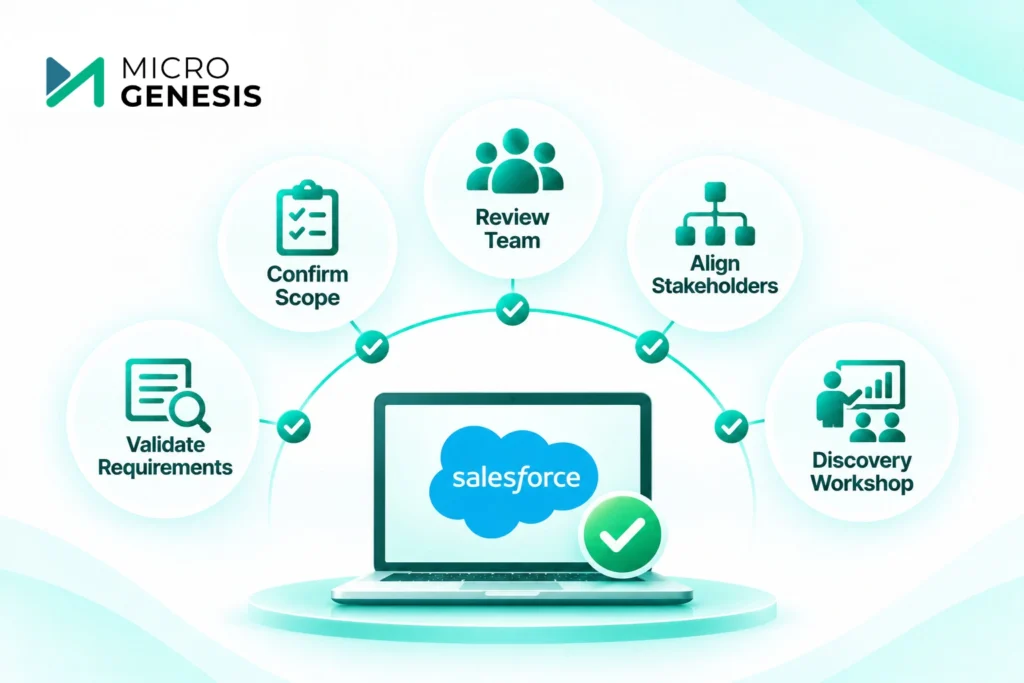
Once you have shortlisted potential partners, complete a final review before signing the agreement.
Confirm that the selected provider understands your requirements, has proposed an appropriate team, and has clearly documented the implementation scope.
You should also align internal stakeholders on project ownership, decision-making responsibilities, and expected outcomes.
A practical next step is to conduct a discovery workshop with the shortlisted provider.
This gives both teams an opportunity to clarify requirements, identify dependencies, and determine whether the proposed delivery approach is realistic.
For a structured preparation process, use our Salesforce Implementation Checklist for Enterprise Businesses before finalizing the project.
Frequently Asked Questions About Salesforce Implementation Partners
How do I choose the best Salesforce implementation partner?
Evaluate relevant Salesforce experience, verified certifications, business understanding, integration capabilities, implementation methodology, data migration expertise, user training, and post-go-live support. Choose a provider whose capabilities match your specific project requirements.
Should I hire a certified Salesforce consulting partner?
Verified Salesforce credentials and partner status can be useful indicators of platform expertise. However, organizations should also evaluate relevant project experience, the proposed delivery team, customer references, and technical capabilities.
How much does it cost to hire a Salesforce implementation partner?
Costs depend on the implementation scope, Salesforce products, customization, integrations, data migration, training, and support requirements. Request a detailed proposal that separates included services, assumptions, and potential additional costs.
Is a Salesforce implementation partner better than an in-house team?
An external partner can provide specialized implementation expertise, while an internal team offers valuable business knowledge and long-term ownership. Many organizations benefit from combining both approaches.
What should I look for in Salesforce consulting partner reviews?
Look for feedback about communication, delivery quality, technical expertise, problem-solving, project management, and post-implementation support. Prioritize reviews and references from projects similar to yours.
Final Thoughts: Choose a Partner Who Understands Your Business
Selecting a Salesforce implementation partner should not be based only on certifications, company size, or the lowest proposal.
The right partner should understand your business processes, evaluate your existing technology environment, explain technical decisions clearly, and establish a realistic implementation plan.
For enterprise organizations, integration capabilities, data quality, user adoption, and long-term support are particularly important.
Take time to compare providers, ask detailed questions, and validate their experience before making a decision.
A thoughtful selection process can help you avoid unnecessary complexity and build a Salesforce environment that supports your business beyond the initial launch.
Discuss Your Salesforce Implementation with MicroGenesis
Are you evaluating Salesforce consulting partners, preparing an implementation project, or looking for support with enterprise CRM integration?
MicroGenesis brings together Salesforce consulting with enterprise engineering, integration, and managed services capabilities to support your CRM transformation.
Schedule a Salesforce Consultation with MicroGenesis to discuss your requirements, implementation priorities, and next steps.