Software is increasingly responsible for controlling systems that can create serious risks if something goes wrong. Industrial automation, process control, machinery, and automotive electronics all depend on software to monitor conditions, make decisions, and respond to faults.
In these environments, software development cannot focus only on whether a function works under normal conditions. Engineering teams must also demonstrate that safety-related functions behave as intended, that potential failures have been considered, and that verification evidence supports the safety claims.
This is where IEC 61508 becomes important. It is a foundational international standard for the functional safety of electrical, electronic, and programmable electronic safety-related systems. It provides a lifecycle-based framework for identifying hazards, assessing risk, specifying safety functions, and developing systems to achieve the required level of risk reduction.
For software teams, understanding IEC 61508 involves more than knowing what a Safety Integrity Level (SIL) means. It requires understanding how safety requirements translate into software architecture, implementation, verification, configuration management, and documented evidence.
In this guide, we explain IEC 61508, its software-specific expectations, how SIL classification works, and how the standard compares with automotive functional safety standard ISO 26262.
What Is IEC 61508?
IEC 61508 is a generic functional safety standard covering electrical, electronic, and programmable electronic systems used to perform safety functions. It applies across industries where these technologies contribute to risk reduction.
The standard takes a lifecycle approach. Safety is considered from initial hazard and risk analysis through requirements specification, design, implementation, verification, operation, maintenance, and modification.
The central idea is straightforward: the safety measures applied to a system should be appropriate to the risks associated with its potential failures.
For example, consider an industrial machine that uses a programmable controller to stop dangerous movement when a protective guard is opened. Engineers must establish the required safety behaviour, determine the necessary risk reduction, design the safety-related control system, and verify that the complete function meets its requirements.
Software is only one part of that function. Sensors, logic solvers, actuators, hardware architecture, and the operating environment may also contribute to the overall safety performance.
IEC 61508 provides the overarching framework for managing these relationships.
For a broader introduction to the underlying concept, read what functional safety means.
Where IEC 61508 is used
IEC 61508 is a generic standard that supports functional safety across different sectors. Sector-specific standards may build on its principles and adapt them to particular industries.
Examples include:
Industrial process control and automation.
Machinery and programmable safety systems.
Electrical and electronic equipment used in safety-related applications.
Development of safety-related embedded software.
Safety engineering for systems where failures can contribute to hazardous events.
It is important to select the standard applicable to the actual product and industry. IEC 61508 is not automatically the governing standard for every safety-related software project.
Planning to improve functional safety across your engineering lifecycle? MicroGenesis helps organisations strengthen requirements management, traceability, and lifecycle workflows for safety-related software development. Explore our ALM services to understand how the right processes and tools can support your compliance objectives.
Understanding Safety Integrity Levels (SIL)
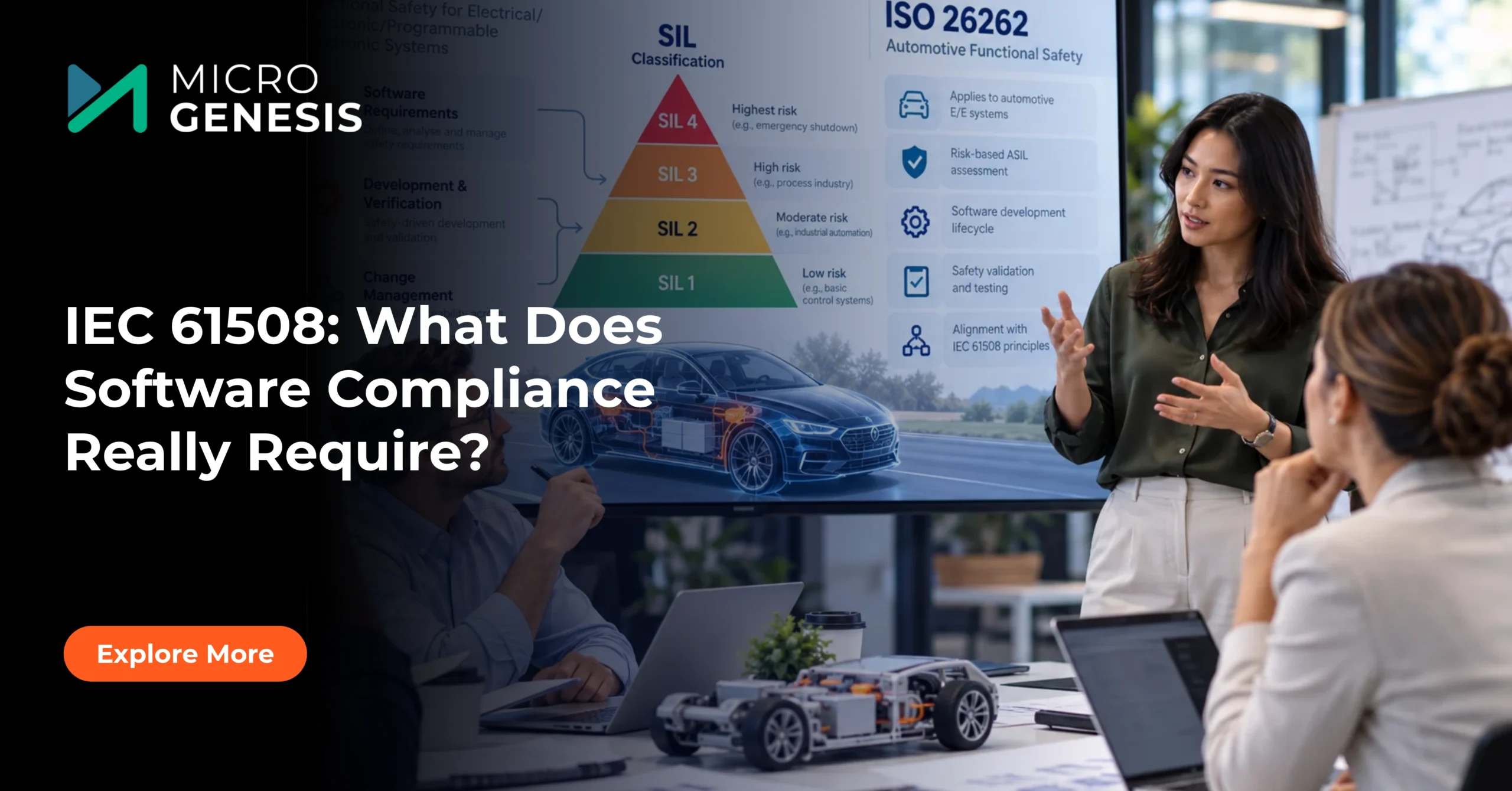
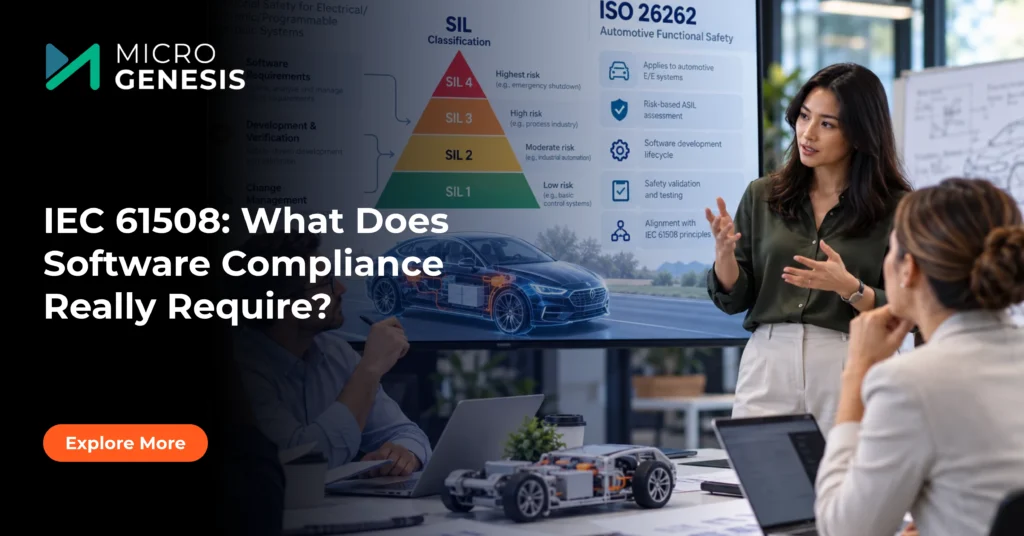
One of the best-known concepts in IEC 61508 is the Safety Integrity Level, or SIL. It represents a level of risk reduction required from a safety function.
IEC 61508 defines four levels, from SIL 1 to SIL 4. SIL 4 represents the highest level of safety integrity within the standard’s framework.
SIL level | General interpretation |
|---|---|
SIL 1 | Lowest of the four specified levels of safety integrity |
SIL 2 | Higher safety integrity requirements than SIL 1 |
SIL 3 | Higher safety integrity requirements than SIL 2 |
SIL 4 | Highest level of safety integrity under IEC 61508 |
The required SIL is determined through hazard and risk assessment, considering factors such as the consequences of a hazardous event and the risk reduction needed from the safety function.
For example, an industrial process may require a safety function that detects a dangerous pressure condition and initiates a shutdown. The required integrity level depends on the risk analysis and the role of that function in reducing risk.
A critical point for software teams is that SIL is not simply a software quality rating. It applies to the safety function and its supporting safety-related system. Software development measures must contribute to achieving the required safety integrity, but software alone does not establish the SIL of the complete function.
The applicable requirements also depend on how the safety function operates. IEC 61508 distinguishes between low-demand operation and high-demand or continuous operation when evaluating dangerous failure probabilities.
This distinction matters because engineers cannot assign a SIL based only on how important a software module appears. The assessment must consider the complete safety function, its architecture, operating mode, and risk reduction requirements.
Software-Specific Requirements Under IEC 61508
Software presents a particular functional safety challenge: many dangerous failures arise not from random hardware faults, but from systematic errors in requirements, design, implementation, or verification.
A software defect may remain hidden until a particular combination of inputs, timing conditions, or system states occurs. IEC 61508-3 addresses software requirements for safety-related systems and software used to develop or configure those systems.
The aim is to establish a controlled development process that reduces the likelihood of systematic failures and provides evidence that the software meets its safety requirements.
Need support managing software requirements and verification evidence for safety-related systems? MicroGenesis helps engineering teams establish connected requirements, test management, and traceability workflows. Explore our Codebeamer ALM solutions to see how lifecycle management can support your software development and compliance processes.
A. Define clear and testable software safety requirements
Software safety requirements should be derived from the safety requirements allocated to the software. They need to specify expected behaviour, relevant operating conditions, failure responses, and interfaces with other components.
Consider a controller that must detect a pressure sensor reading outside a permitted range.
A vague requirement might say that the software must handle sensor faults. A more useful requirement identifies the conditions for fault detection, the required response, timing constraints where applicable, and the expected diagnostic behaviour.
Clear requirements make implementation decisions easier to review and tests easier to design.
Digital requirements management can help teams maintain these relationships as requirements evolve. Explore the complete guide to digital requirements management.
B. Use a controlled software development lifecycle
Safety-related software should be developed through a defined lifecycle, with appropriate activities and deliverables for each stage.
Depending on the project and applicable requirements, these activities can include:
Software safety requirements specification.
Software architecture and design.
Detailed design and implementation.
Unit verification and integration testing.
Software safety validation.
Configuration management and change control.
Verification reviews and documented evidence.
The specific techniques and level of rigour depend on the applicable IEC 61508 requirements, the SIL, and the software lifecycle approach.
For example, a safety-related controller may pass its unit tests but still fail when integrated with a sensor interface or communication subsystem. Integration verification must therefore assess interactions and failure behaviour, not just the correctness of individual functions.
See test management and its role in software quality for more on organising test activities and results.
C. Apply appropriate verification and validation
Verification asks whether the software work products satisfy their specified requirements. Validation considers whether the resulting system fulfils its intended safety-related purpose in the relevant context.
Both matter.
A test suite may demonstrate that an algorithm produces the expected output for a defined set of inputs. However, the engineering team must also establish whether the requirements cover the relevant hazardous conditions and whether the complete safety function behaves as intended.
Depending on the project, evidence may include requirements reviews, design reviews, static analysis, unit testing, integration testing, fault-injection testing, and system-level validation.
Testing alone is not sufficient to demonstrate compliance. It must be part of a broader safety lifecycle that includes suitable design methods, reviews, analysis, and documentation.
For practical guidance on structuring this work, read compliance-ready software development.
D. Maintain traceability and configuration control
Safety-related software evolves. Requirements change, defects are corrected, components are updated, and test cases are revised. Without configuration control, teams can lose track of which software version was verified against which requirements.
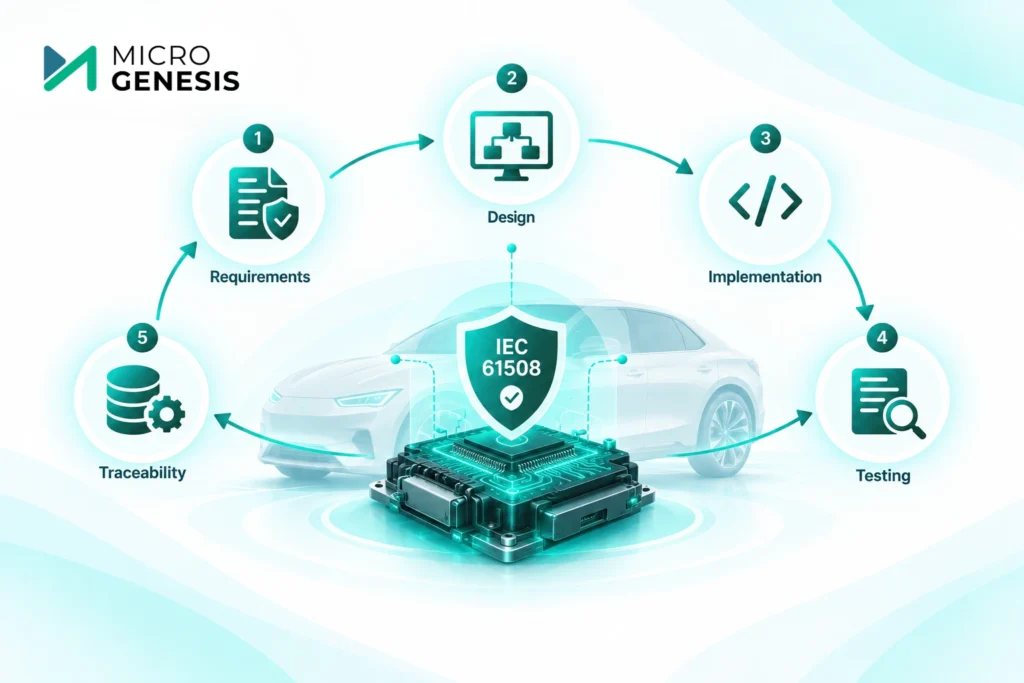
A useful traceability chain connects:
Safety Requirements → Software Requirements → Design → Implementation → Verification Evidence
This allows engineers to identify missing verification links, assess the effect of changes, and establish which evidence applies to a particular software baseline.
For example, if a change modifies how a controller responds to a sensor fault, the team should be able to identify the affected requirements, implementation elements, tests, and approval records.
A structured ALM environment can help maintain these relationships across the lifecycle.
If your organisation is reviewing how to manage safety-related requirements, testing, and change records, explore MicroGenesis ALM services. The focus should be on aligning the platform and its workflows with your applicable safety lifecycle, not simply adding more documentation.
IEC 61508 vs ISO 26262: What Is the Difference?
IEC 61508 and ISO 26262 share functional safety principles, but they serve different purposes.
IEC 61508 is the generic functional safety standard for electrical, electronic, and programmable electronic safety-related systems. ISO 26262 adapts functional safety principles to electrical and electronic systems in road vehicles.
Area | IEC 61508 | ISO 26262 |
|---|---|---|
Primary scope | Generic functional safety across relevant industries | Functional safety of electrical and electronic systems in road vehicles |
Integrity classification | Safety Integrity Levels, SIL 1 to SIL 4 | Automotive Safety Integrity Levels, ASIL A to ASIL D, plus QM |
Risk analysis | Uses the applicable IEC 61508 hazard and risk assessment approach | Uses automotive hazard analysis and risk assessment, including severity, exposure, and controllability |
Software development | Software requirements are addressed in IEC 61508-3 | Software development is addressed in ISO 26262-6 |
Lifecycle focus | Generic safety lifecycle | Automotive-specific safety lifecycle and development practices |
Typical context | Industrial control, machinery, and other safety-related systems | Automotive electrical and electronic systems |
Why the distinction matters
Consider an organisation developing two products: an industrial safety controller and an automotive electronic control unit.
The industrial controller may fall under IEC 61508, while the automotive controller may need to follow ISO 26262, depending on the product and applicable requirements.
Although the standards share underlying principles, their classifications, processes, and required work products are not interchangeable. SIL and ASIL are different classification systems, and there is no direct one-to-one conversion between them.
Organisations should determine the applicable standard based on the product, industry, contractual obligations, and regulatory context.
For a closer look at automotive functional safety, see ASPICE vs ISO 26262. Automotive SPICE focuses on assessing development process capability, whereas ISO 26262 addresses functional safety. Neither should be treated as a substitute for the other.
Need help managing functional safety requirements across engineering projects? MicroGenesis helps organisations improve requirements traceability, lifecycle management, and engineering workflows using enterprise ALM solutions. Explore our IBM Engineering Lifecycle Management services to learn how connected engineering processes can support your safety and compliance objectives.
5. How ALM Tools Support IEC 61508 Software Compliance
A lifecycle management tool does not make software compliant with IEC 61508 on its own. Compliance depends on the applicable requirements, engineering methods, competent personnel, reviews, verification activities, and evidence.
However, a well-configured ALM environment can make these activities easier to manage and demonstrate.
Useful capabilities include:
Requirements management: Maintaining approved requirements, versions, and relationships.
Traceability: Connecting software requirements to design, implementation, tests, and review records.
Test management: Organising test plans, cases, execution results, and defects.
Change management: Identifying affected work products and recording impact assessments and approvals.
Configuration management: Preserving the relationship between a software baseline and the evidence associated with it.
Reporting: Helping teams identify missing links, incomplete reviews, and unresolved verification activities.
For example, before approving a release, a project team may need to establish that all required software verification activities have been completed, relevant defects have been assessed, and the evidence corresponds to the approved baseline.
A connected ALM workflow can help assemble this information without relying entirely on manually maintained spreadsheets.
MicroGenesis supports organisations evaluating and implementing lifecycle management capabilities. Explore Codebeamer ALM for requirements and test management needs, or IBM Engineering Lifecycle Management for enterprise engineering lifecycle requirements.
The appropriate platform depends on the existing toolchain, the development process, integration needs, and the evidence that must be maintained.
Practical Steps to Prepare for IEC 61508 Software Compliance
If your team is beginning an IEC 61508 initiative or reviewing an existing development process, start with the engineering lifecycle rather than the tool selection.
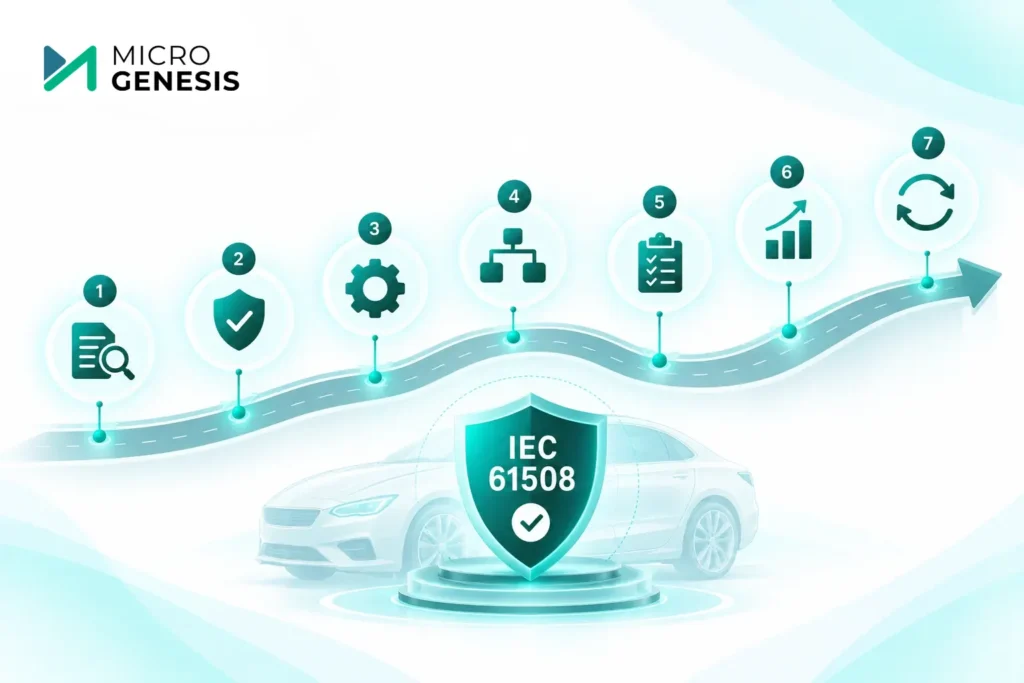
Confirm the applicable standard and scope. Establish which systems and software components are safety-related and which requirements apply.
Understand the safety requirements. Identify the allocated safety functions, required integrity levels, and software responsibilities.
Assess the current development process. Review requirements management, design practices, verification, configuration control, and change management.
Establish traceability. Connect requirements, design, implementation, and verification evidence at the level required by the project.
Review verification coverage. Check whether the planned methods provide appropriate evidence for the software requirements and relevant failure conditions.
Address gaps systematically. Prioritise missing evidence, weak change control, unclear ownership, and disconnected tools.
Maintain the process throughout development. Treat compliance as an ongoing lifecycle responsibility rather than a final documentation exercise.
An assessment can help distinguish gaps in the engineering process from gaps in tool configuration. That distinction is important because a new platform will not solve unclear requirements or inconsistent verification practices by itself.
If you need support reviewing your current lifecycle processes, MicroGenesis ALM services can be a starting point for discussing requirements management, traceability, and toolchain integration needs.
Why Businesses Choose MicroGenesis
Implementing a structured functional safety lifecycle requires more than selecting the right software platform. Organisations need effective requirements management, traceability, verification workflows, and change control to keep engineering activities aligned with project and compliance objectives.
MicroGenesis helps engineering organisations improve their Application Lifecycle Management (ALM) practices through consulting, implementation, and lifecycle integration support.
Businesses choose MicroGenesis for:
ALM Implementation and Consulting: Support for establishing lifecycle workflows that align with engineering processes and project requirements.
Requirements Traceability: Connecting requirements, design activities, test cases, and verification evidence to improve visibility across development.
Enterprise ALM Expertise: Support for evaluating and implementing platforms such as IBM Engineering Lifecycle Management and Codebeamer.
Test Management Integration: Improving the connection between requirements, test execution, defects, and verification records.
Lifecycle Process Improvement: Identifying gaps in existing workflows and helping teams improve change management, configuration control, and engineering collaboration.
Whether your organisation develops industrial control systems or safety-related embedded software, the right ALM approach can help make engineering evidence easier to manage and review. Tool implementation alone does not guarantee compliance, so workflows must be aligned with the applicable standard and safety lifecycle.
Looking to strengthen your engineering lifecycle and compliance processes? Explore MicroGenesis ALM services, learn about IBM Engineering Lifecycle Management, or discover Codebeamer ALM for requirements and test management.
Final Thoughts
IEC 61508 provides a structured framework for developing electrical, electronic, and programmable electronic safety-related systems. For software teams, the central challenge is to turn safety requirements into a controlled development process with suitable design, verification, traceability, and change management.
SIL classification helps establish the required safety integrity for a safety function, while IEC 61508-3 addresses the software lifecycle activities needed to support that objective.
ISO 26262 applies functional safety principles specifically to road vehicles. Although it shares foundations with IEC 61508, its automotive-specific requirements and ASIL classification system must be treated separately.
The practical objective is to make safety requirements clear, verification evidence reliable, and software changes controlled throughout the lifecycle. With the right engineering processes and appropriately configured ALM capabilities, organisations can improve visibility into their safety-related development work and make compliance evidence easier to maintain and review.