Functional safety compliance is not just about having the right processes in place. For automotive and embedded software teams, the tools used to manage requirements, testing, changes, and evidence can have a major impact on how effectively those processes are followed.
Consider a simple situation.
A safety-related requirement changes late in development. The engineering team needs to know what design elements are affected, which software components implement the requirement, which tests verify it, whether those tests need to be repeated, and what evidence needs to be retained.
If all of this information is spread across spreadsheets, documents, emails, and separate test repositories, answering those questions can take considerable effort.
With the right tool support, the same information can be connected through traceability, workflows, baselines, audit trails, and reports.
That does not mean a tool makes an organization compliant automatically. It means the tool can provide the structure needed to execute, monitor, and demonstrate a defined engineering process.
For teams new to the topic, what functional safety means in software development provides a useful foundation before looking at the role of tools.
What Should Functional Safety and Compliance Tools Actually Do?
Before comparing tools, it is worth asking a more practical question:
What should the tool help the engineering team accomplish?
A useful compliance-oriented tool should help teams:
- Define and manage requirements
- Connect requirements to design and implementation
- Create and manage verification activities
- Maintain traceability
- Control changes
- Manage baselines and versions
- Record reviews and approvals
- Preserve audit trails
- Identify gaps
- Generate reports
- Provide evidence for assessments
The exact capabilities will vary between platforms.
A requirements management tool may focus heavily on requirements and traceability. An ALM platform may extend that coverage into testing, defects, workflows, and change management. A dedicated safety tool may focus on safety analysis and safety-specific activities.
The important thing is to understand which part of the compliance lifecycle the tool is supporting.
For teams evaluating how requirements, testing, traceability, change management, and compliance activities can work together, ALM consulting services can help define an approach aligned with the existing engineering lifecycle.
This is particularly relevant when organizations are working with both Automotive SPICE and ISO 26262. They address different aspects of automotive engineering, so it is useful to understand ASPICE vs ISO 26262 before defining the tool requirements.
1. Requirements Management Features That Support Compliance
Requirements are the foundation of most compliance-related evidence.
If requirements are unclear, poorly controlled, or disconnected from verification, it becomes difficult to demonstrate that the intended engineering process was followed.
A compliance-supporting requirements tool should therefore provide more than a place to store text.
Requirement Versioning and Baselines
Requirements rarely remain unchanged throughout a project.
A requirement may be modified because of:
- A customer request
- A design decision
- A safety analysis
- A defect
- A regulatory requirement
- A change in system architecture
The tool should make it possible to understand what changed, when it changed, and which version was approved.
Baselines become particularly important when a project needs to demonstrate the state of requirements at a specific point in time.
For example:
Release 1.0 → Requirement Baseline A
Release 1.1 → Requirement Baseline B
If someone later asks what requirements were approved for Release 1.0, the team should not have to reconstruct the answer from old documents.
The baseline should provide that historical view.
Requirement Reviews and Approvals
Another useful capability is structured review and approval.
Instead of receiving approvals through email and manually updating a spreadsheet, the tool can provide a defined workflow:
Draft → Review → Changes Required → Approved → Baselined
This creates a record of the decision-making process.
It also makes ownership clearer.
Who reviewed the requirement?
When was it approved?
Was a change requested?
Which version was finally approved?
These questions become easier to answer when the review history is maintained within the lifecycle environment.
2. Test Management Features That Support Compliance
Requirements alone do not demonstrate that the software satisfies them.
Verification provides the other side of the story.
A compliance-supporting test environment should allow teams to connect requirements with appropriate verification activities.
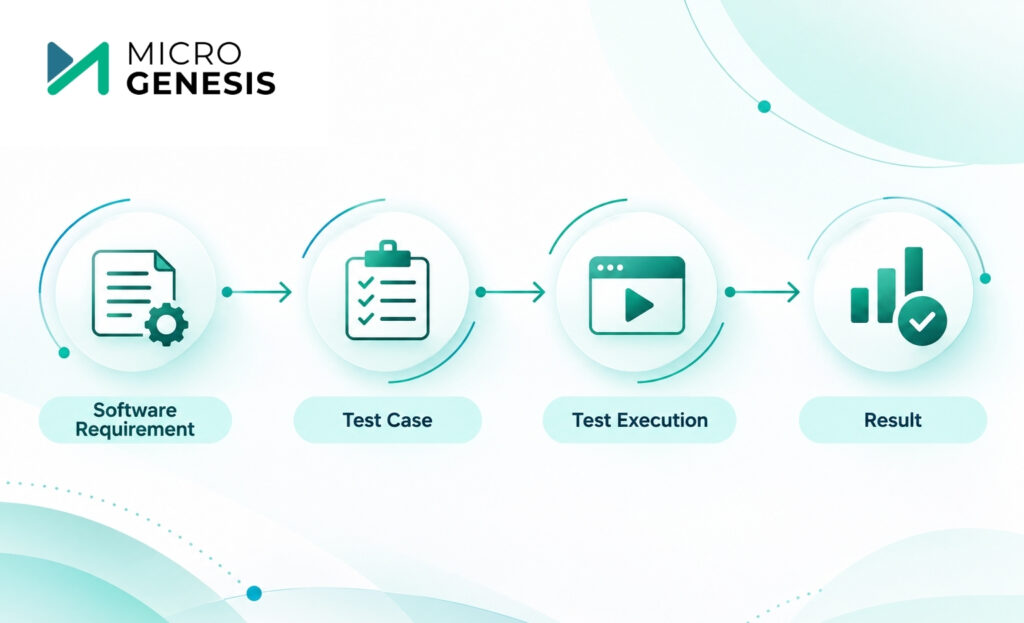
For example:
Software Requirement → Test Case → Test Execution → Result
That connection provides a much stronger evidence chain than maintaining requirements and test results in separate systems.
Test Coverage
One of the first questions an engineering team may face during an assessment is:
“How do you know that the relevant requirements have been verified?”
A test management system should make it possible to identify:
- Which requirements have tests
- Which requirements have no verification coverage
- Which tests have been executed
- Which tests passed
- Which tests failed
- Which failures remain unresolved
This gives engineering teams visibility before an assessment takes place.
It also helps prevent a common problem: discovering verification gaps only when the project is already approaching release.
Test Evidence
A useful test environment should preserve information such as:
- Test case definition
- Test procedure
- Test environment
- Test execution date
- Tester
- Result
- Defects
- Retest information
The level of evidence required will depend on the project, organization, applicable standards, and assessment expectations.
The principle remains the same:
The tool should help the team demonstrate what was verified and what happened during verification.
3. Traceability Matrices: Turning Relationships Into Evidence
Traceability is one of the most valuable capabilities for compliance-oriented engineering.
A traceability matrix can show relationships between different lifecycle artefacts.
For example:
Requirement | Design | Implementation | Test | Result |
REQ-001 | DES-012 | SW-145 | TC-031 | Pass |
REQ-002 | DES-014 | SW-162 | TC-045 | Pass |
REQ-003 | DES-017 | SW-188 | TC-052 | Failed |
The table itself is useful, but the real value comes from being able to navigate those relationships.
Suppose REQ-002 changes.
The engineering team should ideally be able to identify the related design, implementation, and verification artefacts and determine what needs to be reviewed.
That is more useful than simply having a static spreadsheet containing the word “traceability.”
Forward Traceability
Forward traceability answers:
What happened to this requirement after it was created?
For example:
Requirement → Design → Code → Test
This helps demonstrate implementation and verification coverage.
Backward Traceability
Backward traceability asks:
Why does this engineering or test activity exist?
For example:
Test → Requirement → Source
This helps teams understand the reason behind an activity.
Both directions matter when building a defensible engineering evidence chain.
4. Audit Trails: Showing What Changed and Who Changed It
Traceability tells you how artefacts are connected.
An audit trail tells you how those artefacts evolved.
This distinction becomes important when requirements or other engineering artefacts change over time.
A useful audit trail can capture information such as:
- Who made the change
- What was changed
- When it was changed
- Previous version
- New version
- Review status
- Approval
- Related change request
For example:
Requirement REQ-105
Version 1.0: Original requirement
↓
Change requested
↓
Version 1.1: Updated timing requirement
↓
Reviewed by engineering
↓
Approved by responsible stakeholder
↓
Baselined
That history provides context that a simple document repository may not provide.
It can also make internal investigations easier.
If a test result changed after a requirement was modified, the team can investigate the relationship between the two events rather than searching manually through multiple systems.
5. Change Impact Analysis
Change management is another area where tool support can make a significant difference.
In safety-related software development, a small requirement change may have wider consequences.
For example:
Sensor requirement changes
↓
System requirement affected
↓
Software requirement affected
↓
Architecture affected
↓
Implementation affected
↓
Test case affected
The engineering team needs to know this before the change is considered complete.
A connected ALM environment can help identify related artefacts and make impact analysis more systematic.
This does not replace engineering judgment.
The tool identifies relationships. Engineers determine the actual impact.
That distinction is important.
Automation can expose the connections. Engineering teams still make the decisions.
When these relationships span requirements, architecture, implementation, testing, and change management, application lifecycle management solutions can provide a structured environment for managing traceability and impact relationships.
6. Reporting for Assessors and Regulators
The next question is often:
How do we turn all this information into useful evidence?
This is where reporting becomes important.
Assessors, customers, internal quality teams, and regulatory stakeholders may need different views of the same engineering information.
A compliance-supporting tool should therefore provide flexible reporting rather than forcing teams to manually assemble every report.
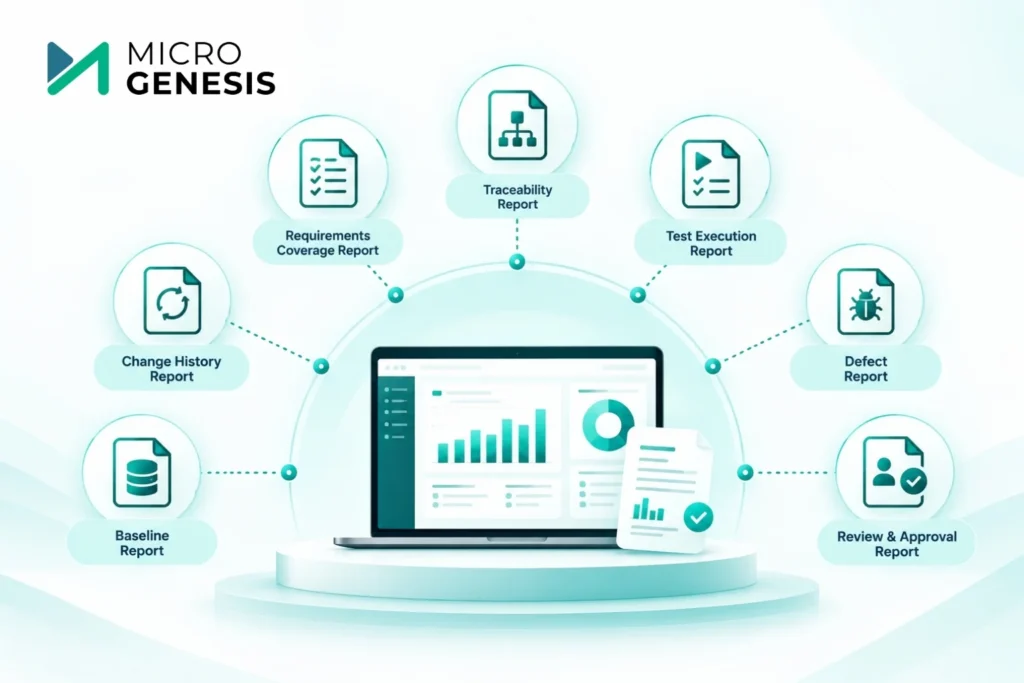
Useful Compliance Reports
Depending on the project, useful reports may include:
Requirements Coverage Report
Shows requirements and their associated verification activities.
Traceability Report
Shows relationships between requirements, design, implementation, and testing.
Test Execution Report
Shows test execution status and results.
Change History Report
Shows significant changes and approvals.
Baseline Report
Shows the approved state of engineering artefacts at a specific milestone.
Defect Report
Shows open, closed, and verification-related defects.
Review and Approval Report
Shows who reviewed or approved specific engineering artefacts.
These reports can provide assessors with a structured view of the evidence rather than requiring engineers to manually collect documents from multiple locations.
7. Reporting Should Help Assessors Answer Questions
Good compliance reporting is not about generating hundreds of pages.
It is about making important questions easier to answer.
For example:
Question: How was this requirement verified?
Report: Requirement → Test Case → Execution → Result.
Question: What changed between two baselines?
Report: Version comparison and change history.
Question: Who approved this requirement?
Report: Review and approval history.
Question: Are all safety-related requirements covered by verification?
Report: Requirement-to-test coverage.
Question: What could be affected by this change?
Report: Traceability and impact relationships.
This is where reporting becomes genuinely useful.
Instead of treating compliance reporting as a documentation exercise, teams can use it as a way to provide visibility into the engineering lifecycle.
8. Tool Examples: DOORS, Codebeamer and Dedicated Safety Tools
There is no single tool that fits every organization.
The right choice depends on the existing engineering environment, product complexity, safety requirements, processes, integrations, and level of lifecycle coverage required.
Several categories are commonly considered.
IBM DOORS / DOORS Next
IBM DOORS Next is primarily associated with requirements management and traceability.
It can support capabilities such as:
- Requirements management
- Requirements organization
- Reviews
- Versioning
- Baselines
- Traceability
- Impact analysis
- Configuration management
- Reporting
For organizations already operating within the IBM Engineering Lifecycle Management ecosystem, requirements information can also be connected with other engineering lifecycle activities.
This can be particularly useful where requirements and traceability form a central part of the organization’s compliance process.
If your organization is already using or evaluating IBM’s engineering ecosystem, IBM Engineering Lifecycle Management is worth exploring as part of a broader lifecycle approach.
PTC Codebeamer
PTC Codebeamer takes a broader ALM approach, bringing requirements, risk, testing, workflows, and traceability into a connected environment.
For organizations working with complex product development and regulated engineering processes, this broader lifecycle approach can be useful when the objective is to connect requirements with downstream development and verification activities.
The important comparison is not simply:
Which tool has more features?
Instead, ask:
Which tool fits the way our engineering organization needs to work?
Dedicated Safety Tools
Some organizations also use dedicated tools for specific safety engineering activities.
These may support areas such as:
- Safety analysis
- Hazard analysis
- FMEA
- Fault Tree Analysis
- Safety cases
- Safety work products
- Safety lifecycle management
Dedicated safety tools can be particularly relevant when an organization has complex safety analysis requirements that extend beyond conventional requirements and test management.
In some environments, these tools may be used alongside an ALM platform rather than replacing it.
That creates another important requirement:
The tools need to exchange information effectively.
9. What Should You Look for When Evaluating a Tool?
Rather than starting with a product name, start with your engineering workflow.
Ask these questions.
Requirements
- Can we version requirements?
- Can we create baselines?
- Can requirements be reviewed and approved?
- Can relationships between requirements be maintained?
Traceability
- Can we trace requirements to tests?
- Can we trace tests back to requirements?
- Can we perform impact analysis?
- Can we generate traceability reports?
Change Management
- Can changes be controlled?
- Is change history retained?
- Can approvals be recorded?
- Can affected artefacts be identified?
Testing
- Can test cases be connected to requirements?
- Are execution results retained?
- Can failures be linked to defects?
- Can verification coverage be measured?
Auditability
- Is there a reliable audit trail?
- Can historical versions be retrieved?
- Can users and approvals be identified?
- Can baselines be reproduced?
Reporting
- Can reports be customized?
- Can evidence be generated by project or release?
- Can assessors access the information they need?
- Can management get a high-level view without losing engineering detail?
Integration
- Can the tool connect with development environments?
- Can it integrate with testing tools?
- Can it exchange information with other ALM platforms?
- Can it support the organization’s existing engineering ecosystem?
These questions usually provide more useful information than simply comparing feature lists.
10. Tool Support Does Not Replace Process Discipline
There is one point worth emphasizing.
Buying a compliance tool does not make a development organization compliant.
A team can have an advanced ALM platform and still have:
- Poorly defined requirements
- Missing reviews
- Incomplete traceability
- Weak change control
- Inconsistent testing
- Poor ownership
- Missing evidence
The tool provides the infrastructure.
The organization provides the process.
The engineering team provides the execution.
This is why tool selection should happen alongside process definition.
If you want to understand how compliance activities can be incorporated into the wider development lifecycle, Building a Compliance-Ready Software Lifecycle covers how checkpoints, evidence, roles, and continuous compliance can be integrated into the V-model.
How MicroGenesis Can Help Connect Compliance and ALM
For many organizations, the difficult part is not identifying that they need traceability or better reporting.
The difficult part is figuring out how those capabilities should fit into the existing engineering process.
For example, a team may already have requirements in one system, testing in another, development activities elsewhere, and safety evidence maintained through documents.
Simply introducing another tool may create another information silo.
A more practical approach is to first understand the engineering lifecycle, identify where traceability and evidence gaps exist, and then determine how ALM capabilities can address them.
MicroGenesis supports organizations in structuring ALM environments around requirements, traceability, testing, change management, and connected engineering workflows.
If your current compliance process involves manually preparing traceability reports, searching for approval records, or collecting evidence from multiple systems before every assessment, MicroGenesis ALM Software Solutions can be a starting point for evaluating a more connected approach.
For organizations already working with IBM engineering technologies, IBM Engineering Lifecycle Management can also provide a broader framework for connecting requirements and engineering lifecycle activities.
The goal should not be to introduce technology simply because compliance requires it.
The goal should be to make the engineering process more connected, more visible, and easier to demonstrate.
Final Thoughts
Functional safety and compliance management require more than documentation.
Engineering teams need to demonstrate how requirements were defined, reviewed, implemented, verified, changed, and approved.
That is where tool support becomes valuable.
A well-designed tool environment can provide:
- Structured requirements management
- Test and verification coverage
- Traceability matrices
- Change impact analysis
- Version and baseline control
- Audit trails
- Review and approval history
- Evidence reporting
- Lifecycle visibility
Tools such as IBM DOORS Next, PTC Codebeamer, and dedicated safety engineering platforms can address different parts of this landscape. The right choice depends on the organization’s engineering processes, existing toolchain, safety needs, lifecycle complexity, and integration requirements.
The important question is therefore not simply:
Which compliance tool should we buy?
A better starting point is:
What evidence do we need to produce, how is that evidence created during engineering, and what tool capabilities can make that process reliable?
When requirements, testing, changes, approvals, and evidence are connected from the beginning, compliance becomes part of engineering rather than a separate activity that teams have to reconstruct at the end.