
Service Level Agreements (SLAs) define what customers can expect from an IT or service provider and how performance will be measured. But creating an SLA is only the first step. Organizations need clear metrics, automated monitoring, escalation rules, and regular reviews to ensure service commitments are consistently achieved.
For organizations using Jira Service Management, effective SLA implementation can improve service visibility, prioritize requests, identify breaches, and give leadership measurable insight into service performance.
This guide explains what an SLA is, how SLA implementation works, which SLA metrics to track, common challenges, and best practices for improving SLA performance.
What Is an SLA?
A Service Level Agreement (SLA) is a formal agreement between a service provider and customer that defines expected service levels, responsibilities, response times, resolution targets, and performance measurements.
For example, an IT service desk may define a 1-hour response SLA for critical incidents and a 4-hour resolution target for high-priority requests.
An effective SLA should be measurable, achievable, business-relevant, and understood by both service teams and customers.
Planning a Jira Service Management implementation?
Talk to our Atlassian experts about designing SLA workflows around your business requirements.
Why Are SLAs Important?
SLAs create measurable expectations between service teams and customers. They help organizations prioritize work, monitor service quality, identify performance gaps, and establish accountability.
For service leaders, SLA management also provides a common framework for discussing service performance with business stakeholders.
Atlassian recommends tracking metrics such as time to first response, time to resolution, SLA achievement, and customer satisfaction when evaluating service performance.
What Are the Key Components of an SLA?
A well-designed SLA typically includes:
- Service scope – What services are covered?
- Response targets – How quickly should the team respond?
- Resolution targets – How quickly should issues be resolved?
- Availability targets – What uptime is expected?
- Priority levels – How are incidents classified?
- Escalation procedures – What happens when an SLA is at risk?
- Reporting requirements – How will performance be measured?
- Exclusions – Which situations are outside the SLA?
- Review frequency – When should the SLA be reassessed?
The objective is to create an SLA that is measurable, realistic, and aligned with business priorities.
Types of Service Level Agreements
There are three commonly used SLA structures.
Customer-Based SLA
A customer-based SLA defines service commitments for a specific customer or customer group. It typically covers service scope, availability, response times, resolution targets, responsibilities, and escalation procedures.
Internal SLA
An internal SLA defines service expectations between departments within the same organization.
For example, IT may establish an SLA with HR for employee onboarding requests or with Finance for application-support requests.
Multilevel SLA
A multilevel SLA applies different service commitments to different customer groups, services, or subscription levels.
This approach is useful when organizations offer multiple service tiers with different response and resolution requirements.
SLA vs KPI: What Is the Difference?
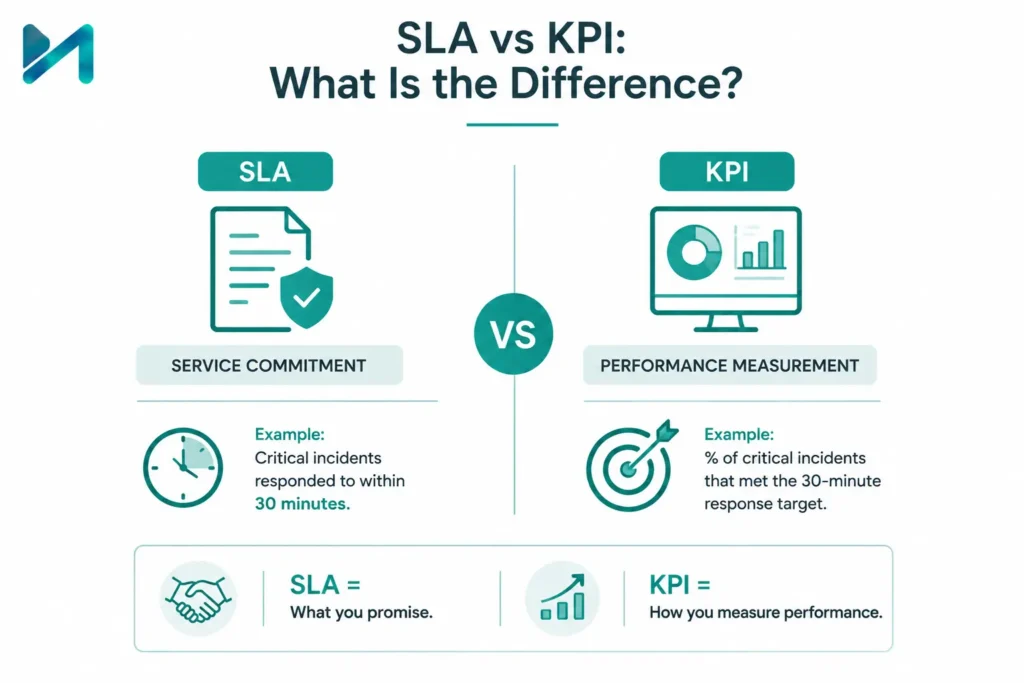
An SLA defines the service commitment, while a KPI measures performance.
For example, an SLA may require critical incidents to receive a response within 30 minutes. A KPI could measure the percentage of critical incidents that actually received a response within that target.
In simple terms:
SLA = What you promise.
KPI = How you measure performance.
What SLA Metrics Should You Track?
The right metrics depend on the service, but most IT service teams should monitor:
- SLA compliance rate
- SLA breach rate
- Time to first response
- Time to resolution
- Mean time to resolution (MTTR)
- First-contact resolution
- Customer satisfaction (CSAT)
- Number of escalations
- Reopened tickets
- Backlog age
Modern ITSM platforms provide dashboards for monitoring these metrics and identifying SLA trends. Jira Service Management, for example, provides reporting for SLA met vs. breached, time to first response, time to resolution, workload, and customer satisfaction.
Need better SLA visibility?
Explore MicroGenesis Atlassian solutions to improve SLA reporting, workflows, and service management.
What Is a Good SLA Compliance Rate?
There is no universal SLA target because service requirements differ by business, priority, and service type.
As a useful benchmark, the Freshservice 2025 ITSM Benchmark reported an average 96.16% SLA resolution rate and 95.99% SLA response rate across its benchmark data. The report analyzed data from more than 10,700 teams.
Organizations should therefore establish targets based on their own service criticality, historical performance, customer expectations, and industry requirements rather than blindly adopting an industry percentage.
How to Implement SLAs Successfully
SLA implementation should follow a structured process.
Identify Business-Critical Services
Start by identifying the services that have the greatest impact on customers, employees, revenue, or operations.
Not every service requires the same SLA.
Define Service Priorities
Create clear priority levels such as:
- Critical
- High
- Medium
- Low
Then define response and resolution targets for each priority.
Define Measurable SLA Targets
Avoid vague commitments such as “respond quickly.”
Instead, define measurable targets such as:
Critical incident → 30-minute response
High-priority request → 2-hour response
Standard request → 8-hour response
Targets should be realistic and achievable.
Define SLA Working Hours
Determine whether the SLA operates:
- 24/7
- Business hours only
- Regional working hours
- Custom support schedules
This prevents disputes around how SLA time is calculated.
Configure Escalation Rules
Create automated escalation when an SLA approaches its threshold.
For example:
75% elapsed → Agent notification
90% elapsed → Team lead notification
100% elapsed → Escalation
Automation can prevent teams from discovering breaches only after they happen.
Want to automate Jira workflows and SLA escalation?
Speak with our Atlassian implementation team.
How to Monitor SLA Performance
Effective SLA monitoring requires more than checking whether a ticket breached its target.
Track:
- SLA trends over time
- Breaches by priority
- Breaches by service
- Breaches by support team
- First-response performance
- Resolution performance
- Customer satisfaction
- Recurring SLA failures
Atlassian’s Jira Service Management reporting includes SLA met vs. breached reporting and allows teams to analyze first-response and resolution performance.
How to Reduce SLA Breaches
SLA breaches are usually symptoms of process, capacity, prioritization, or workflow problems.
To reduce them:
Identify the most common breach reasons.
Improve ticket categorization.
Automate repetitive requests.
Improve knowledge-base coverage.
Create escalation rules.
Balance agent workloads.
Review SLA targets regularly.
Track recurring bottlenecks.
For organizations using Jira, workflow automation can help reduce manual intervention and improve consistency.
Related: Jira Automation Workflows
SLA Best Practices for IT Service Teams
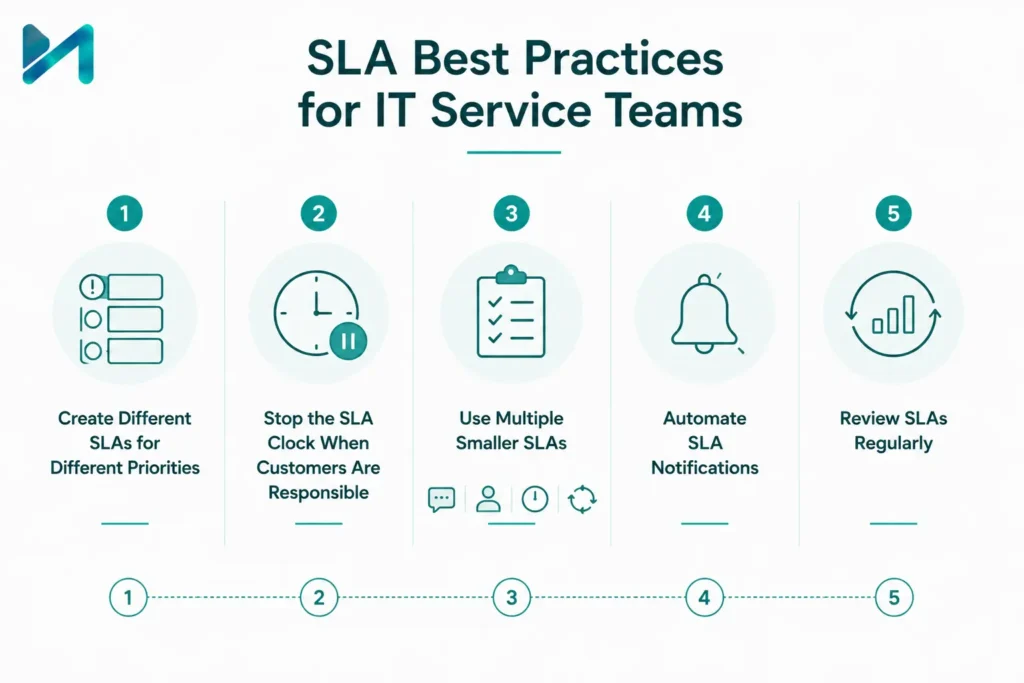
Create Different SLAs for Different Priorities
Critical incidents should not have the same response target as low-priority requests.
Use priority-based SLAs to align service commitments with business impact.
Stop the SLA Clock When Customers Are Responsible
If the service team is waiting for information from the customer, consider configuring the SLA so customer-waiting time does not unfairly affect the team’s performance.
Use Multiple Smaller SLAs
Instead of creating one complicated SLA, separate measurements such as:
- Time to first response
- Time to assignment
- Time to resolution
- Time to customer update
This makes performance easier to diagnose.
Automate SLA Notifications
Automated alerts should notify agents and managers before a breach occurs.
This changes SLA management from reactive reporting to proactive service management.
Review SLAs Regularly
Business priorities change. SLA targets should therefore be reviewed periodically using historical performance, customer feedback, service demand, and business requirements.
SLA Implementation in Jira Service Management
Jira Service Management provides SLA capabilities that allow teams to define goals, measure response and resolution times, and report on SLA performance.
Organizations can configure SLAs based on:
- Priority
- Request type
- Issue type
- Working hours
- Calendars
- Customer or organization
- Workflow status
Teams can then use SLA reports to identify requests that are approaching or have breached their targets.
For complex environments, the challenge is often not the SLA feature itself but designing the right SLA structure, workflows, automation, reporting, and governance.
Need help configuring Jira Service Management SLAs?
Work with MicroGenesis Atlassian Solution Partners for SLA design, implementation, customization, and optimization.
SLA Challenges Organizations Commonly Face
Complex SLA Configuration
Large service environments may have hundreds of request types, priorities, teams, and service calendars.
Poor Business Alignment
Inherited SLA targets may no longer reflect current customer or business requirements.
Limited Reporting
Basic reporting may not provide enough insight into why breaches are occurring.
Manual Escalations
Teams relying on manual monitoring can discover SLA breaches too late.
Too Many SLA Goals
Excessive SLA targets can make service management confusing for agents and managers.
Inconsistent Processes
Different teams may follow different escalation and prioritization processes.
These challenges can be addressed through better workflow design, automation, reporting, and service management governance.
SLA vs XLA: Should Organizations Measure Experience?
Traditional SLAs focus on measurable service commitments such as response time and resolution time.
Experience Level Agreements (XLAs) go further by considering how users actually experience the service.
This distinction is becoming increasingly important as organizations move from simply measuring “Did we meet the SLA?” to asking “Did the service help the user achieve their goal?”
The 2025 HappySignals IT Experience Benchmark analyzed feedback from enterprise IT users and found that 47% of open-text feedback about overall IT experience referenced IT services and support as the most influential factor.
Related: XLAs vs SLAs: Productivity and Experience
SLA Management: What Should Leadership Measure?
For CIOs, IT directors, service owners, and operations leaders, SLA reporting should answer five questions:
Are we meeting our commitments?
Where are breaches occurring?
Why are breaches happening?
Which services create the most business impact?
Is service performance improving over time?
A leadership dashboard should therefore combine SLA compliance with CSAT, resolution time, backlog, escalation volume, and business impact.
Why SLA Management Matters to Business Outcomes
SLA performance directly influences the perceived reliability of IT services.
A 2024 ServiceNow study of Indian consumers found that 66% of respondents would consider switching companies if an issue was not resolved within three working days. The research also found that Indian consumers spent an average of 3.9 days resolving each customer issue.
For businesses, this highlights why service responsiveness is not merely an IT metric—it can influence customer loyalty and operational productivity.
When Should You Review Your SLA Strategy?
Consider reviewing your SLA framework when:
- SLA breaches are increasing
- Customer complaints are rising
- Services or priorities have changed
- Support volumes are growing
- Teams are relying heavily on manual escalation
- SLA reports are difficult to interpret
- New business units or geographies are being added
- Your organization is moving to Jira Service Management
- Existing SLA targets no longer reflect customer expectations
A structured SLA review can identify whether the issue is the target, workflow, staffing model, automation, or reporting process.
How MicroGenesis Helps With SLA Implementation
MicroGenesis helps organizations design and optimize SLA-driven service management processes across the Atlassian ecosystem.
Our services can include:
- Jira Service Management implementation
- SLA design and configuration
- Workflow customization
- SLA automation
- Service desk optimization
- Reporting and dashboards
- ITSM consulting
- Jira Service Management integration
- Managed Atlassian services
- Continuous optimization
As an Atlassian Solution Partner, MicroGenesis can help organizations move beyond basic SLA configuration and build a measurable, automated, and scalable service management framework.
Ready to improve SLA performance?
Talk to MicroGenesis Atlassian experts about your Jira Service Management requirements.
Conclusion
Effective SLA implementation is about more than setting response and resolution targets. Organizations need clear priorities, measurable metrics, automated escalation, accurate reporting, and continuous SLA reviews.
For Jira Service Management users, a well-designed SLA framework can improve visibility, accountability, and service performance while helping leadership make data-driven decisions.
Whether you are implementing Jira Service Management for the first time or optimizing an existing environment, MicroGenesis can help design SLA workflows aligned with your business objectives.
Explore Atlassian Solution Partner Services | Speak with our experts
FAQs
What is an SLA in ITSM?
An SLA is a formal agreement defining expected service levels, response times, resolution targets, responsibilities, and performance measurements between a service provider and customer.
How do you implement an SLA?
SLA implementation involves defining services, priorities, response and resolution targets, working hours, escalation rules, monitoring methods, reporting, and review processes.
What are the best SLA metrics?
Common SLA metrics include SLA compliance, breach rate, first-response time, resolution time, MTTR, first-contact resolution, CSAT, escalations, and backlog.
What is a good SLA compliance percentage?
There is no universal target. As a benchmark, Freshworks reported 96.16% SLA resolution and 95.99% SLA response in its 2025 ITSM benchmark.
How do you reduce SLA breaches?
Reduce breaches by improving prioritization, automating escalations, balancing workloads, improving knowledge management, removing workflow bottlenecks, and regularly reviewing SLA targets.
Can Jira Service Management manage SLAs?
Yes. Jira Service Management supports SLA goals, working calendars, response and resolution measurements, SLA reporting, and breach monitoring.
What is the difference between SLA and KPI?
An SLA defines the agreed service commitment, while a KPI measures performance against operational or business objectives.
What is the difference between SLA and XLA?
SLAs measure defined service commitments such as response and resolution times. XLAs focus more broadly on the user’s experience and business outcomes.
When should an SLA be reviewed?
Review SLAs when business priorities, customer expectations, service volumes, support processes, or technology environments change—or when SLA breaches consistently increase.
Can MicroGenesis help implement Jira Service Management SLAs?
Yes. MicroGenesis provides Atlassian consulting and implementation services covering Jira Service Management, SLA configuration, workflows, automation, reporting, and optimization.