Modern engineering projects are becoming increasingly complex. Organizations developing automotive software, medical devices, aerospace systems, industrial automation solutions, and enterprise applications often manage thousands of requirements, software components, hardware configurations, and engineering artifacts throughout a product’s lifecycle.
As products evolve, engineering teams continuously introduce new features, fix defects, update configurations, and respond to changing customer or regulatory requirements. Without a structured approach to managing these changes, projects can quickly become difficult to control. Different teams may work with outdated versions, unauthorized modifications may be introduced, and inconsistencies between development, testing, and production environments can lead to costly delays and quality issues.
This is where Configuration Management (CM) becomes essential. Configuration Management establishes a disciplined framework for identifying, controlling, tracking, and auditing every change made throughout the engineering lifecycle. It ensures that every software component, hardware configuration, document, requirement, and release remains consistent, traceable, and aligned with approved baselines.
Configuration Management is particularly important as organizations build increasingly connected and intelligent products, including Software-Defined Vehicles, where software updates, integrated toolchains, and continuous engineering practices require complete lifecycle visibility and controlled change management.
Configuration Management also forms one of the fundamental disciplines within the broader Role of Systems Engineering, supporting collaboration between systems engineers, software developers, testers, quality teams, and operations throughout the product lifecycle.
Whether developing embedded software, enterprise applications, or complex cyber-physical systems, Configuration Management helps organizations reduce risks, improve collaboration, maintain compliance, and deliver high-quality products faster.
What Is Configuration Management?
Configuration Management (CM) is the systematic process of identifying, organizing, controlling, tracking, and verifying changes made to a product, system, or software throughout its lifecycle.
Rather than allowing engineering assets to evolve independently, Configuration Management establishes structured processes that ensure every approved change is documented, reviewed, implemented, and traceable.
Configuration Management applies to numerous engineering assets, including:
- Software source code
- System requirements
- Architecture documents
- Hardware designs
- Test cases
- Configuration files
- Release packages
- Engineering documentation
- Infrastructure configurations
The primary objective is to maintain consistency between what has been designed, developed, tested, approved, and deployed.
A successful Configuration Management process enables organizations to answer important questions such as:
- Which version of the software is currently deployed?
- Who approved a specific engineering change?
- Which requirements were affected by a recent modification?
- Which release contains a particular feature or bug fix?
- Can previous configurations be restored if needed?
By maintaining complete visibility into engineering changes, Configuration Management reduces uncertainty and improves product quality throughout the development lifecycle.
Why Configuration Management Is Important
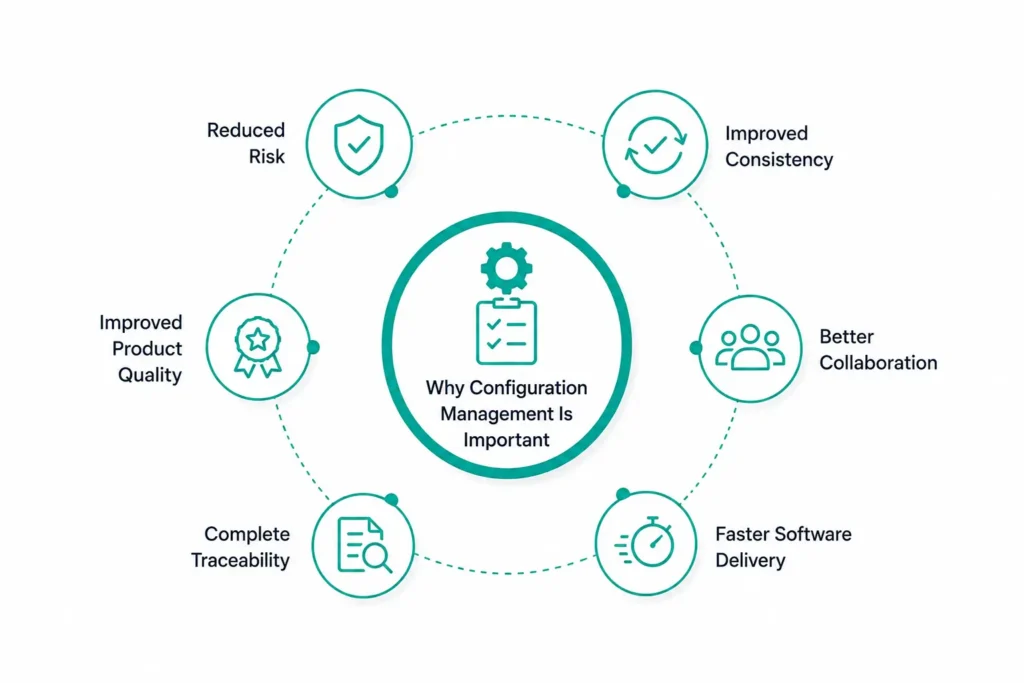
As engineering projects grow in scale and complexity, controlling changes becomes increasingly challenging. Multiple teams often work simultaneously on different modules, components, and releases, making coordination difficult without structured governance.
Configuration Management provides the foundation needed to maintain consistency across engineering activities while supporting continuous development and delivery.
Key business benefits include:
Improved Consistency
Configuration Management ensures every stakeholder works with approved and up-to-date configurations, reducing inconsistencies between development, testing, and production environments.
Better Collaboration
Shared repositories, controlled baselines, and version management enable distributed engineering teams to collaborate efficiently without overwriting or losing critical work.
Reduced Risk
Every engineering change follows an established approval process, reducing the likelihood of unauthorized modifications, integration failures, and production issues.
Faster Software Delivery
Automated configuration management processes simplify builds, testing, deployment, and release management, allowing organizations to deliver software updates more rapidly.
Complete Traceability
Every configuration item, change request, release, and engineering artifact can be traced throughout the product lifecycle, simplifying audits and regulatory compliance.
Improved Product Quality
Structured change control minimizes defects introduced through unmanaged modifications while ensuring engineering teams always work from validated baselines.
Core Components of Configuration Management
An effective Configuration Management strategy consists of several interconnected processes that maintain control throughout the engineering lifecycle.
Configuration Identification
Configuration Identification establishes exactly which engineering assets need to be managed.
These assets, commonly known as Configuration Items (CIs), may include:
- Requirements
- Source code
- Software builds
- Hardware components
- Test artifacts
- Design documents
- User documentation
- Infrastructure configurations
Each Configuration Item receives a unique identifier, allowing it to be tracked throughout the project lifecycle.
Version Control
Version Control enables engineering teams to manage multiple revisions of software, documentation, and configuration files without losing historical information.
Modern version control systems allow developers to:
- Track every modification
- Restore previous versions
- Compare changes
- Merge parallel development efforts
- Maintain complete development history
Popular Version Control tools include Git, GitHub, GitLab, and Subversion.
Version Control Best Practices
- Commit changes frequently.
- Use meaningful commit messages.
- Create feature branches.
- Merge regularly.
- Protect production branches.
- Review code before merging.
Change Management
Configuration Management relies on disciplined Change Management processes to ensure modifications are evaluated before implementation.
A typical workflow includes:
- Submit change request.
- Perform impact analysis.
- Review and approve.
- Implement changes.
- Validate functionality.
- Update documentation.
- Release approved configuration.
This structured approach minimizes project risks while maintaining engineering integrity.
Configuration Status Accounting
Configuration Status Accounting records the current state of every Configuration Item throughout its lifecycle.
It answers questions such as:
- Which version is currently approved?
- Which changes are pending?
- Which releases include specific features?
- Which configuration items have changed?
Maintaining accurate configuration records improves engineering visibility and project governance.
Configuration Audits
Configuration Audits verify that approved configurations accurately match documented baselines.
Audits typically validate:
- Approved requirements
- Implemented changes
- Software versions
- Test evidence
- Release contents
- Compliance documentation
Regular audits help identify configuration drift before it impacts product quality.
Configuration Management Process
An effective Configuration Management process provides a structured approach for controlling engineering assets throughout the product lifecycle. Instead of reacting to changes after they occur, organizations proactively establish processes that ensure every modification is reviewed, approved, documented, and traceable.
Although implementation varies across industries, most Configuration Management frameworks follow these key stages.
Step 1: Identify Configuration Items
The first step is identifying all Configuration Items (CIs) that require governance.
Configuration Items may include:
- Software source code
- Requirements
- System architecture
- Hardware components
- Firmware
- Test cases
- Release packages
- Infrastructure configurations
- Technical documentation
Clearly identifying these assets establishes the foundation for effective lifecycle management.
Step 2: Establish Configuration Baselines
A configuration baseline represents an approved version of a product or engineering artifact at a specific point in time.
Baselines provide stability throughout development by ensuring engineering teams work from verified and approved configurations.
Typical baselines include:
- Functional baseline
- Design baseline
- Product baseline
- Release baseline
Baselines also simplify rollback procedures if unexpected issues occur after deployment.
Step 3: Control Engineering Changes
Every proposed modification should follow a formal change control process.
Typical activities include:
- Submit change request
- Evaluate business impact
- Analyze technical impact
- Review dependencies
- Obtain stakeholder approval
- Schedule implementation
Controlled changes reduce the risk of introducing defects or inconsistencies into production environments.
Step 4: Verify and Validate Changes
Before deployment, every approved change should undergo comprehensive verification.
Validation activities commonly include:
- Unit testing
- Integration testing
- Regression testing
- Security testing
- Performance testing
- Compliance verification
These activities ensure changes satisfy both technical and business requirements.
Step 5: Maintain Configuration Records
Organizations should maintain complete records of:
- Approved versions
- Engineering changes
- Release history
- Build information
- Configuration baselines
- Audit results
Accurate documentation enables engineering teams to quickly investigate issues, perform audits, and support future product releases.
Step 6: Release and Monitor
After validation, approved configurations are deployed into production.
Configuration Management continues even after release by monitoring:
- Configuration drift
- Software updates
- Security patches
- Version history
- Operational feedback
Continuous monitoring ensures deployed systems remain aligned with approved configurations throughout their lifecycle.
Organizations developing intelligent products increasingly integrate Configuration Management into an SDV Toolchain Architecture, enabling seamless collaboration between requirements management, software development, testing, deployment, and operations.
Configuration Management Tools
Modern Configuration Management depends on integrated engineering tools that automate version control, change tracking, testing, deployment, and lifecycle governance.
Selecting the right toolset enables organizations to improve collaboration while reducing manual effort and engineering risks.
|
Category |
Popular Tools |
|
Version Control |
Git, GitHub, GitLab, SVN |
|
Continuous Integration |
Jenkins, GitLab CI/CD |
|
Automation |
Ansible, Puppet, Chef |
|
Containerization |
Docker, Kubernetes |
|
Artifact Management |
JFrog Artifactory, Nexus Repository |
|
Monitoring |
Prometheus, Grafana |
Engineering organizations often integrate Configuration Management with IBM Engineering Lifecycle Management (IBM ELM) to connect requirements, development, testing, change management, and release activities within a single engineering ecosystem.
Similarly, PTC Codebeamer enables organizations to manage requirements, risks, configurations, releases, and engineering traceability while supporting compliance for safety-critical industries.
Best Practices for Effective Configuration Management
Implementing Configuration Management successfully requires more than selecting the right tools. Organizations should establish standardized processes that promote consistency, collaboration, and continuous improvement.
Establish Clear Configuration Baselines
Approved baselines provide a stable reference point for development, testing, and deployment activities.
Use Version Control for Every Engineering Asset
Version control should extend beyond source code to include documentation, infrastructure scripts, test cases, and configuration files.
Automate Configuration Processes
Automation reduces manual errors while accelerating builds, testing, deployments, and reporting.
Maintain Complete Documentation
Every engineering change should include supporting documentation, approvals, implementation details, and validation results.
Monitor Configuration Drift
Regular audits help ensure deployed environments remain aligned with approved configurations.
Integrate Continuous Integration
CI pipelines automatically verify configuration changes before deployment, reducing integration issues and improving software quality.
Implement Strong Access Controls
Role-based permissions help prevent unauthorized modifications while maintaining accountability.
Continuously Review Engineering Processes
Configuration Management should evolve alongside changing business requirements, technology platforms, and regulatory expectations.
Benefits of Configuration Management
Organizations implementing mature Configuration Management practices experience measurable improvements across engineering, operations, and product delivery.
Some of the most significant benefits include:
- Improved software quality
- Faster release cycles
- Reduced engineering rework
- Better collaboration across distributed teams
- Stronger lifecycle traceability
- Enhanced regulatory compliance
- Lower operational risk
- Greater release consistency
- Improved customer satisfaction
- Simplified maintenance and support
These benefits become even more valuable for organizations developing complex, software-intensive products.
Configuration Management in Modern Engineering
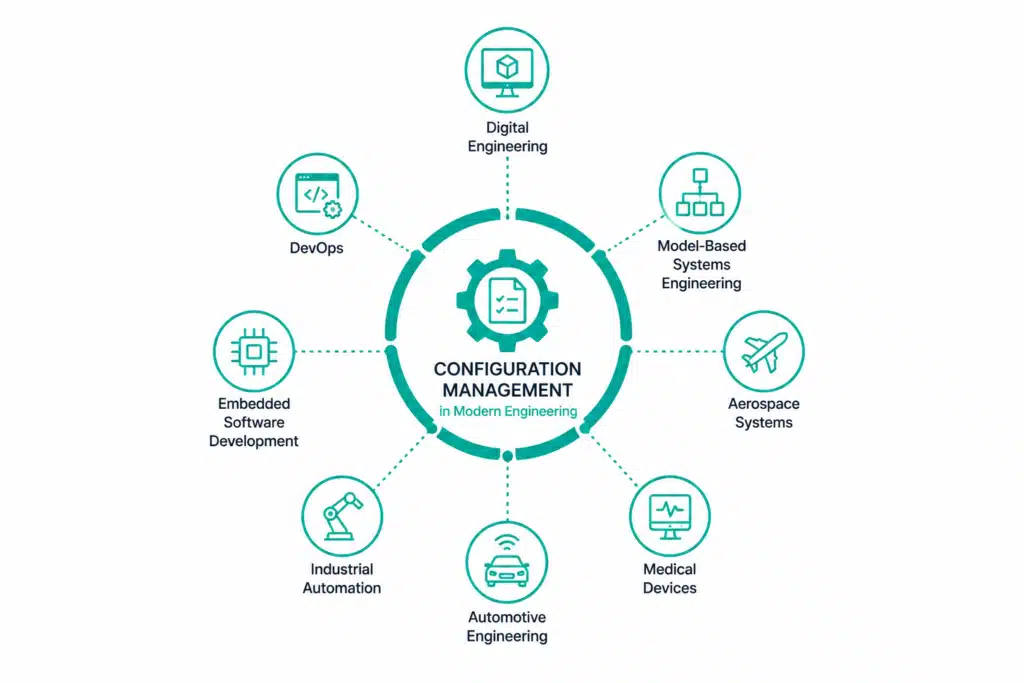
As products become increasingly connected, intelligent, and software driven, Configuration Management plays an essential role in maintaining engineering consistency across multidisciplinary teams.
Today, Configuration Management supports engineering initiatives such as:
- Digital Engineering
- Model-Based Systems Engineering
- DevOps
- Embedded Software Development
- Automotive Engineering
- Aerospace Systems
- Medical Devices
- Industrial Automation
Organizations adopting Embedded DevOps Services combine Configuration Management with Continuous Integration, automated testing, and Continuous Delivery to accelerate embedded software development while maintaining reliability and engineering governance.
Similarly, organizations implementing MBSE Consulting Services improve configuration control by managing system models, requirements, architecture, and verification activities within a connected engineering environment.
Configuration Management also supports the SDV Development Lifecycle, where frequent software releases, feature updates, cybersecurity patches, and continuous validation require disciplined change control throughout the vehicle lifecycle.
Digital transformation initiatives such as Digital Engineering for Automotive further strengthen Configuration Management by connecting engineering data, digital twins, lifecycle management platforms, and engineering toolchains into a unified ecosystem.
Challenges of Configuration Management
While Configuration Management provides significant benefits, implementing and maintaining an effective Configuration Management framework can be challenging, particularly in large-scale engineering projects involving multiple teams, complex toolchains, and rapidly changing requirements.
Understanding these challenges helps organizations establish stronger governance and adopt best practices that improve long-term engineering efficiency.
Managing Rapid Changes
Modern software and systems engineering projects evolve continuously. New features, bug fixes, security updates, and customer requests can introduce hundreds of configuration changes throughout the product lifecycle.
Without structured change control, organizations may experience:
- Conflicting software versions
- Inconsistent environments
- Duplicate engineering effort
- Delayed releases
- Increased technical debt
A disciplined Configuration Management process ensures every change is reviewed, documented, and implemented in a controlled manner.
Configuration Drift
Configuration drift occurs when deployed environments gradually diverge from approved baselines because of undocumented or unauthorized changes.
Common causes include:
- Manual configuration updates
- Emergency fixes
- Environment-specific modifications
- Inconsistent deployment processes
Regular configuration audits and automated infrastructure management help minimize drift while maintaining consistency across development, testing, and production environments.
Toolchain Complexity
Engineering organizations typically use multiple tools for requirements management, development, testing, deployment, and release management.
If these tools operate independently, organizations often struggle with:
- Fragmented engineering data
- Duplicate information
- Poor traceability
- Manual synchronization
- Limited lifecycle visibility
Integrating engineering tools creates a connected ecosystem where changes flow seamlessly throughout the development lifecycle.
Regulatory Compliance
Industries such as automotive, aerospace, healthcare, and defense require organizations to maintain strict engineering records throughout product development.
Configuration Management must support:
- Complete traceability
- Controlled documentation
- Version history
- Audit readiness
- Change approval records
Automating these activities significantly reduces compliance effort while improving engineering governance.
Scaling Across Large Teams
As organizations grow, coordinating multiple engineering disciplines becomes increasingly complex.
Configuration Management must support collaboration between:
- Systems engineers
- Software developers
- Hardware engineers
- Test engineers
- Quality teams
- Operations teams
Establishing standardized workflows ensures all teams work from approved configurations while reducing communication gaps.
Organizations developing intelligent automotive platforms must also address broader SDV Engineering Challenges, where software complexity, cybersecurity, lifecycle management, and continuous software updates require robust Configuration Management practices.
How MicroGenesis Helps
MicroGenesis helps organizations establish modern Configuration Management practices that improve engineering consistency, lifecycle visibility, and product quality across complex software and systems engineering environments.
Our experts work with organizations to implement scalable engineering solutions that connect requirements, development, testing, release management, and compliance into a unified engineering ecosystem.
Our Configuration Management capabilities include:
- Configuration Management consulting
- Engineering Lifecycle Management (ELM)
- Requirements Management and Traceability
- Change and Release Management
- Configuration Audits
- DevOps and CI/CD implementation
- Engineering Toolchain Integration
- Digital Engineering transformation
- Model-Based Systems Engineering (MBSE)
- Embedded software engineering support
Organizations beginning their engineering transformation often leverage our Automotive Process Consulting services to assess existing engineering processes, identify improvement opportunities, and implement Configuration Management practices aligned with industry standards and business objectives.
By combining industry expertise with leading engineering platforms and best practices, MicroGenesis enables organizations to improve collaboration, reduce engineering risks, accelerate product delivery, and establish a robust foundation for digital engineering.
Frequently Asked Questions
What is Configuration Management?
Configuration Management is the process of identifying, controlling, tracking, and auditing changes made to software, systems, hardware, and engineering assets throughout their lifecycle. It ensures consistency, traceability, and controlled change management.
Why is Configuration Management important?
Configuration Management helps organizations maintain consistency across development, testing, and production environments while improving collaboration, reducing errors, supporting compliance, and accelerating software delivery.
What are Configuration Items (CIs)?
Configuration Items are the components managed within a Configuration Management system. These can include software source code, hardware components, requirements, documentation, test cases, infrastructure configurations, and release packages.
What is the difference between Configuration Management and Change Management?
Configuration Management focuses on identifying, maintaining, and controlling engineering assets throughout their lifecycle. Change Management is a process within Configuration Management that governs how proposed modifications are reviewed, approved, implemented, and documented.
Which tools are commonly used for Configuration Management?
Organizations commonly use tools such as Git, GitHub, GitLab, Jenkins, Docker, Kubernetes, Ansible, Puppet, IBM Engineering Lifecycle Management (IBM ELM), and PTC Codebeamer to automate Configuration Management activities.
Which industries benefit from Configuration Management?
Configuration Management is widely used in:
- Automotive
- Aerospace and Defense
- Medical Devices
- Industrial Automation
- Telecommunications
- Electronics
- Manufacturing
- Enterprise Software Development
How does Configuration Management support DevOps?
Configuration Management enables DevOps by providing version control, automated deployments, infrastructure consistency, continuous integration, release management, and traceability across the software delivery pipeline.
Conclusion
Configuration Management is far more than version control or documenting software changes. It is a strategic engineering discipline that ensures every component of a product remains consistent, traceable, and aligned throughout the entire lifecycle. By establishing structured processes for configuration identification, change control, version management, audits, and release management, organizations can reduce risk, improve collaboration, and deliver higher-quality products with greater confidence.
As engineering projects become increasingly software-driven and multidisciplinary, Configuration Management plays a central role in enabling faster releases, stronger compliance, improved lifecycle visibility, and more efficient collaboration across teams. Whether developing embedded systems, enterprise applications, or complex cyber-physical products, adopting mature Configuration Management practices helps organizations respond to change without compromising quality or governance.
With deep expertise in Engineering Lifecycle Management, DevOps, Model-Based Systems Engineering, and digital engineering transformation, MicroGenesis helps organizations implement scalable Configuration Management solutions that accelerate innovation while ensuring long-term product reliability and operational excellence.